Samsung patents antenna tuning that balances multiple frequencies
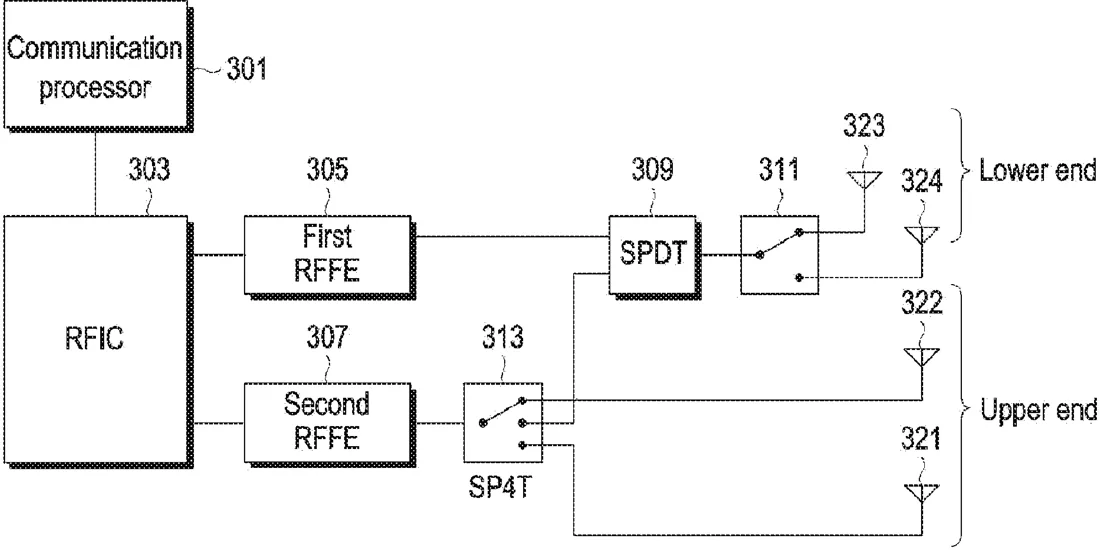
This filing describes a method for electronic devices to adjust their antennas for better signal strength. The system checks how well different antennas work at specific frequencies and calculates a single setting that optimizes performance for a group of antennas sharing a tuner.
In the filing’s own words
An electronic device is provided. The electronic device includes a plurality of antennas, an RF circuit connected to the plurality of antennas, memory, including one or more storage media, storing instructions, and at least one processor, wherein the instructions, when executed by the at least one processor, cause the electronic device to identify a first antenna for communication based on a first frequency and a second antenna for communication based on a second frequency, identify a first event configured for performing tuning based on one tuner included in the RF circuit, based on the first antenna and the second antenna being included in a first antenna group, identify first efficiency data corresponding to each of a plurality of tune codes associated with the first antenna, the first efficiency data being configured for the first event and the first frequency, and identify second efficiency data corresponding to each of a plurality of tune codes associated with the second antenna, the second efficiency data being configured the first event and the second frequency, identify third efficiency data for each of a plurality of tune codes corresponding to the first antenna group, based on the first efficiency data and the second efficiency data, identify an optimal tune code corresponding to the first antenna group, based on the third efficiency data, and control a portion of the one tuner to perform tuning based on the optimal tune code.
What exactly they claim (claim 1)
1. An electronic device comprising: a plurality of antennas; at least one radio frequency (RF) circuit connected to the plurality of antennas; memory, comprising one or more storage media, storing instructions; and at least one processor communicatively coupled to the at least one RF circuit and the memory, wherein the instructions, when executed by the at least one processor individually or collectively, cause the electronic device to: identify a first antenna for communication based on a first frequency and a second antenna for communication based on a second frequency from among the plurality of antennas, identify a first event configured for tuning based on at least one tuner included in the at least one RF circuit, based on the first antenna and the second antenna being included in a first antenna group: identify first efficiency data corresponding to each of a plurality of tune codes associated with the first antenna, the first efficiency data being configured for the first event and the first frequency, and identify second efficiency data corresponding to each of a plurality of tune codes associated with the second antenna, the second efficiency data being configured for the first event and the second frequency, identify third efficiency data for each of a plurality of tune codes corresponding to the first antenna group, based on the first efficiency data and the second efficiency data, identify an optimal tune code corresponding to the first antenna group, based on the third efficiency data, and control at least a portion of the at least one tuner to perform tuning based on the optimal tune code.
Facts
- Company
- Samsung (Samsung Electronics Co., Ltd.)
- Official title
- ELECTRONIC DEVICE FOR PERFORMING ANTENNA TUNING AND OPERATION METHOD THEREOF
- Publication number
- US20260322465A1
- Application number
- 19685997
- Filed
- May 22, 2026
- Published
- Oct 15, 2026
- Inventors
- 10
- Claims
- 20
Classified under
H04B 7/0691 Electricity & electronicsH04B 7/0874 Electricity & electronicsMore from Samsung in Networks & wireless
- Samsung patents UWB method to save power while tracking distance Sep 1, 2026
- Samsung patents system to keep satellite calls connected as satellites move Sep 1, 2026
- Samsung patents low-power IoT tags that reply without precise clocks Sep 1, 2026
- Samsung patents phone feature that switches networks to fix slow connections Sep 1, 2026
- Samsung patents satellite phone method for switching between signal types Sep 1, 2026
Summaries are simplified from the filing’s own abstract and first claim. A patent filing is not a product announcement.
Patent data and drawings: U.S. Patent and Trademark Office (USPTO). Nebula is not affiliated with or endorsed by the USPTO.