Samsung patents battery charger with special transistor to manage voltage
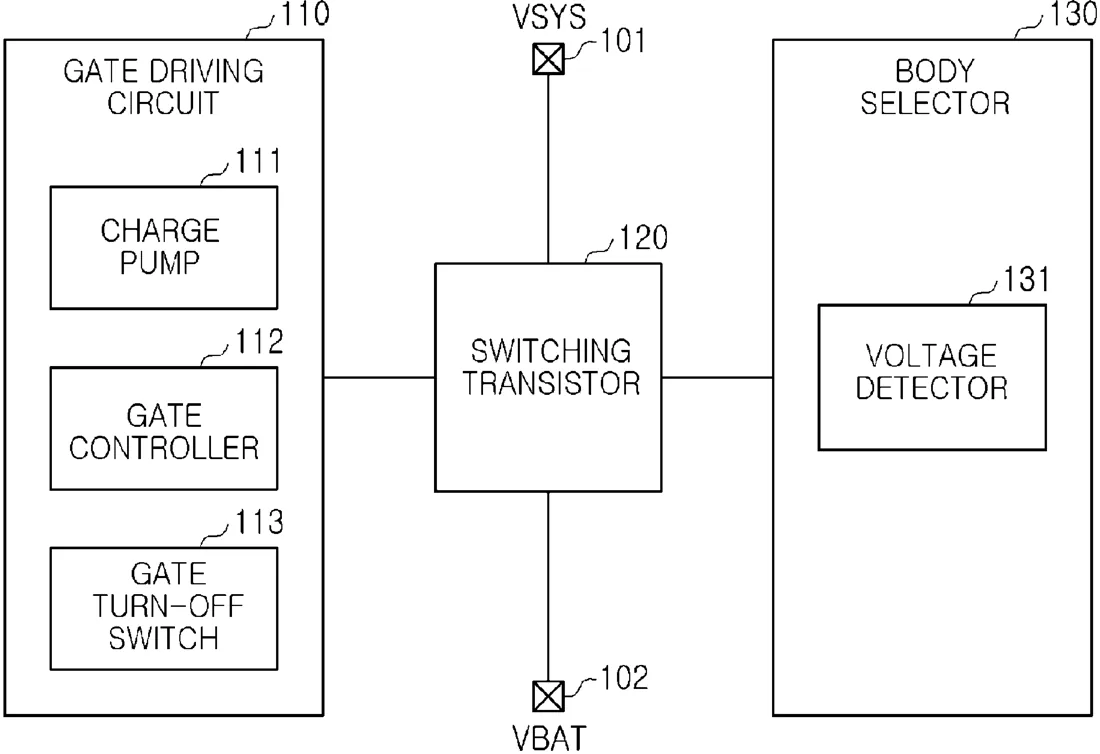
Samsung has filed a patent for a battery charging device that uses a specific type of transistor called a triple well structure. The invention includes circuits that adjust the voltage applied to the transistor's gate and body to control how electricity flows during charging.
In the filing’s own words
A battery charging device includes a switching transistor having a triple well structure with a body terminal electrically connected to a first well region. A gate driving circuit provides a gate controller for adjusting a gate voltage applied to the gate of the switching transistor and a gate turn-off switch for selectively connecting the gate to a ground node. A body selector generates a first detection signal using a first voltage and a second voltage, and adjusts a voltage supplied to the body terminal. The body selector connects the body terminal to a node supplying the second voltage in response to the first detection signal and a delayed second detection signal, and connects the body terminal to the ground node in response to a third detection signal obtained by inverting the first detection signal.
What exactly they claim (claim 1)
1. A battery charging device, comprising: a switching transistor including a first well region doped with a first impurity, a second well region disposed within the first well region and doped with a second impurity, different from the first impurity, a source region and a drain region disposed within the second well region and doped with the first impurity, a body terminal disposed within the second well region and doped with the second impurity and electrically connected to the first well region, and a gate disposed between the source region and the drain region; a gate driving circuit including a gate controller receiving a first voltage and adjusting a gate voltage input to the gate, and a gate turn-off switch connected between a ground node supplying a ground voltage and the gate; and a body selector generating a first detection signal using the first voltage and a second voltage different from the first voltage, and adjusting a voltage supplied to the body terminal, wherein the body selector connects the body terminal to a node supplying the second voltage in response to the first detection signal and a second detection signal delaying the first detection signal during a predetermined time, and connecting the body terminal to the ground node in response to a third detection signal obtained by inverting the first detection signal.
Facts
- Company
- Samsung (SAMSUNG ELECTRONICS CO., LTD.)
- Official title
- BATTERY CHARGING DEVICE, OPERATING METHOD OF THE SAME, AND MOBILE DEVICE INCLUDING THE SAME
- Publication number
- US20260322144A1
- Application number
- 19402134
- Filed
- Nov 26, 2025
- Published
- Oct 15, 2026
- Inventors
- 7
- Claims
- 20
Classified under
H02J 7/64 Electricity & electronicsH02J 7/62 Electricity & electronicsH02J 7/80 Electricity & electronicsMore from Samsung in Batteries & energy
- Samsung patents layered silicon coating for better lithium batteries Sep 1, 2026
- Samsung patents phone power-saving mode that pauses network checks Sep 8, 2026
- Samsung patents AI system that updates battery safety models when faults appear Sep 22, 2026
- Samsung patents new material for solid-state batteries Sep 29, 2026
- Samsung patents wireless charger that shows where your phone is charging Sep 29, 2026
Summaries are simplified from the filing’s own abstract and first claim. A patent filing is not a product announcement.
Patent data and drawings: U.S. Patent and Trademark Office (USPTO). Nebula is not affiliated with or endorsed by the USPTO.