Microsoft patents memory manager that stores free space lists in the memory itself
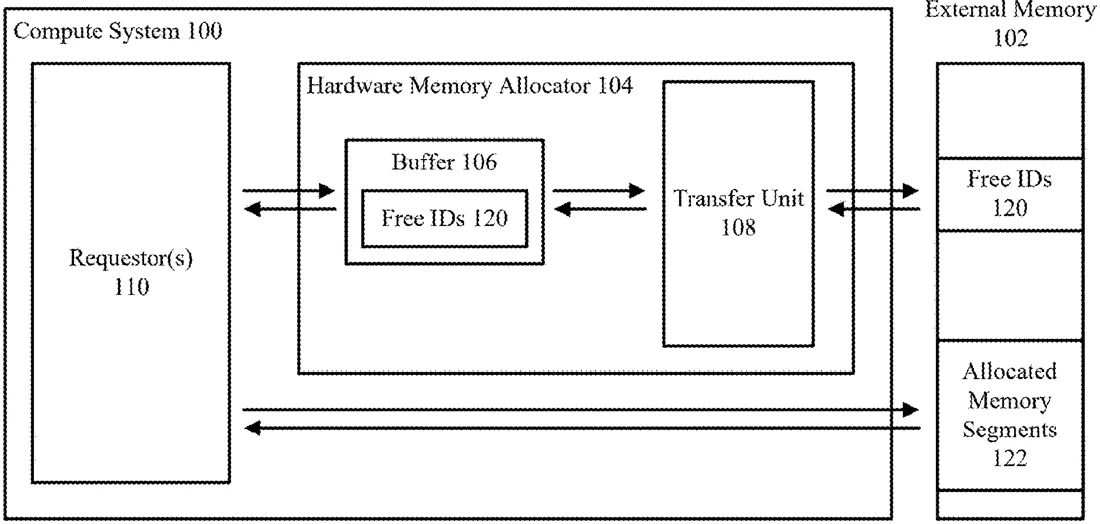
Microsoft describes a hardware component that manages memory by keeping lists of available storage slots inside the memory itself rather than in separate control chips. When memory is freed up, the system uses one of the empty slots to store the list of other empty slots, effectively using zero extra space for the management data.
In the filing’s own words
A hardware memory allocator of a compute system is described. The allocator stores batches of free identifiers (IDs) as elements of a linked list in a memory external to the system, each free ID identifying a respective segment of the memory, and transfers batch(es) of free IDs from the head of the linked list to an internal buffer. The allocator then responds to memory requests by allocating free IDs from among the batch(es) of free IDs in the buffer and to memory deallocation requests by deallocating previously-allocated free IDs. The allocator transfers batches of deallocated free IDs from the buffer to the head of the linked list, wherein transferring a batch of deallocated free IDs includes selecting one of the deallocated free IDs in the buffer exclusive of the batch and storing the batch of at the memory segment identified by the selected deallocated free ID.
What exactly they claim (claim 1)
1. A method for allocating memory by a hardware memory allocator of a compute system, comprising: storing batches of free identifiers (IDs) as elements of a linked list in a memory external to the compute system, each free ID identifying a respective memory segment of the memory; transferring one or more of the batches of free IDs from a head of the linked list in the memory to a buffer within the hardware memory allocator; in response to memory allocation requests received from one or more requestors within the compute system, allocating free IDs from among the one or more batches of free IDs in the buffer to the one or more requestors; in response to memory de-allocation requests received from the one or more requestors, de-allocating the previously-allocated free IDs; and transferring a batch of the deallocated free IDs from the buffer to the head of the linked list in the memory by: selecting one of the deallocated free IDs in the buffer exclusive of the batch of the deallocated free IDs; and storing the batch of the deallocated free IDs at the memory segment identified by the selected deallocated free ID.
Facts
- Company
- Microsoft (Microsoft Technology Licensing, LLC)
- Official title
- ZERO SPACE COST HARDWARE MEMORY ALLOCATION
- Publication number
- US20260319943A1
- Application number
- 19212182
- Filed
- May 19, 2025
- Published
- Oct 15, 2026
- Inventors
- 6
- Claims
- 20
Classified under
G06F 12/023 Physics & computingMore from Microsoft in Chips & hardware
- Microsoft patents chips with liquid cooling built inside Oct 1, 2026
- Microsoft patents chip design that guesses code steps ahead Sep 8, 2026
- Microsoft patents 3D glass storage using laser light patterns Sep 8, 2026
- Microsoft patents hand-held radar reflectors for tracking movement Sep 8, 2026
- Microsoft patents video boost that reuses old frames to save power Sep 15, 2026
Summaries are simplified from the filing’s own abstract and first claim. A patent filing is not a product announcement.
Patent data and drawings: U.S. Patent and Trademark Office (USPTO). Nebula is not affiliated with or endorsed by the USPTO.