Google patents chip system that predicts heat to manage performance
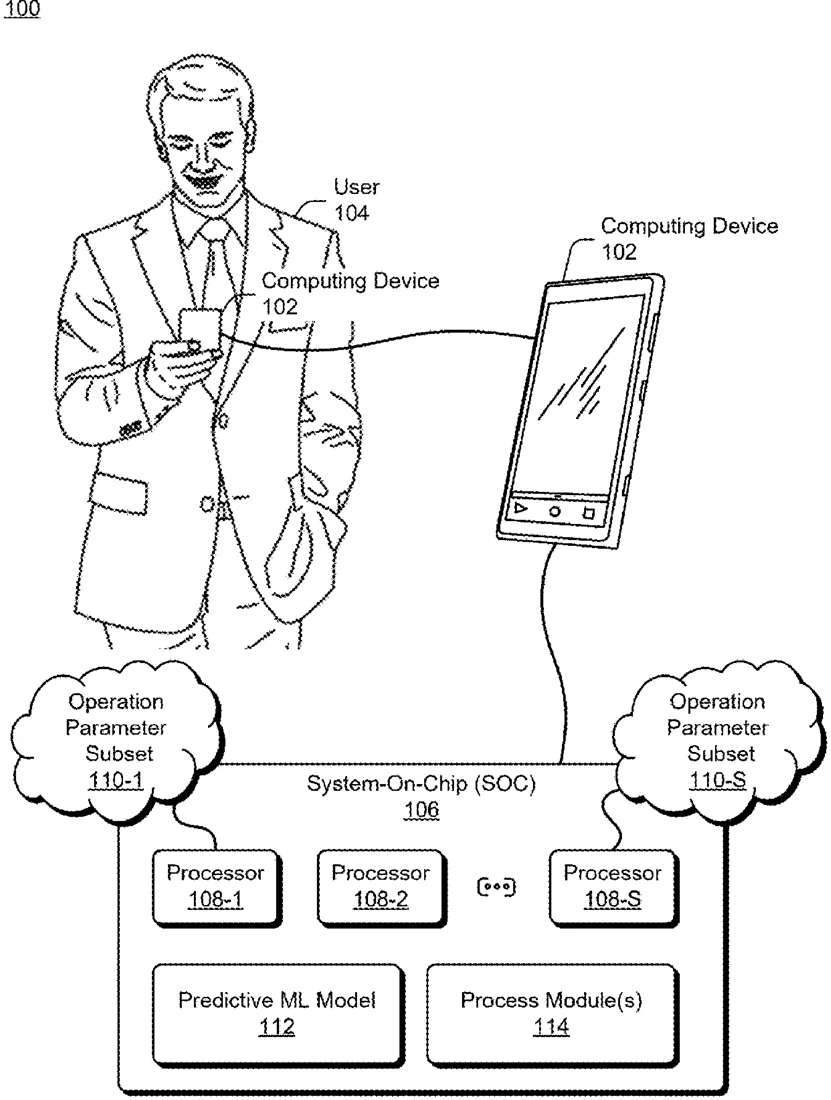
This filing describes a system-on-chip that uses a machine-learning model to predict future operating conditions, such as processor temperature. Based on these predictions, the system adjusts settings like frequency, voltage, or task assignments to balance performance and heat.
In the filing’s own words
Techniques and apparatuses are described for implementing a machine-learning (ML) based prediction and dynamic core allocation architecture. In example aspects, a plurality of parameters related to one or more operating conditions (e.g., temperature of a core) of one or more processors are generated. The plurality of parameters are used as an input for an ML-based model, which outputs a prediction of future parameters. The prediction is used as input for one or more process modules. The one or more process modules parse the prediction to provide a decision output, which is used to modify one or more facets of the one or more processors (a frequency, a voltage, core assignments for tasks, etc.). In this way, a system-on-chip can dynamically manage multiple operations concerns for the one or more processors, such as balancing performance and temperature concerns to realize a tailored user experience.
What exactly they claim (claim 1)
1. A method performed by a system-on-chip, the method comprising: generating a plurality of parameters related to one or more operating conditions of one or more processors; receiving one or more prediction outputs from a machine-learned (ML) model, the ML model: configured to use an ML input, the ML input based on the plurality of parameters related to the one or more operating conditions of the one or more processors and the one or more prediction outputs based on the ML input; and trained on data related to the one or more operating conditions of the one or more processors; and generating, by one or more process modules and based on the one or more prediction outputs, a command for the one or more processors, the command configured to change one or more of the one or more operating conditions of the one or more processors.
Facts
- Company
- Google (Google LLC)
- Official title
- Machine-Learning-Based Prediction and Dynamic Core Allocation Architecture
- Publication number
- US20260310960A1
- Application number
- 19574897
- Filed
- Mar 23, 2026
- Published
- Oct 8, 2026
- Inventors
- 2
- Claims
- 20
Classified under
G06N 3/08 Physics & computingG06N 3/0464 Physics & computingMore from Google in Chips & hardware
- Google patents quantum gates to simulate particle physics Sep 1, 2026
- Waymo patents lidar chips that split light into multiple beams Sep 8, 2026
- Google patents chip design to speed up AI math tasks Sep 8, 2026
- Google patents display that turns off colors to save battery Sep 8, 2026
- Google patents display tech that skips blank screen areas to save power Sep 15, 2026
Summaries are simplified from the filing’s own abstract and first claim. A patent filing is not a product announcement.
Patent data and drawings: U.S. Patent and Trademark Office (USPTO). Nebula is not affiliated with or endorsed by the USPTO.