Microsoft patents system to check if AI models follow specific rules
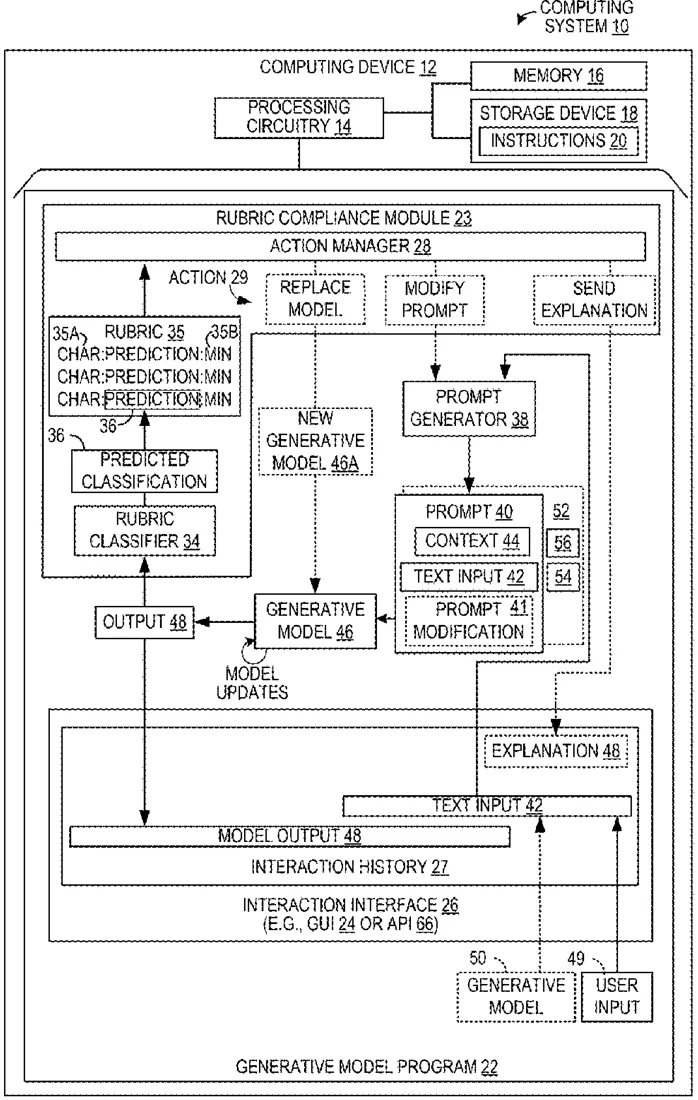
Microsoft describes a method for testing whether a generative language model sticks to a set of rules, or rubric, when creating text. The system uses a second AI to create fake questions, feeds them to the first AI, and then uses a classifier to check if the answers meet the required standards.
In the filing’s own words
A computing system for monitoring language model compliance with a rubric of one or more output characteristics. The computing system includes processing circuitry configured to interface with a trained generative language model that receives input of a prompt including natural language text input and, in response, generates an output that includes natural language text output. The processing circuitry is further configured to monitor compliance of the generative language model with the rubric, by feeding the output of the generative language model to a rubric classifier configured to generate a predicted classification for an output characteristic in the rubric, and output the predicted classification.
What exactly they claim (claim 1)
1. A computing system for monitoring model compliance with a rubric, the computing system comprising: processing circuitry configured to: instantiate a plurality of synthetic interaction sessions between a first generative model and a second generative model, wherein in each of the plurality of synthetic interaction sessions, the processing circuitry is configured to: generate synthetic natural language text input via the second generative model; incorporate the synthetic natural language text input into a prompt; input the prompt including the synthetic natural language text input into the first generative model to generate an output that includes natural language text output; monitor compliance of the first generative model with the rubric, by feeding the output of the first generative model to a rubric classifier to generate a first predicted classification for an output characteristic in the rubric; monitor compliance of the second generative model with the rubric, by feeding the synthetic natural language text input to the rubric classifier to generate a second predicted classification for the output characteristic in the rubric; and output the first predicted classification and the second predicted classification, wherein the synthetic natural language text input generated by the second generative model and the output generated by the first generative model in each of the plurality of synthetic interaction sessions are a plurality of outputs of the plurality of synthetic interaction sessions; and the plurality of outputs are fed to the rubric classifier to generate a series of predicted classifications for the output characteristic in the rubric.
Facts
- Company
- Microsoft (Microsoft Technology Licensing, LLC)
- Official title
- MONITORING COMPLIANCE OF A GENERATIVE LANGUAGE MODEL WITH AN OUTPUT CHARACTERISTIC RUBRIC
- Publication number
- US20260310906A1
- Application number
- 19466828
- Filed
- Feb 2, 2026
- Published
- Oct 8, 2026
- Inventors
- 3
- Claims
- 20
Classified under
G06F 40/40 Physics & computingG06F 16/35 Physics & computingMore from Microsoft in AI & software
- Microsoft patents method to check AI answers against verified facts Oct 20, 2026
- Microsoft patents AI that presents PowerPoint slides for you Sep 3, 2026
- Microsoft patents method to check if LLM answers are based on real data Sep 10, 2026
- Microsoft patents system to blend multiple AI agents into one chat Oct 1, 2026
- Microsoft patents system that answers questions using your screen history Oct 15, 2026
Summaries are simplified from the filing’s own abstract and first claim. A patent filing is not a product announcement.
Patent data and drawings: U.S. Patent and Trademark Office (USPTO). Nebula is not affiliated with or endorsed by the USPTO.