Samsung patents self-tuning noise removal for memory chips
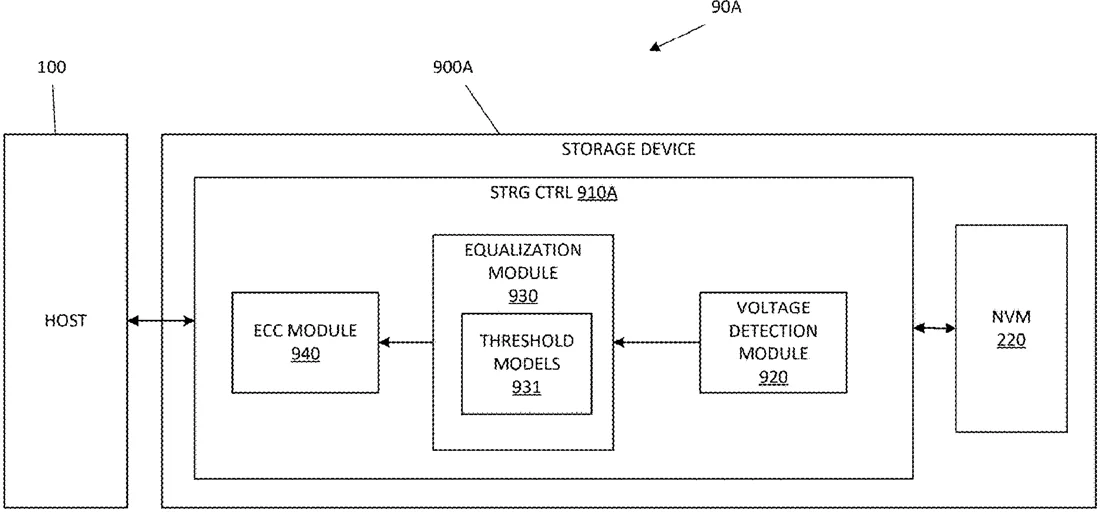
Samsung describes a method for reading data from non-volatile memory by using machine learning models to filter out electrical noise. The system adjusts its own settings in two steps: first tuning the model based on initial readings, then calibrating it to improve accuracy before extracting the final data.
In the filing’s own words
Methods and devices for controlling a storage device including a non-volatile memory, including: reading a plurality of voltages from a target memory cell included in the non-volatile memory; obtaining a plurality of initial log-likelihood ratio (LLR) values by providing the plurality of voltages to an initial threshold model; generating at least one tuned model parameter based on the plurality of initial LLR values; tuning the initial threshold model based on the at least one tuned model parameter to obtain a tuned threshold model; obtaining a plurality of uncalibrated LLR values by providing the plurality of voltages to the tuned threshold model; calculating a calibration parameter based on the plurality of uncalibrated LLR values; modifying the tuned threshold model based on the calibration parameter to obtain calibrated tuned threshold model; obtaining a final predicted LLR value by providing at least one of the plurality of voltages to the calibrated tuned threshold model; and obtaining data based on the final predicted LLR values.
What exactly they claim (claim 1)
1. A method of reading data stored in a storage device, the method comprising: reading a plurality of voltages from a target memory cell included in a non-volatile memory of the storage device; obtaining a plurality of initial log-likelihood ratio (LLR) values by providing the plurality of voltages to an initial threshold model; generating at least one tuned model parameter based on the plurality of initial LLR values; tuning the initial threshold model based on the at least one tuned model parameter to obtain a tuned threshold model; obtaining a plurality of uncalibrated LLR values by providing the plurality of voltages to the tuned threshold model; calculating a calibration parameter based on the plurality of uncalibrated LLR values; modifying the tuned threshold model based on the calibration parameter to obtain calibrated tuned threshold model; obtaining a final predicted LLR value by providing at least one of the plurality of voltages to the calibrated tuned threshold model; and obtaining data based on the final predicted LLR value.
Facts
- Company
- Samsung (SAMSUNG ELECTRONICS CO, LTD.)
- Official title
- SELF TUNING FOR DE-NOISING USING MULTIPLE THRESHOLD-EXPERT MACHINE LEARNING MODELS
- Publication number
- US20260310551A1
- Application number
- 19098310
- Filed
- Apr 2, 2025
- Published
- Oct 8, 2026
- Inventors
- 3
- Claims
- 20
Classified under
G06F 11/1068 Physics & computingG11C 29/028 Physics & computingG11C 29/12005 Physics & computingG11C 2207/2254 Physics & computingMore from Samsung in Chips & hardware
- Samsung patents chip that combines camera and screen Oct 13, 2026
- Samsung patents faster chip testing using machine learning Sep 1, 2026
- Samsung patents radar method to pinpoint target direction more accurately Sep 1, 2026
- Samsung patents memory chip that searches data by content, not address Sep 1, 2026
- Samsung patents chip design that skips empty data to speed up AI Sep 1, 2026
Summaries are simplified from the filing’s own abstract and first claim. A patent filing is not a product announcement.
Patent data and drawings: U.S. Patent and Trademark Office (USPTO). Nebula is not affiliated with or endorsed by the USPTO.