Samsung patents split AI method to improve wireless signal feedback
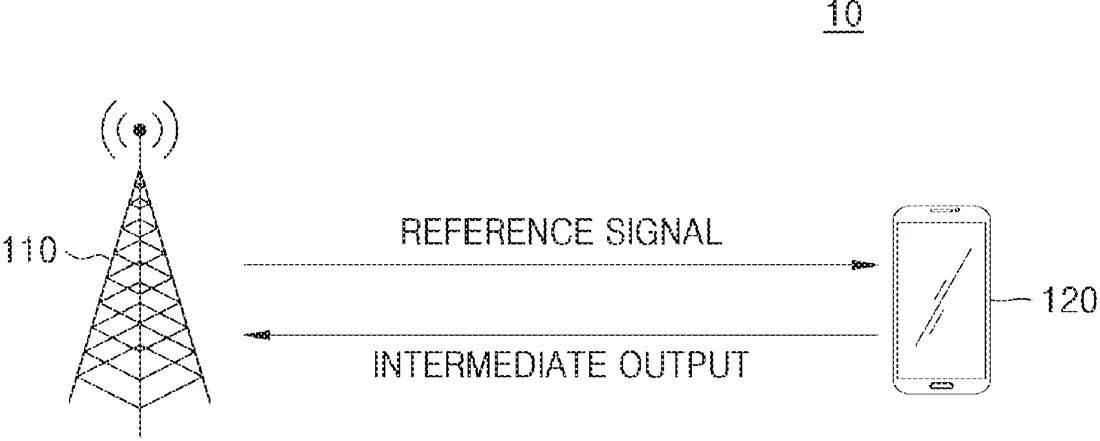
Samsung describes a method where a phone and a cell tower share parts of an AI model to compress and decompress wireless signal data. The phone sends compressed signal information to the tower, which processes it and sends back specific instructions to help the phone's AI model learn better.
In the filing’s own words
A method of operating a base station, includes: transmitting a reference signal to an electronic device comprising a first model and a third model; receiving a first intermediate output from the electronic device; obtaining a second intermediate output by inputting the first intermediate output to a partial model excluding an output layer from a second model comprising a second neural network for data decompression; transmitting the second intermediate output to the electronic device; receiving a first gradient value from the electronic device and updating weight parameters of the partial model; and generating a second gradient value different from the first gradient value and transmitting the second gradient value to the electronic device.
What exactly they claim (claim 1)
1. A method of operating an electronic device, the method comprising: obtaining a channel estimation result, based on a reference signal received from a base station; obtaining a first intermediate output by inputting the channel estimation result to a first model comprising a first neural network for data compression; transmitting, to the base station, the first intermediate output; receiving, from the base station, a second intermediate output different from the first intermediate output; obtaining a decompressed channel estimation result by inputting the second intermediate output to a third model corresponding to an output layer of a second model comprising a second neural network for data decompression; calculating a loss between the obtained channel estimation result and the decompressed channel estimation result by comparing the obtained channel estimation result with the decompressed channel estimation result; transmitting, to the base station, a first gradient value for minimizing the loss; receiving, from the base station, a second gradient value different from the first gradient value; and updating the first model based on the second gradient value.
Facts
- Company
- Samsung (SAMSUNG ELECTRONICS CO., LTD.)
- Official title
- ELECTRONIC DEVICE FOR FEEDING BACK CHANNEL STATE INFORMATION BY USING AUTOENCODER BASED ON MODIFIED SPLIT LEARNING, AND METHOD OF OPERATING THE SAME
- Publication number
- US20260303415A1
- Application number
- 19677519
- Filed
- May 14, 2026
- Published
- Oct 1, 2026
- Inventors
- 3
- Claims
- 19
Classified under
H04L 25/0254 Electricity & electronicsH04L 5/0048 Electricity & electronicsMore from Samsung in Networks & wireless
- Samsung patents UWB method to save power while tracking distance Sep 1, 2026
- Samsung patents system to keep satellite calls connected as satellites move Sep 1, 2026
- Samsung patents low-power IoT tags that reply without precise clocks Sep 1, 2026
- Samsung patents phone feature that switches networks to fix slow connections Sep 1, 2026
- Samsung patents satellite phone method for switching between signal types Sep 1, 2026
Summaries are simplified from the filing’s own abstract and first claim. A patent filing is not a product announcement.
Patent data and drawings: U.S. Patent and Trademark Office (USPTO). Nebula is not affiliated with or endorsed by the USPTO.