Microsoft patents image tool that learns new object states without retraining
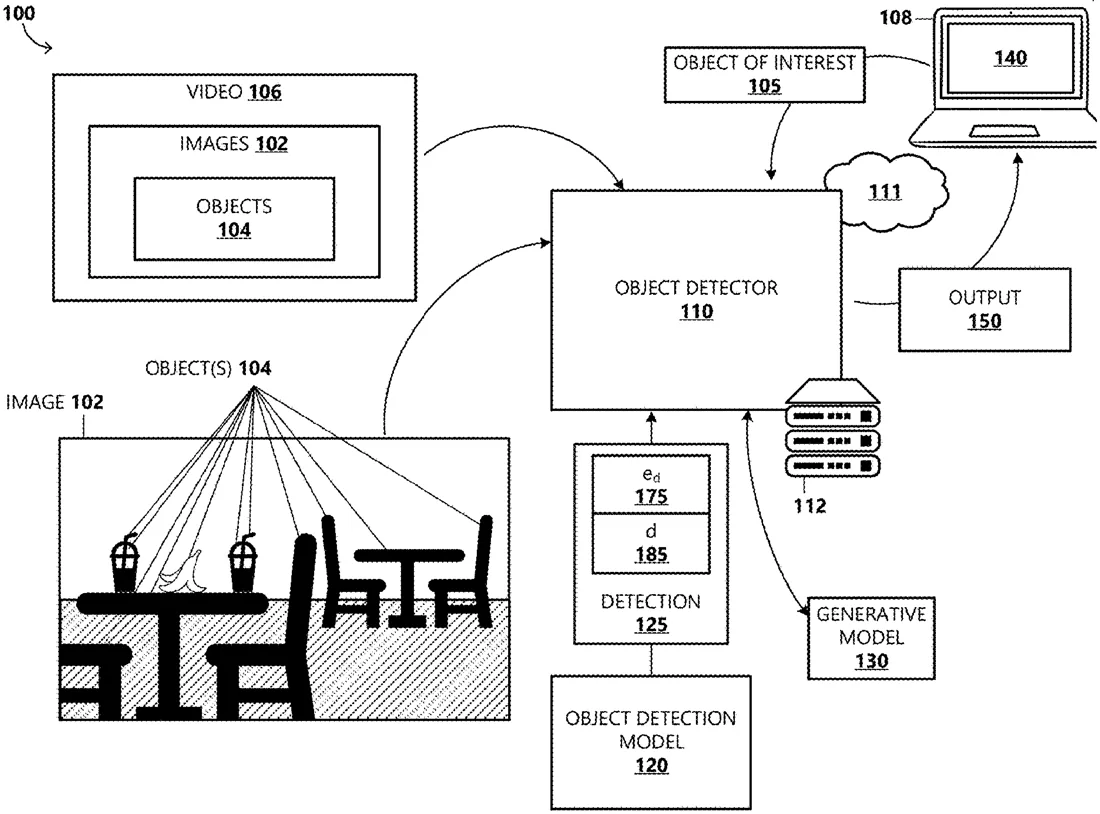
Microsoft describes a system that identifies specific conditions of objects in images without needing to retrain its main detection model. It works by comparing the detected object against generated examples of different states to determine which one matches best.
In the filing’s own words
Systems and methods for dynamic customization for object detection. An object detector uses an object detection model (e.g., an open vocabulary model) to detect and classify objects. The object detector supports customization of classifications without requiring the model to be retrained. Embeddings are used to differentiate between various states of detections, enhancing accuracy and relevance of the detection process. In examples, the object detector handles logical conditions by creating a classifier trained to differentiate between various combinations of objects. Aspects of the present disclosure support the use of images for customization, allowing users to provide examples from which the object detector described herein can learn. In further examples, capabilities of the object detector extend to processing live video streams, where users can mark examples in real-time. In some examples, the object detector leverages a generative model (e.g., to provide state contrasts), allowing the system to be adaptable to complex conditions.
What exactly they claim (claim 1)
1. A method, comprising: receiving a first image; receiving an object of interest having an object class and a state; identifying a detection in the first image based on the object class; generating a first representation of the detection; determining a contrast state to the state; generating a second representation of the object class and the state; generating a third representation of the object class and the contrast state; comparing a first similarity measure between the first representation and the second representation to a second similarity measure between the first representation and the third representation; generating a first classification of the detection based on whether the first similarity measure is less than the second similarity measure or whether the second similarity measure is less than the first similarity measure; and providing an output of the first classification.
Facts
- Company
- Microsoft (Microsoft Technology Licensing, LLC)
- Official title
- DYNAMIC CUSTOMIZATION FOR OBJECT DETECTION
- Publication number
- US20260301369A1
- Application number
- 19094053
- Filed
- Mar 28, 2025
- Published
- Oct 1, 2026
- Inventors
- 4
- Claims
- 20
Classified under
G06V 10/764 Physics & computingG06T 11/60 Physics & computingG06V 10/761 Physics & computingMore from Microsoft in AI & software
- Microsoft patents method to check AI answers against verified facts Oct 20, 2026
- Microsoft patents AI that presents PowerPoint slides for you Sep 3, 2026
- Microsoft patents method to check if LLM answers are based on real data Sep 10, 2026
- Microsoft patents system to blend multiple AI agents into one chat Oct 1, 2026
- Microsoft patents system that answers questions using your screen history Oct 15, 2026
Summaries are simplified from the filing’s own abstract and first claim. A patent filing is not a product announcement.
Patent data and drawings: U.S. Patent and Trademark Office (USPTO). Nebula is not affiliated with or endorsed by the USPTO.