Microsoft patents system to sort computer logs using AI
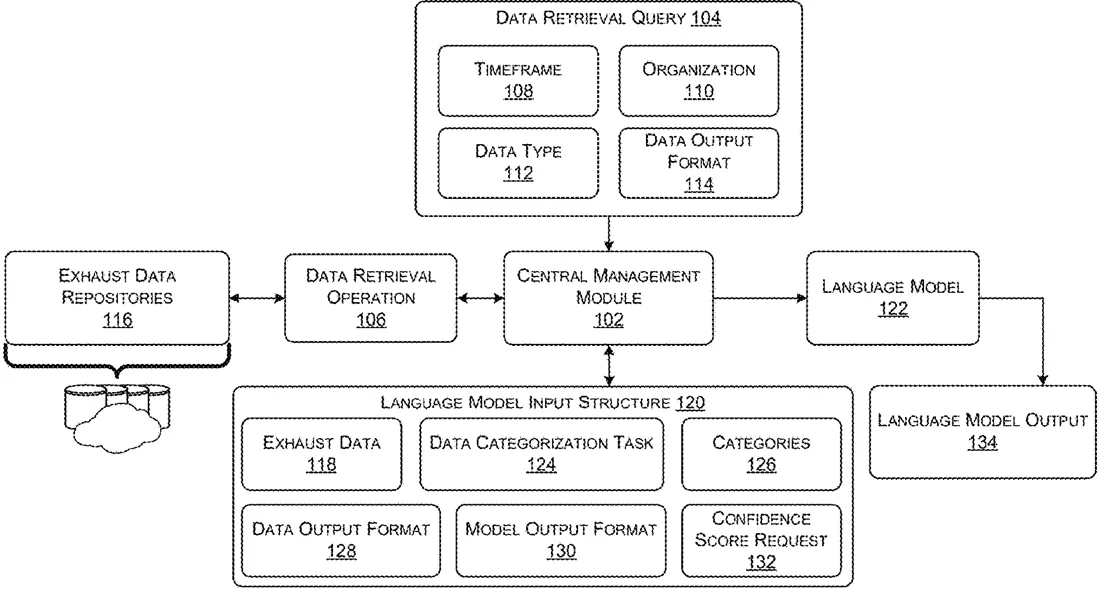
This filing describes a method for automatically organizing large amounts of digital records left behind by computer systems, known as exhaust data. The system retrieves specific logs based on user-defined criteria like time and data type, then feeds them into an AI model to categorize the information into predefined groups.
In the filing’s own words
The techniques presented herein provide a system for implementing automated exhaust data categorization. In general, exhaust data is a trail of data left by the activities of a computer system during regular activity, behavior, and/or transactions. As such, the amount and/or variety of exhaust data for a given can oftentimes be greater than the associated primary data. Consequently, analyzing exhaust data across an entire organization (e.g., a company) can be overwhelming for many automated tools, much less a manual approach. To that end, the present system streamlines the process of organizing and analyzing exhaust data through a customizable exhaust data retrieval query and a well-defined language model input structure. In various examples, the query is targeted to a specific timeframe, organization, data type, and so forth. Likewise, the language model input structure utilizes prompt engineering to leverage the powerful data processing capabilities of modern language models while minimizing inconsistencies.
What exactly they claim (claim 1)
1. A method for implementing an exhaust data categorization task, the method comprising: receiving a query for an exhaust data retrieval operation, wherein the query defines: a timeframe for the exhaust data retrieval operation; an organization associated with the exhaust data retrieval operation; a data type of the exhaust data retrieval operation; and an output format for the exhaust data retrieval operation; executing the exhaust data retrieval operation by processing the query across a plurality of exhaust data repositories, wherein executing the exhaust data retrieval operation produces exhaust data; appending the exhaust data to a language model input structure, wherein the language model input structure includes: a natural language description of the exhaust data categorization task; a plurality of predefined categories; a natural language description of the output format defined by the query for the exhaust data retrieval operation; and a language model output format for the exhaust data categorization task; providing the language model input structure with the appended exhaust data to a language model for execution; receiving a language model output in response to an execution of the language model input structure by a language model, the language model output indicating a successful execution of the exhaust data categorization task; and returning the language model output to a computing device from which the query for the exhaust data retrieval operation was received.
Facts
- Company
- Microsoft (MICROSOFT TECHNOLOGY LICENSING, LLC)
- Official title
- AUTOMATED EXHAUST DATA CLASSIFICATION
- Publication number
- US20260300368A1
- Application number
- 19092707
- Filed
- Mar 27, 2025
- Published
- Oct 1, 2026
- Inventors
- 1
- Claims
- 20
Classified under
G06F 16/353 Physics & computingG06F 16/38 Physics & computingMore from Microsoft in AI & software
- Microsoft patents method to check AI answers against verified facts Oct 20, 2026
- Microsoft patents AI that presents PowerPoint slides for you Sep 3, 2026
- Microsoft patents method to check if LLM answers are based on real data Sep 10, 2026
- Microsoft patents system to blend multiple AI agents into one chat Oct 1, 2026
- Microsoft patents system that answers questions using your screen history Oct 15, 2026
Summaries are simplified from the filing’s own abstract and first claim. A patent filing is not a product announcement.
Patent data and drawings: U.S. Patent and Trademark Office (USPTO). Nebula is not affiliated with or endorsed by the USPTO.