Microsoft patents system to predict and share server resources
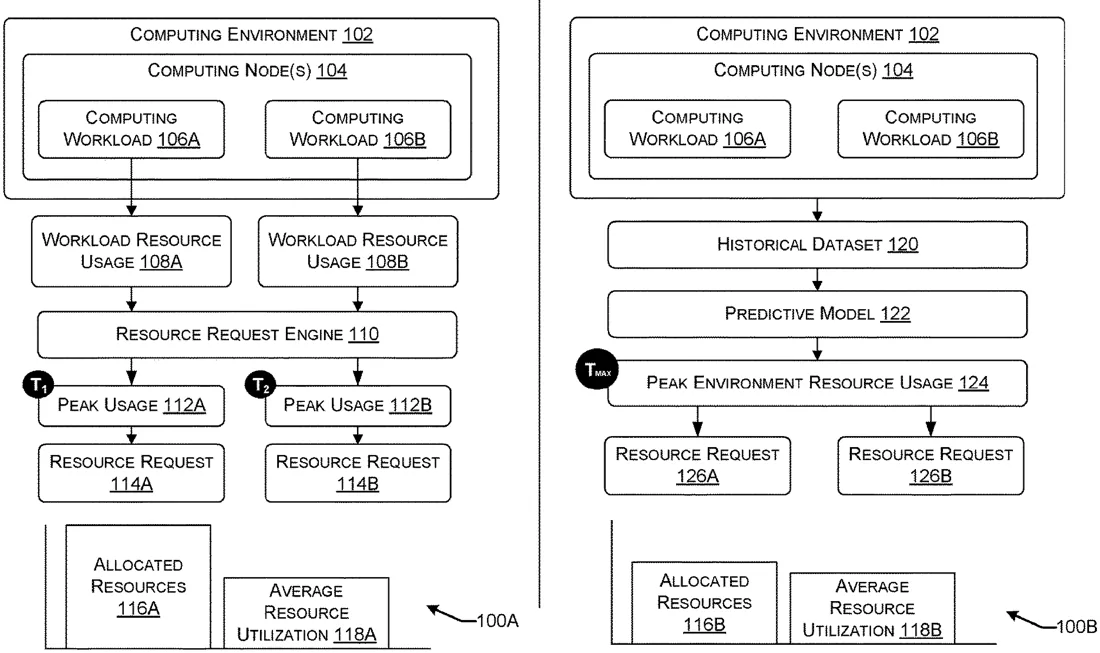
Microsoft describes a method for data centers to predict when servers will be busiest using past usage data. The system then assigns tasks to specific servers and automatically moves unused resources from idle tasks to busy ones in real-time.
In the filing’s own words
The techniques disclosed herein enable systems to efficiently allocate computing resources for various computing workloads through a shared peak resource usage prediction. To achieve this, a predictive model analyzes a historical dataset defining resource usage of a computing environment for a past timeframe, and calculates a peak environment resource usage for a future or current timeframe. In addition, the predictive model estimates a peak number of computing workloads for the computing environment. Using the peak resource usage and/or the peak number of computing workloads, the system derives resource requests for allocating computing resources to a plurality of computing workloads. The computing workloads are subsequently assigned to computing nodes within the computing environment for execution. Furthermore, computing workloads within a computing node are configured to share computing resources to accommodate sudden surges in demand. In this way, the system can reduce computing resource wastage for computing environments.
What exactly they claim (claim 1)
1. A method for automated computing resource reallocation in a computing environment executing a plurality of computing workloads, the method comprising: extracting, by a processing system executing a predictive model, a historical dataset from the computing environment for a past timeframe, the historical dataset defining computing resource usage of the computing environment during the past timeframe; calculating, by execution of the predictive model, a peak computing resource usage of the computing environment at a given time based on the historical dataset, wherein the peak computing resource usage represents a predicted peak computing resource usage for a current timeframe; deriving a computing resource request for each computing workload of the plurality of computing workloads to be deployed to the computing environment based on the predicted peak computing resource usage for the current timeframe; generating a computing resource allocation for each computing workload of the plurality of computing workloads to be deployed to the computing environment according to the computing resource request derived for each computing workload of the plurality of computing workloads; assigning, as part of a computing workload deployment, each computing workload of the plurality of computing workloads to the computing environment for execution using the computing resource allocation generated for each computing workload of the plurality of computing workloads; determining, during execution of a first computing workload, that a first resource utilization of the first computing workload within the computing environment is above a resource utilization threshold; determining, during execution of a second computing workload, that a second resource utilization of the second computing workload within the computing environment is below the resource utilization threshold; and reallocating a portion of computing resources from the second computing workload to the first computing workload based on the first resource utilization being above the resource utilization threshold and the second resource utilization being below the resource utilization threshold.
Facts
- Company
- Microsoft (MICROSOFT TECHNOLOGY LICENSING, LLC)
- Official title
- COMPUTING RESOURCE PREDICTION FOR OPTIMIZING RESOURCE UTILIZATION AND COMPUTING WORKLOAD DENSITY
- Publication number
- US20260300035A1
- Application number
- 19700860
- Filed
- Jun 8, 2026
- Published
- Oct 1, 2026
- Inventors
- 5
- Claims
- 20
Classified under
G06F 9/5083 Physics & computingG06F 9/5038 Physics & computingG06F 9/5044 Physics & computingG06F 9/505 Physics & computingG06F 2209/508 Physics & computingMore from Microsoft in AI & software
- Microsoft patents method to check AI answers against verified facts Oct 20, 2026
- Microsoft patents AI that presents PowerPoint slides for you Sep 3, 2026
- Microsoft patents method to check if LLM answers are based on real data Sep 10, 2026
- Microsoft patents system to blend multiple AI agents into one chat Oct 1, 2026
- Microsoft patents system that answers questions using your screen history Oct 15, 2026
Summaries are simplified from the filing’s own abstract and first claim. A patent filing is not a product announcement.
Patent data and drawings: U.S. Patent and Trademark Office (USPTO). Nebula is not affiliated with or endorsed by the USPTO.