Google patents chip design that runs two AI tasks at once
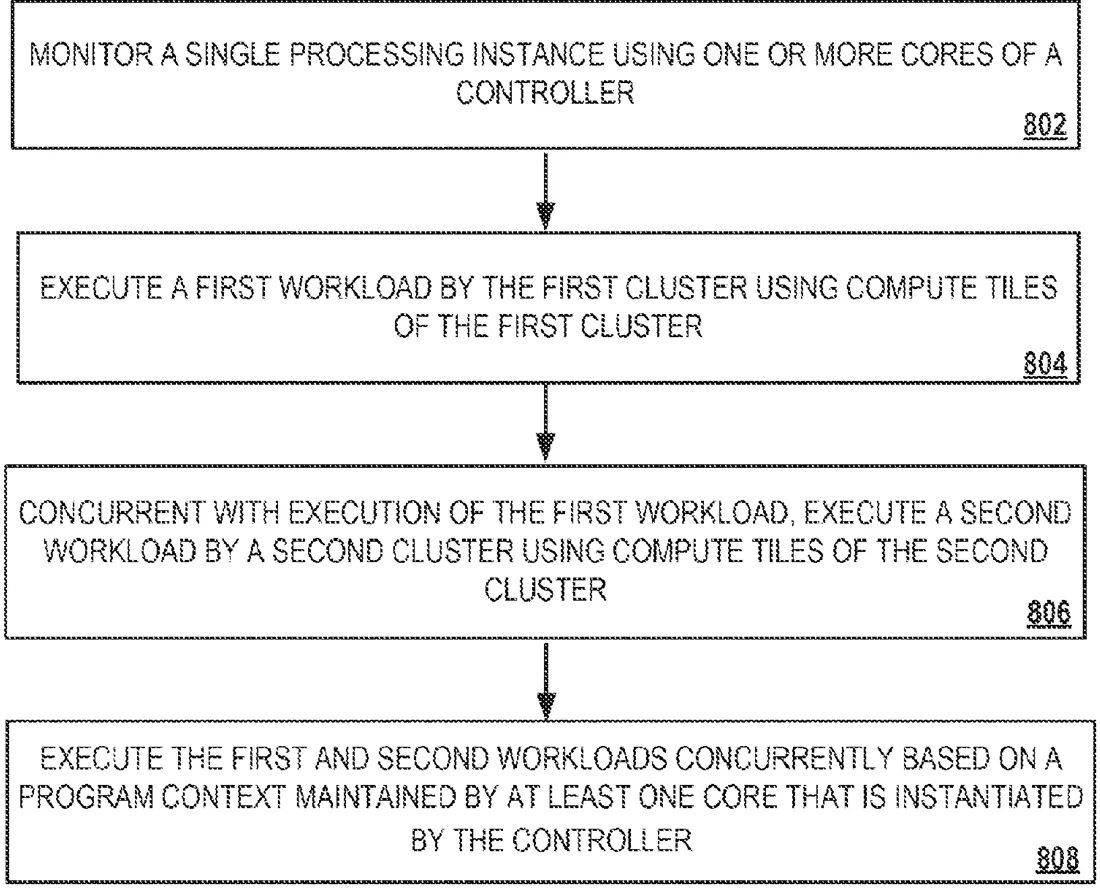
Google describes a hardware design for a machine-learning chip that splits its processing power into two separate groups, or clusters. This allows the chip to run two different AI tasks at the same time by using a central controller to manage how work is distributed between the groups.
In the filing’s own words
Methods and systems, including computer-readable media, are described for implementing a multi-cluster architecture for a hardware machine-learning (ML) accelerator. The architecture is implemented as a hardware integrated circuit and includes a controller that communicates with one or more cores and a first and second cluster of compute tiles. Each of the first and second cluster of compute tiles is configured to execute a respective ML workload. A first workload can be assigned to the first cluster of compute tiles and a second, different workload can be assigned to the second cluster of compute tiles. The first and second workloads are executed concurrently using the first and second clusters based on a program context of at least one core that is coupled to compute tiles of the first and second cluster.
What exactly they claim (claim 1)
1. An integrated circuit comprising: a controller configured to communicate with one or more cores; a first cluster comprising a first plurality of compute tiles, the first cluster being configured to execute a first workload using the first plurality of compute tiles; and a second cluster comprising a second plurality of compute tiles, the second cluster being configured to execute a second workload using the second plurality of compute tiles; wherein the first workload and the second workload are executed concurrently based on a program context of at least one core that is instantiated by the controller and that is coupled to the first and second plurality of compute tiles.
Facts
- Company
- Google (Google LLC)
- Official title
- MULTI-CLUSTER ARCHITECTURE FOR A HARDWARE INTEGRATED CIRCUIT
- Publication number
- US20260299961A1
- Application number
- 19476064
- Filed
- Apr 17, 2024
- Published
- Oct 1, 2026
- Inventors
- 7
- Claims
- 21
Classified under
G06F 9/3891 Physics & computingG06F 9/4818 Physics & computingMore from Google in Chips & hardware
- Google patents quantum gates to simulate particle physics Sep 1, 2026
- Waymo patents lidar chips that split light into multiple beams Sep 8, 2026
- Google patents chip design to speed up AI math tasks Sep 8, 2026
- Google patents display that turns off colors to save battery Sep 8, 2026
- Google patents display tech that skips blank screen areas to save power Sep 15, 2026
Summaries are simplified from the filing’s own abstract and first claim. A patent filing is not a product announcement.
Patent data and drawings: U.S. Patent and Trademark Office (USPTO). Nebula is not affiliated with or endorsed by the USPTO.