Samsung patents storage system that sorts data by usage patterns
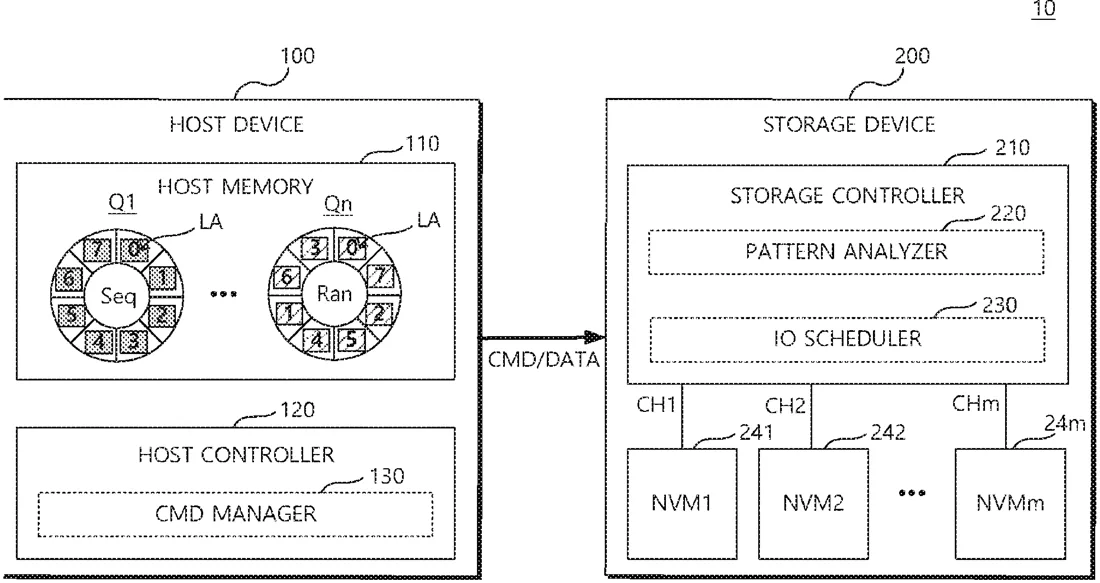
This filing describes a storage system where the computer's processor tags data requests with specific IDs and priority levels. The storage device then uses these tags to detect usage patterns and place data in memory accordingly to improve parallel processing.
In the filing’s own words
A storage system includes a host device supporting multiple queues and a storage device communicating with the host device. The host device may include first and second cores, first and second queues corresponding to the first and second cores and storing commands, and a host controller that sets a queue ID and/or a parallelism demand level for each commands stored in the first and second queues. The storage device may include nonvolatile memories and a storage controller that detects pattern information of commands, received from the host device, based on the queue ID and places the commands, received from the host device, in the nonvolatile memories based on the pattern information.
What exactly they claim (claim 1)
1. A storage system comprising: a host device supporting multiple queues, the host device comprising: a first core; a first queue corresponding to the first core and configured to store a plurality of first commands; a second core; a second queue corresponding to the second core and configured to store a plurality of second commands; and a host controller configured to set a queue identifier (ID) for each the plurality of first commands stored in the first queue and each of the plurality of second commands stored in the second queue; and set a parallelism demand level for each of the plurality of first commands stored in the first queue and each of the plurality of second commands stored in the second queue, the parallelism demand level being set for each queue and indicating a priority for a parallel processing function between queues having a same pattern, and a storage device communicating with the host device, the storage device comprising: a plurality of nonvolatile memories; and a storage controller configured to detect pattern information of received commands that are received from the host device, based on the queue ID, and the parallelism demand level of the received commands, and to place the received commands in the plurality of nonvolatile memories based on both the pattern information and the parallelism demand level.
Facts
- Company
- Samsung (SAMSUNG ELECTRONICS CO., LTD.)
- Official title
- STORAGE SYSTEM SUPPORTING MULTIPLE QUEUES
- Publication number
- US20260299838A1
- Application number
- 19699556
- Filed
- Jun 5, 2026
- Published
- Oct 1, 2026
- Inventors
- 3
- Claims
- 1
Classified under
G06F 3/0659 Physics & computingG06F 3/0604 Physics & computingG06F 3/0658 Physics & computingG06F 3/0679 Physics & computingMore from Samsung in Chips & hardware
- Samsung patents chip that combines camera and screen Oct 13, 2026
- Samsung patents faster chip testing using machine learning Sep 1, 2026
- Samsung patents radar method to pinpoint target direction more accurately Sep 1, 2026
- Samsung patents memory chip that searches data by content, not address Sep 1, 2026
- Samsung patents chip design that skips empty data to speed up AI Sep 1, 2026
Summaries are simplified from the filing’s own abstract and first claim. A patent filing is not a product announcement.
Patent data and drawings: U.S. Patent and Trademark Office (USPTO). Nebula is not affiliated with or endorsed by the USPTO.