Microsoft patents live meeting boards that update from chat and speech
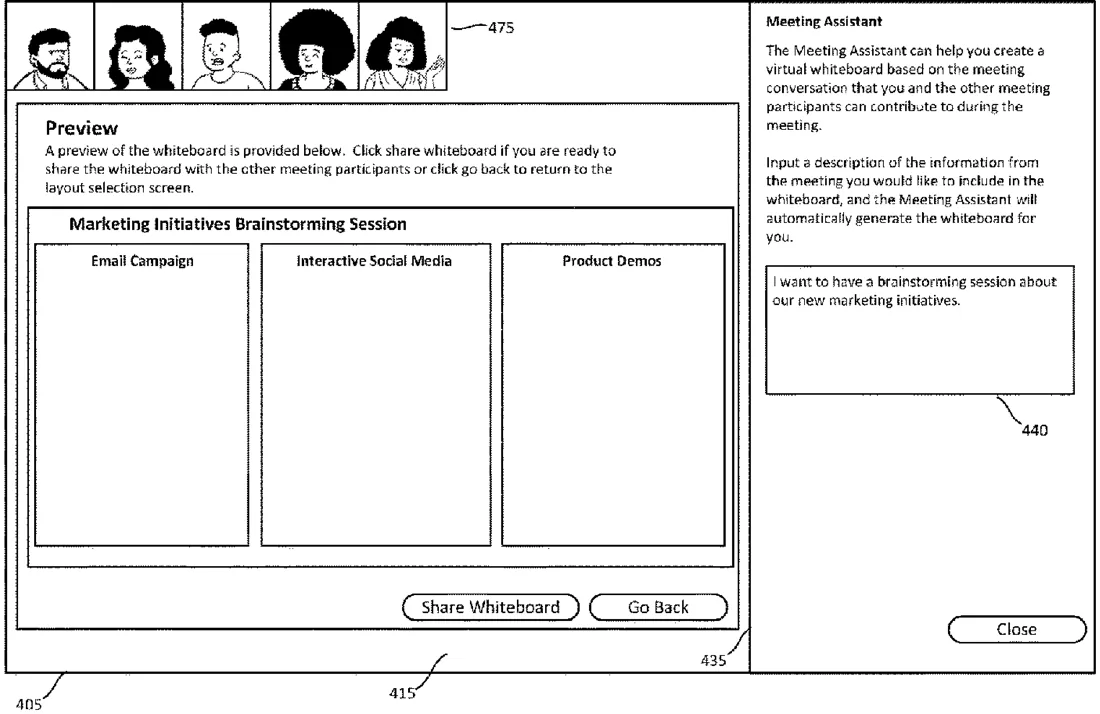
Microsoft describes a system that creates interactive visual boards during online meetings using a language model. It analyzes the meeting transcript and chat messages to automatically add new ideas to a shared whiteboard for all participants.
In the filing’s own words
A data processing system implements techniques for automatically generating visualizations of content for meetings on an online communications platform. The visualizations are interactive and encourage participant engagement. The system automatically generates the visualizations based on a transcript of the meeting and other information associated with the meeting as the meeting is taking place. The system determines a meeting category based on this information and suggests a visualization layout based on the meeting category. The system then automatically generates the visualization using a generative language model. The generative language model generates interactive visualization based on the suggested visualization layout and transcript of the meeting and other information associated with the meeting as the meeting. The interactive visualization is then presented to the participants of the online communication session via the online communications platform to enable the participants to collaborate on the interactive visualization.
What exactly they claim (claim 1)
1. A data processing system comprising: a processor; and a memory storing executable instructions that, when executed, cause the processor alone or in combination with other processors to perform operations of: detecting an occurrence of a trigger condition during an online communication session among a plurality of client devices associated with participants of the online communication session, the occurrence of the trigger condition indicating that a visualization of content associated with the online communication session should be generated and presented on the plurality of client devices associated with the participants of the online communication session; selecting a candidate visualization layout from a plurality of visualization layouts in a visualization layout datastore based on a meeting category associated with the online communication session; constructing a first prompt for a language model based on the candidate visualization layout and a transcript of the online communication session; providing the first prompt as an input to the language model; obtaining visualization information as an output from the language model, wherein the visualization information is formatted according to the candidate visualization layout and includes information based on the transcript; causing the plurality of client devices associated with the participants of the online communication session to present an interactive virtual whiteboard populated with the visualization information on a user interface of the plurality of client devices; and synchronizing changes to the visualization information among the plurality of client devices during the online communication session, wherein synchronizing the changes to the visualization information includes: determining that a synchronization trigger condition has been satisfied based on changes to one or more of the transcript of the online communication session, chat messages among the participants to the online communication session, or both during the online communication session; analyzing the transcript of the online communication session, chat messages among the participants to the online communication session, or both to identify ideas that have been introduced by one or more participants to the online communication session but have not yet been integrated into the visualization information presented in the interactive virtual whiteboard by the language model or manually integrated into the visualization information by the one or more participants; constructing a second prompt to instruct the language model to update the visualization information based on the ideas that have been introduced by the one or more participants; providing the second prompt, the visualization information, and the ideas as an input to the language model to cause the language model to output updated visualization information; and causing the interactive virtual whiteboard to present the updated visualization information on the user interface of the plurality of client devices associated with the participants of the online communication session.
Facts
- Company
- Microsoft (Microsoft Technology Licensing, LLC)
- Official title
- Meeting visualizer
- Patent number
- US12771734B2
- Application number
- 18471210
- Filed
- Sep 20, 2023
- Granted
- Oct 20, 2026
- Inventors
- 6
- Claims
- 20
Classified under
H04L 65/1059 Electricity & electronicsG06F 3/167 Physics & computingG06F 40/30 Physics & computingG06F 40/35 Physics & computingG10L 15/00 Physics & computingG06F 2203/04803 Physics & computingMore from Microsoft in AI & software
- Microsoft patents method to check AI answers against verified facts Oct 20, 2026
- Microsoft patents AI that presents PowerPoint slides for you Sep 3, 2026
- Microsoft patents method to check if LLM answers are based on real data Sep 10, 2026
- Microsoft patents system to blend multiple AI agents into one chat Oct 1, 2026
- Microsoft patents system that answers questions using your screen history Oct 15, 2026
Summaries are simplified from the filing’s own abstract and first claim. A patent filing is not a product announcement.
Patent data and drawings: U.S. Patent and Trademark Office (USPTO). Nebula is not affiliated with or endorsed by the USPTO.