Microsoft patents video tracking that skips frames to keep motion smooth
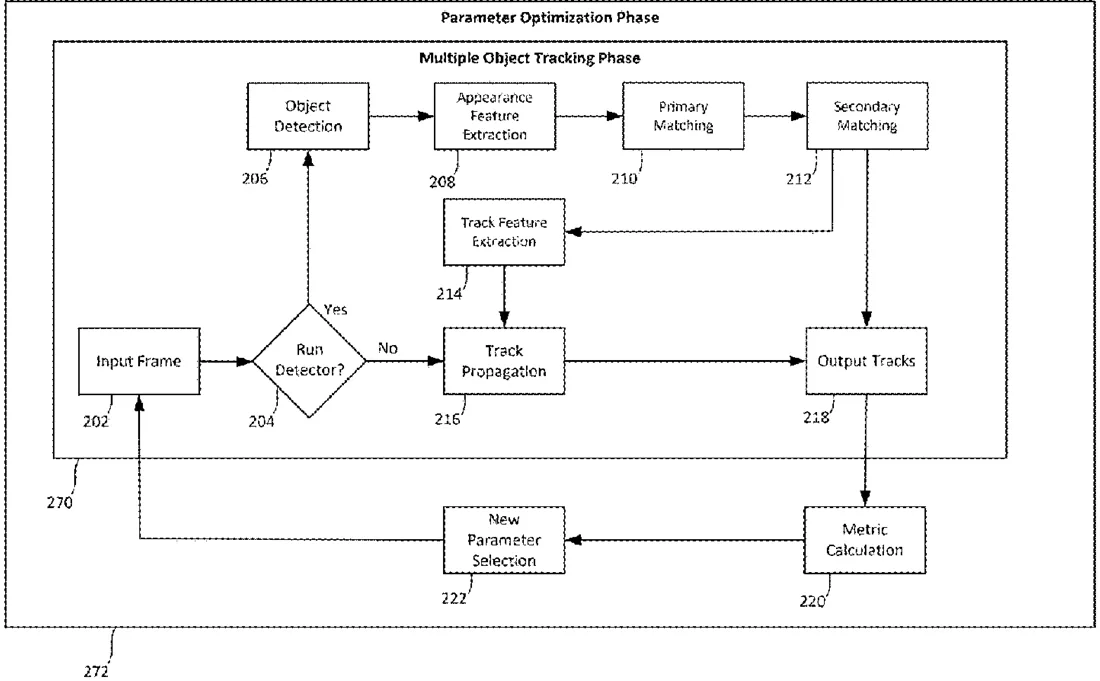
This patent describes a method for tracking multiple objects in video by deciding whether to analyze every frame or estimate positions based on previous data. If processing every frame would slow down the system, it uses 'detection propagation' to guess where objects are, ensuring the video stays smooth.
In the filing’s own words
A data processing system implements obtaining a frame of video content at an object detection pipeline, the video content comprising a plurality of frames; analyzing the frame using an object detection model to detect a plurality of objects and associate each object with a confidence score; performing a primary matching operation on high confidence detection objects to associate the high confidence detection objects with an object track of a plurality of object tracks, the high confidence detection objects being objects associated with a confidence score that satisfies a confidence threshold; performing a secondary matching operation on low confidence detection objects to associate the low confidence detection objects with an object track of the plurality of object tracks, low confidence detection objects being objects associated with a confidence score that does not satisfy the confidence threshold; and outputting the plurality of object tracks.
What exactly they claim (claim 1)
1. A data processing system comprising: a processor; and a memory storing executable instructions that, when executed, cause the processor alone or in combination with other processors to perform operations of: obtaining a frame of video content at an object detection pipeline, the video content comprising a plurality of frames; analyzing the frame of video content using an object detection model to detect a plurality of objects in the frame of video content, the object detection model associating each object of the plurality of objects with a confidence score; determining whether to perform object detection on the frame or detection propagation based on whether performing the object detection on the frame would cause a frame rate of the object detection pipeline to fall below a threshold; responsive to determining that the frame rate would fall below the threshold if the object detection pipeline were to perform object detection on the frame: performing detection propagation to extrapolate object tracks for a plurality of objects from previously determined object tracks; and outputting the object tracks for the plurality of objects for the frame; and responsive to determining that the frame rate would not fall below the threshold, performing the object detection on the frame by: performing a primary matching operation on high confidence detection objects to determine first object tracks of the high confidence detection objects by associating the high confidence detection objects with an object track of a plurality of object tracks, the high confidence detection objects being objects from the plurality of objects associated with a confidence score that satisfies a confidence threshold, the first object tracks tracking the high confidence detection objects across the plurality of frames; performing a secondary matching operation on low confidence detection objects to determine second object tracks of the low confidence detection objects by associating the low confidence detection objects with an object track of the plurality of object tracks, the low confidence detection objects being objects from the plurality of objects associated with a confidence score that does not satisfy the confidence threshold, the second object tracks tracking the low confidence detection objects across the plurality of frames; and outputting, from the object detection pipeline, the first object tracks and the second object tracks.
Facts
- Company
- Microsoft (Microsoft Technology Licensing, LLC)
- Official title
- Techniques for robust real-time multiple-object tracking with detection propagation and per-class optimization
- Patent number
- US12770270B2
- Application number
- 18642890
- Filed
- Apr 23, 2024
- Granted
- Oct 20, 2026
- Inventors
- 3
- Claims
- 18
Classified under
G06T 7/20 Physics & computingG06T 5/20 Physics & computingG06V 10/25 Physics & computingG06V 10/761 Physics & computingG06V 2201/07 Physics & computingMore from Microsoft in AI & software
- Microsoft patents method to check AI answers against verified facts Oct 20, 2026
- Microsoft patents AI that presents PowerPoint slides for you Sep 3, 2026
- Microsoft patents method to check if LLM answers are based on real data Sep 10, 2026
- Microsoft patents system to blend multiple AI agents into one chat Oct 1, 2026
- Microsoft patents system that answers questions using your screen history Oct 15, 2026
Summaries are simplified from the filing’s own abstract and first claim. A patent filing is not a product announcement.
Patent data and drawings: U.S. Patent and Trademark Office (USPTO). Nebula is not affiliated with or endorsed by the USPTO.