Samsung patents fridge cooling part with special heat-conducting filler
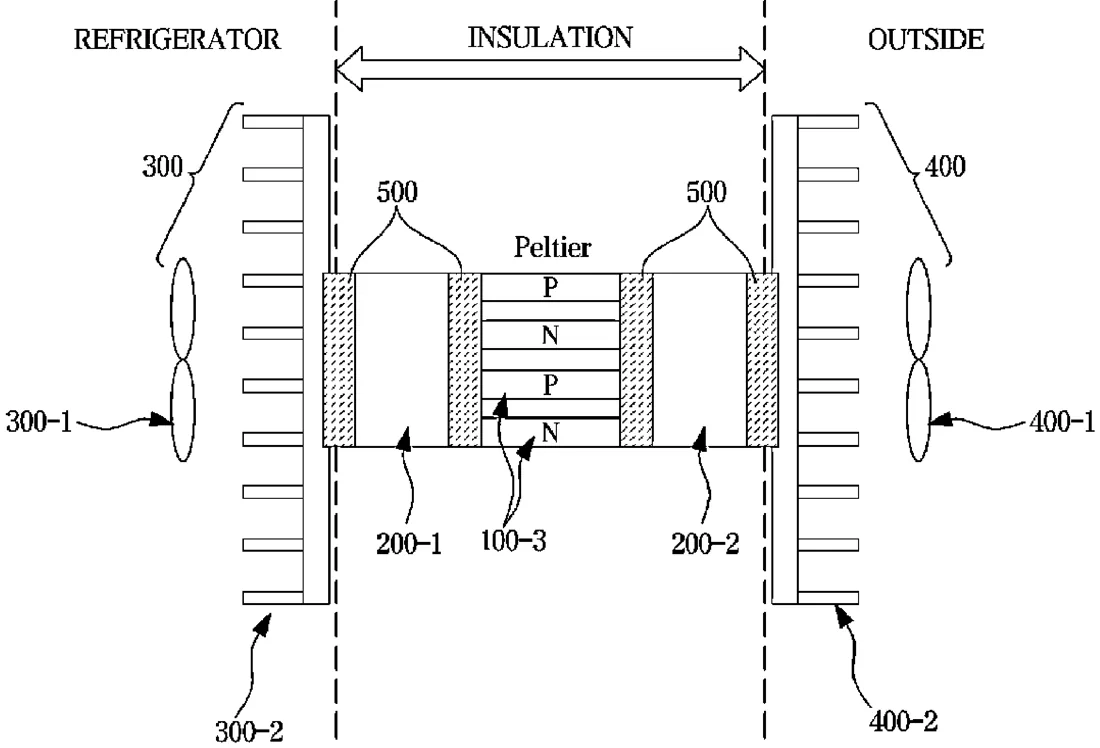
Samsung has been granted a patent for a cooling system that uses a thermoelectric element to move heat from inside a refrigerator to the outside. The design includes a specific material with directional heat-conducting fillers placed between the cooling element and metal plates to improve heat transfer efficiency.
In the filing’s own words
Disclosed is a thermoelectric element cooling device including: a thermoelectric element having an endothermic surface and an exothermic surface; a first heat dissipation plate connected to the endothermic surface and configured to dissipate heat to the endothermic surface; a first heat exchanger configured to transfer heat to the first heat dissipation plate; a second heat dissipation plate configured to dissipate heat received from the exothermic surface to a second heat exchanger; the second heat exchanger configured to release heat received from the second heat dissipation plate to the outside; and a thermoconductive member disposed at at least one position between the endothermic surface of the thermoelectric element and the first heat dissipation plate or between the exothermic surface and the second heat dissipation plate, wherein the thermoconductive member has: one side in contact with one of the surfaces of the thermoelectric element; and the other side in contact with the first heat dissipation plate or the second heat dissipation plate, the thermoconductive member includes a plurality of anisotropic, thermoconductive fillers, and at least one of the plurality of anisotropic, thermoconductive fillers is located adjacent to the one side and the other side.
What exactly they claim (claim 1)
1. A thermoelectric element cooling device comprising: a thermoelectric element including an endothermic surface and an exothermic surface; a first heat dissipation plate connected to the endothermic surface and configured to dissipate heat to the endothermic surface; a first heat exchanger configured to transfer heat to the first heat dissipation plate; a second heat dissipation plate configured to dissipate heat received from the exothermic surface; a second heat exchanger configured to release heat received from the second heat dissipation plate to the outside; and a thermoconductive member disposed at at least one of: a position between the endothermic surface of the thermoelectric element and the first heat dissipation plate or a position between the exothermic surface and the second heat dissipation plate, wherein the thermoconductive member has: one side in contact with one of the surfaces of the thermoelectric element; and the other side in contact with the first heat dissipation plate or the second heat dissipation plate, the thermoconductive member includes a plurality of anisotropic, thermoconductive fillers, and at least one anisoptropic, thermoconductive filler of the plurality of anisotropic, thermoconductive fillers is located adjacent to each of the one side and the other side.
Facts
- Company
- Samsung (SAMSUNG ELECTRONICS CO., LTD.)
- Official title
- Thermoelectric element cooling device and refrigerator comprising same
- Patent number
- US12768575B2
- Application number
- 18923068
- Filed
- Oct 22, 2024
- Granted
- Oct 20, 2026
- Inventors
- 3
- Claims
- 15
Classified under
F25B 21/02 Mechanical engineeringF25B 2321/0251 Mechanical engineeringMore from Samsung in Chips & hardware
- Samsung patents chip that combines camera and screen Oct 13, 2026
- Samsung patents faster chip testing using machine learning Sep 1, 2026
- Samsung patents radar method to pinpoint target direction more accurately Sep 1, 2026
- Samsung patents memory chip that searches data by content, not address Sep 1, 2026
- Samsung patents chip design that skips empty data to speed up AI Sep 1, 2026
Summaries are simplified from the filing’s own abstract and first claim. A patent filing is not a product announcement.
Patent data and drawings: U.S. Patent and Trademark Office (USPTO). Nebula is not affiliated with or endorsed by the USPTO.