Samsung patents Wi-Fi scheduling to handle overlapping wake times
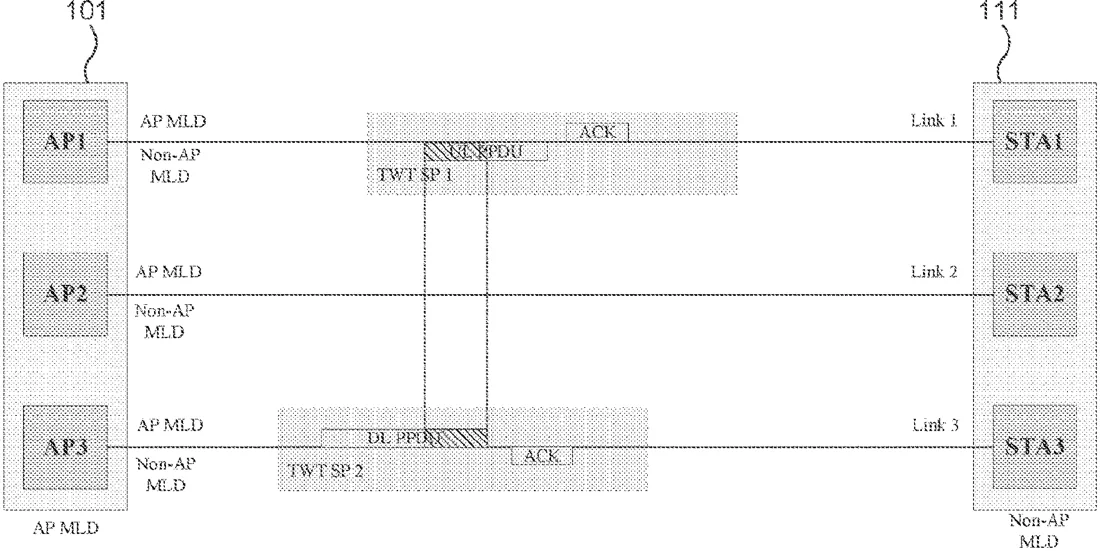
This patent describes a method for Wi-Fi devices to manage data transmission when two separate wireless links wake up at the same time. The device uses a processor to prioritize traffic based on importance, ensuring it does not try to send and receive on incompatible links simultaneously.
In the filing’s own words
Methods and apparatuses for facilitating restricted TWT operation between multi-link devices (MLDs) across multiple links under non-simultaneous transmit/receive (NSTR) constraints. A non-access point (AP) MLD comprises a processor and stations (STAs), each comprising a transceiver configured to form links with APs of an AP MLD. First and second links form an NSTR link pair subject to NSTR constraints. First and second target wake time (TWT) schedules that have first and second TWT service periods (SPs), respectively, and associated first and second sets of traffic identifiers (TIDs), respectively, are established on the first and second links, respectively. The first and second TWT SPs have an overlapping portion. The processor is configured to determine, based on characteristics of the sets of TIDs, scheduling for traffic on the first and second links during the overlapping portion of the TWT SPs such that the NSTR constraints are not violated.
What exactly they claim (claim 1)
1. A non-access point (AP) multi-link device (MLD) comprising: stations (STAs) comprising transceivers configured to form links with APs, respectively, the APs affiliated with an AP MLD, wherein: first and second links of the links form a non-simultaneous transmit/receive (NSTR) link pair subject to NSTR constraints, a first target wake time (TWT) schedule that has a first TWT service period (SP) and an associated first set of traffic identifiers (TIDs) is established on the first link and a second TWT schedule that has a second TWT SP and an associated second set of TIDs is established on the second link, and the first and second TWT SPs have an overlapping portion; and a processor operably coupled to the transceivers, the processor configured to determine, based on characteristics of the first and second sets of TIDs, scheduling for traffic on the first and second links during the overlapping portion of the TWT SPs such that the NSTR constraints are not violated, wherein the TWT SP from a highest-priority TID is prioritized to resolve a conflict with the NSTR constraints during the overlapping portion of the TWT SPs, wherein the processor is further configured to determine the scheduling during the overlapping portion of the TWT SPs by scheduling traffic corresponding to an access category (AC) of a highest priority TID among TIDs in the first and second sets of TIDs is scheduled first, followed by traffic corresponding to an AC of a next highest priority TID, such that the scheduling dynamically alternates between the first and second links within the overlapping portion based on a descending priority order of the TIDs in the first and second sets of TIDs, and wherein at least one of the transceivers is further configured to transmit or receive the traffic to or from the AP MLD.
Facts
- Company
- Samsung (Samsung Electronics Co., Ltd.)
- Official title
- Method and apparatus for NSTR operation with multiple TWT over multiple links
- Patent number
- US12764659B2
- Application number
- 18182204
- Filed
- Mar 10, 2023
- Granted
- Oct 13, 2026
- Inventors
- 4
- Claims
- 20
Classified under
H04W 52/0216 Electricity & electronicsH04W 74/04 Electricity & electronicsMore from Samsung in Networks & wireless
- Samsung patents UWB method to save power while tracking distance Sep 1, 2026
- Samsung patents system to keep satellite calls connected as satellites move Sep 1, 2026
- Samsung patents low-power IoT tags that reply without precise clocks Sep 1, 2026
- Samsung patents phone feature that switches networks to fix slow connections Sep 1, 2026
- Samsung patents satellite phone method for switching between signal types Sep 1, 2026
Summaries are simplified from the filing’s own abstract and first claim. A patent filing is not a product announcement.
Patent data and drawings: U.S. Patent and Trademark Office (USPTO). Nebula is not affiliated with or endorsed by the USPTO.