Samsung patents smart surfaces to bounce terahertz signals further
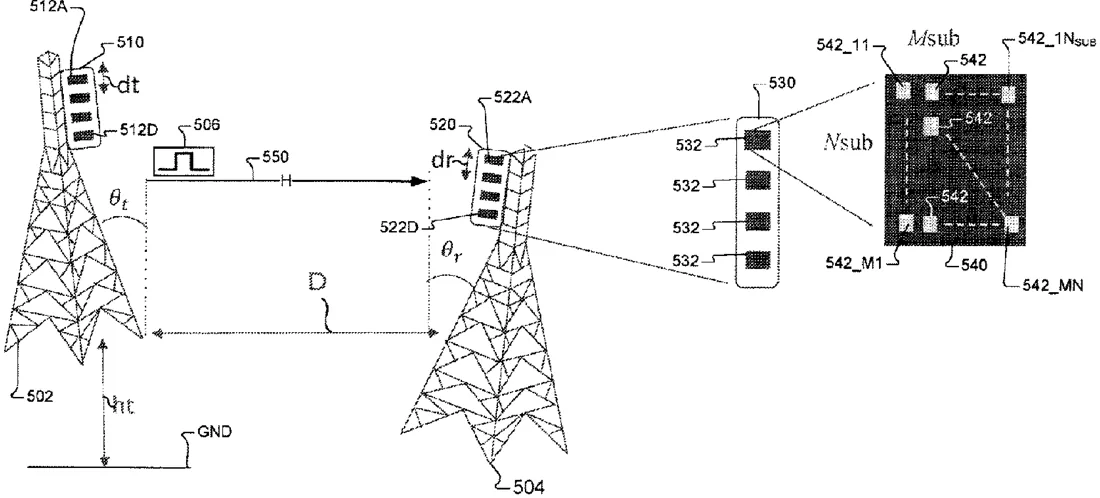
Samsung has patented a method using reconfigurable intelligent surfaces (RIS) to extend the range of high-frequency wireless connections. The system detects signals from a transmitter and adjusts a matrix of passive reflectors to steer the signal toward a receiver, effectively acting as a smart mirror for terahertz waves.
In the filing’s own words
A method, implemented by a processor connected to a reconfigurable intelligent surface (RIS) system that includes one or more RISs, includes detecting one or more wireless control signals from a transmitter. The method includes identifying a channel state and one or more phases based on the detected wireless control signals; improving a beam-steering reflection matrix (Φ) of the RIS system based on a singular value decomposition of channel matrices; and configuring the RIS system based on the Φ. Among the RISs, each RIS is configured to redirect an incident signal toward an antenna array of an intended receiver. The incident signal is received from the transmitter. Locations of the RIS and transmitter differ by a height placement value (h RIS). In a horizontal plane, the location of the RIS is a first distance (D TX-RIS) from the transmitter and a second distance (D RX-RIS) from the receiver.
What exactly they claim (claim 1)
1. A method implemented by a processor operably connected to a reconfigurable intelligent surface (RIS) system that includes one or more RISs, the method comprising: detecting one or more wireless control signals from a transmitter; identifying a channel state and one or more phases based on the detected one or more wireless control signals; improving a beam-steering reflection matrix (Φ) of the RIS system based on a singular value decomposition of channel matrices; and configuring the RIS system based on the beam-steering reflection matrix, wherein the one or more RISs extend a range between the transmitter and a receiver base station, wherein among the one or more RISs, each RIS is configured to redirect an incident electromagnetic (EM) signal toward an antenna array of an intended receiver, each RIS includes a plurality of passive reflectors arranged such that an arrangement of the passive reflectors within the RIS includes a uniform linear array that includes a number (W) of reflector panels separated by a reflector panel separation distance (d RIS) that is equivalent to an antenna panel separation distance (d t) of the transmitter, the incident EM signal received from an antenna array of the transmitter at a wavelength (λ), and wherein: in a vertical plane, a location of the RIS above ground differs from a vertical location (h t) of the transmitter by a height placement value (h RIS); and in a horizontal plane, the location of the RIS is a first distance (D TX-RIS) from the transmitter and a second distance (D RX-RIS) from the receiver base station.
Facts
- Company
- Samsung (Samsung Electronics Co., Ltd.)
- Official title
- Reconfigurable intelligent surfaces (RIS) assisted line-of-sight (LOS) multiple-input multiple-output (MIMO) for range extension at terahertz (THz)
- Patent number
- US12763842B2
- Application number
- 18167016
- Filed
- Feb 9, 2023
- Granted
- Oct 13, 2026
- Inventors
- 3
- Claims
- 20
Classified under
H04B 7/145 Electricity & electronicsH01Q 15/14 Electricity & electronicsMore from Samsung in Networks & wireless
- Samsung patents UWB method to save power while tracking distance Sep 1, 2026
- Samsung patents system to keep satellite calls connected as satellites move Sep 1, 2026
- Samsung patents low-power IoT tags that reply without precise clocks Sep 1, 2026
- Samsung patents phone feature that switches networks to fix slow connections Sep 1, 2026
- Samsung patents satellite phone method for switching between signal types Sep 1, 2026
Summaries are simplified from the filing’s own abstract and first claim. A patent filing is not a product announcement.
Patent data and drawings: U.S. Patent and Trademark Office (USPTO). Nebula is not affiliated with or endorsed by the USPTO.