Microsoft patents AI method that learns by asking itself questions
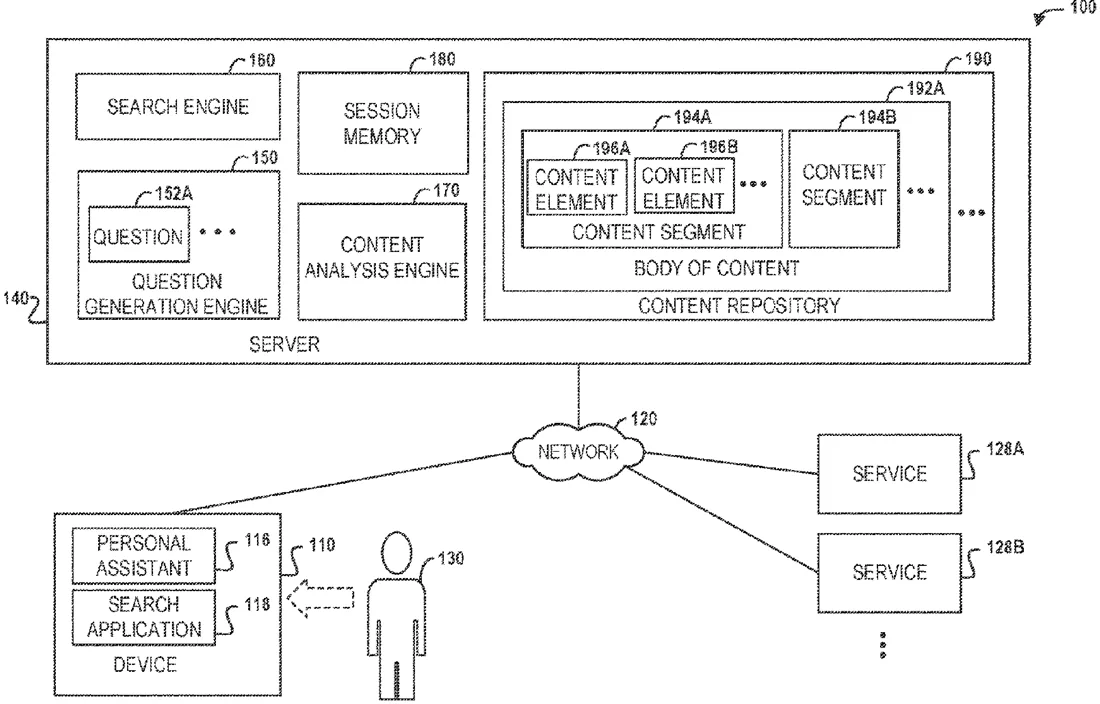
Microsoft describes a system where an AI learns to understand content by generating its own questions and checking the answers. It compares different pieces of information to find unique details, stores them in a temporary memory, and adjusts its learning based on whether its answers are correct.
In the filing’s own words
Systems and methods are disclosed for inquiry-based deep learning. In one implementation, a first content segment is selected from a body of content. The content segment includes a first content element. The first content segment is compared to a second content segment to identify a content element present in the first content segment that is not present in the second content segment. Based on an identification of the content element present in the first content segment that is not present in the second content segment, the content element is stored in a session memory. A first question is generated based on the first content segment. The session memory is processed to compute an answer to the first question. An action is initiated based on the answer. Using deep learning, content segments can be encoded into memory. Incremental questioning can serve to focus various deep learning operations on certain content segments.
What exactly they claim (claim 1)
1. A system comprising: a processing device; a session memory coupled to the processing device; and a memory coupled to the processing device and storing instructions that, when executed by the processing device, cause the system to perform operations for reinforcement learning (RL) teaching of semantic understanding to a content analysis engine of a scaffolding network, the operations comprising: receiving a series of questions generated by a question generation engine of the scaffolding network and based on a body of content; comparing a first content segment of the body of content to a second content segment of the body of the content stored in the session memory to identify a content element present in the first content segment that is not present in the second content segment: storing the identified content element in the session memory based on the identification of the content element: encoding, based on a previous reward and by the content analysis engine, a question of the series of questions relative to the body of content; generating, by the content analysis engine and by processing content elements stored in the session memory, an answer to the question that maximizes a total sum of rewards for answering the series of questions; determining a next reward and updating associations between content elements stored in the session memory based on whether the answer is correct or incorrect resulting in updated session memory, and answering a next question of the series of questions based on the next reward and based on the updated session memory.
Facts
- Company
- Microsoft (Microsoft Technology Licensing, LLC)
- Official title
- Reinforcement learning using scaffolding question networks
- Patent number
- US12762422B2
- Application number
- 18212289
- Filed
- Jun 21, 2023
- Granted
- Oct 13, 2026
- Inventors
- 4
- Claims
- 19
Classified under
G06N 3/092 Physics & computingG06F 16/3329 Physics & computingG06N 3/006 Physics & computingMore from Microsoft in AI & software
- Microsoft patents method to check AI answers against verified facts Oct 20, 2026
- Microsoft patents AI that presents PowerPoint slides for you Sep 3, 2026
- Microsoft patents method to check if LLM answers are based on real data Sep 10, 2026
- Microsoft patents system to blend multiple AI agents into one chat Oct 1, 2026
- Microsoft patents system that answers questions using your screen history Oct 15, 2026
Summaries are simplified from the filing’s own abstract and first claim. A patent filing is not a product announcement.
Patent data and drawings: U.S. Patent and Trademark Office (USPTO). Nebula is not affiliated with or endorsed by the USPTO.