Nvidia patents smarter safety zones for self-driving cars
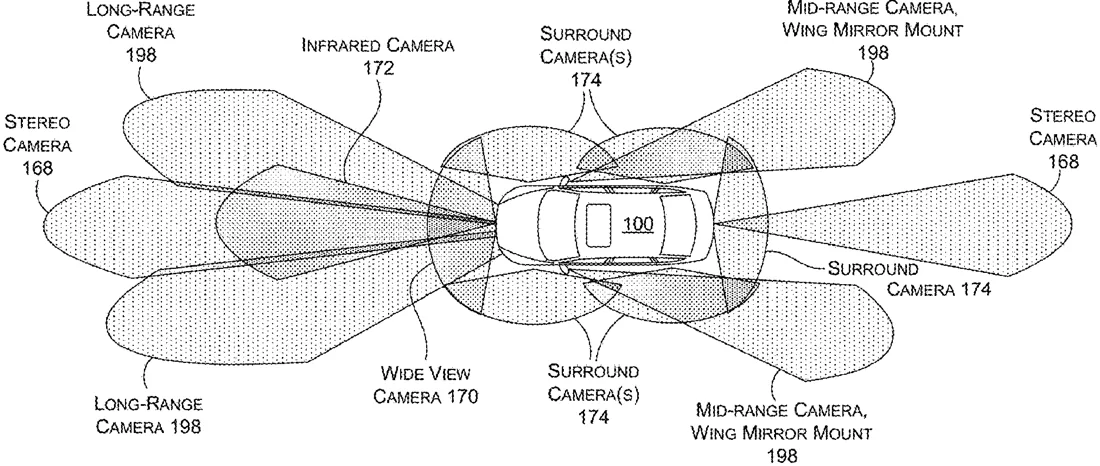
Nvidia describes a method for self-driving systems to focus their sensors only on areas where a collision is actually possible during a specific maneuver. By using the car's intended path to shrink the 'safety zone,' the system ignores irrelevant parts of the road, reducing unnecessary caution and improving reaction speed.
In the filing’s own words
In various examples, systems and methods are disclosed relating to refinement of safety zones and improving evaluation metrics for the perception modules of autonomous and semi-autonomous systems. Example implementations can exclude areas in the state space that are not safety critical, while retaining the areas that are safety-critical. This can be accomplished by leveraging ego maneuver information and conditioning safety zone computations on ego maneuvers. A maneuver-based decomposition of perception safety zones may leverage a temporal convolution operation with the capability to account for collision at any intermediate time along the way to maneuver completion. This provides a significant reduction in zone volume while maintaining completeness, thus optimizing or otherwise enhancing obstacle perception performance requirements by filtering out regions of state space not relevant to a system's route of travel. Computation of safety-zones conditioned on the ego maneuver greatly reduces excessive conservatism.
What exactly they claim (claim 1)
1. At least one processor comprising: one or more circuits to: obtain sensor data corresponding to one or more objects in a first volume of space perceivable by an autonomous system; determine one or more values of one or more parameters corresponding to one or more predicted trajectories associated with an intended maneuver of the autonomous system; generate, using the sensor data and based at least on conditioning the generation on the one or more values of the one or more parameters, an obstacle perception zone corresponding to a second volume of space, smaller than and within the first volume of space, containing potential threats to the autonomous system and excluding one or more regions of the first volume of space that are not relevant to the one or more predicted trajectories; and based at least on potential threats detected within the obstacle perception zone: performing one or more maneuvers by transmitting control signals to at least one of a propulsion system, a steering system, or a brake system of the autonomous system; and/or transmitting, to one or more control circuits, data corresponding to the one or more maneuvers for performance of the one or more maneuvers by the one or more control circuits via control signals to at least one of the propulsion system, the steering system, or the brake system.
Facts
- Company
- Nvidia (NVIDIA Corporation)
- Official title
- Context-aware perception
- Patent number
- US12759582B2
- Application number
- 18328007
- Filed
- Jun 2, 2023
- Granted
- Oct 13, 2026
- Inventors
- 7
- Claims
- 20
Classified under
B60W 60/0015 Operations & transportB60W 2420/403 Operations & transportB60W 2554/4049 Operations & transportMore from Nvidia in Cars & transport
- Nvidia patents robotaxi system with AI dispatcher and virtual rails Sep 15, 2026
- Nvidia patents car drowsiness check that uses your body clock Oct 13, 2026
- Nvidia patents 3D camera system to measure passengers in vehicles Oct 13, 2026
- Nvidia patents cruise control that predicts driver's next move Oct 20, 2026
- Nvidia patents dual-brain system for self-driving cars Sep 17, 2026
Summaries are simplified from the filing’s own abstract and first claim. A patent filing is not a product announcement.
Patent data and drawings: U.S. Patent and Trademark Office (USPTO). Nebula is not affiliated with or endorsed by the USPTO.