Microsoft patents video code tweaks to make splicing streams easier
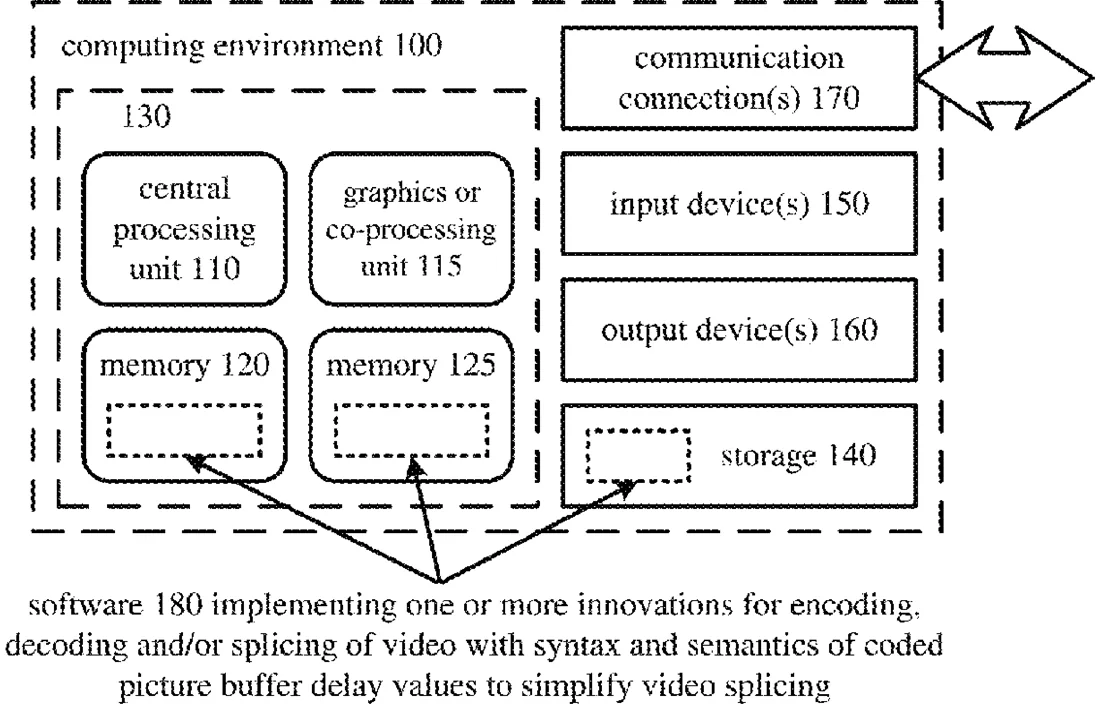
Microsoft has been granted a patent for a specific way to handle timing data in video files. The system uses a simplified method to calculate how long a decoder should wait before processing each frame, which makes it easier to join two separate video streams together without errors.
In the filing’s own words
Innovations in syntax and semantics of coded picture buffer removal delay (“CPBRD”) values potentially simplify splicing operations. For example, a video encoder sets a CPBRD value for a current picture that indicates an increment value relative to a nominal coded picture buffer removal time of a preceding picture in decoding order, regardless of whether the preceding picture has a buffering period SEI message. The encoder can signal the CPBRD value according to a single-value approach in which a flag indicates how to interpret the CPBRD value, according to a two-value approach in which another CPBRD value (having a different interpretation) is also signaled, or according to a two-value approach that uses a flag and a delta value. A corresponding video decoder receives and parses the CPBRD value for the current picture. A splicing tool can perform simple concatenation operations to splice bitstreams using CPBRD value for the current picture.
What exactly they claim (claim 1)
1. A computer system comprising one or more processing units and memory, wherein the computer system implements a video decoder configured to perform operations comprising: receiving a concatenation flag and a coded picture buffer removal delay (“CPBRD”) delta value, the concatenation flag having a given value; receiving encoded data in a bitstream for a given decoding unit of a given access unit, the given access unit corresponding to a current picture among pictures of a video sequence, wherein the given decoding unit is a subset of the current picture; determining a nominal coded picture buffer (“CPB”) removal time of a preceding access unit based on a nominal CPB removal time of a last decoding unit of the preceding access unit, the preceding access unit corresponding to a preceding picture among the pictures of the video sequence, wherein the last decoding unit is a subset of the preceding picture; determining a value of a constraint that ensures that delay is at least as long as delay would be if decoding started at the given access unit; and determining a nominal CPB removal time based at least in part on a sum of (a) the nominal CPB removal time of the preceding access unit and (b) a product of a clock tick value and a factor, wherein the factor depends on the CPBRD delta value, constrained by the value of the constraint.
Facts
- Company
- Microsoft (Microsoft Technology Licensing, LLC)
- Official title
- Syntax and semantics for buffering information to simplify video splicing
- Patent number
- US12756853B2
- Application number
- 19026937
- Filed
- Jan 17, 2025
- Granted
- Oct 6, 2026
- Inventors
- 2
- Claims
- 20
Classified under
H04N 19/46 Electricity & electronicsH04N 19/70 Electricity & electronicsH04N 21/23424 Electricity & electronicsH04N 21/44016 Electricity & electronicsH04N 7/147 Electricity & electronicsH04N 7/15 Electricity & electronicsMore from Microsoft in AI & software
- Microsoft patents method to check AI answers against verified facts Oct 20, 2026
- Microsoft patents AI that presents PowerPoint slides for you Sep 3, 2026
- Microsoft patents method to check if LLM answers are based on real data Sep 10, 2026
- Microsoft patents system to blend multiple AI agents into one chat Oct 1, 2026
- Microsoft patents system that answers questions using your screen history Oct 15, 2026
Summaries are simplified from the filing’s own abstract and first claim. A patent filing is not a product announcement.
Patent data and drawings: U.S. Patent and Trademark Office (USPTO). Nebula is not affiliated with or endorsed by the USPTO.