Microsoft patents video edge smoothing for smoother remote gaming
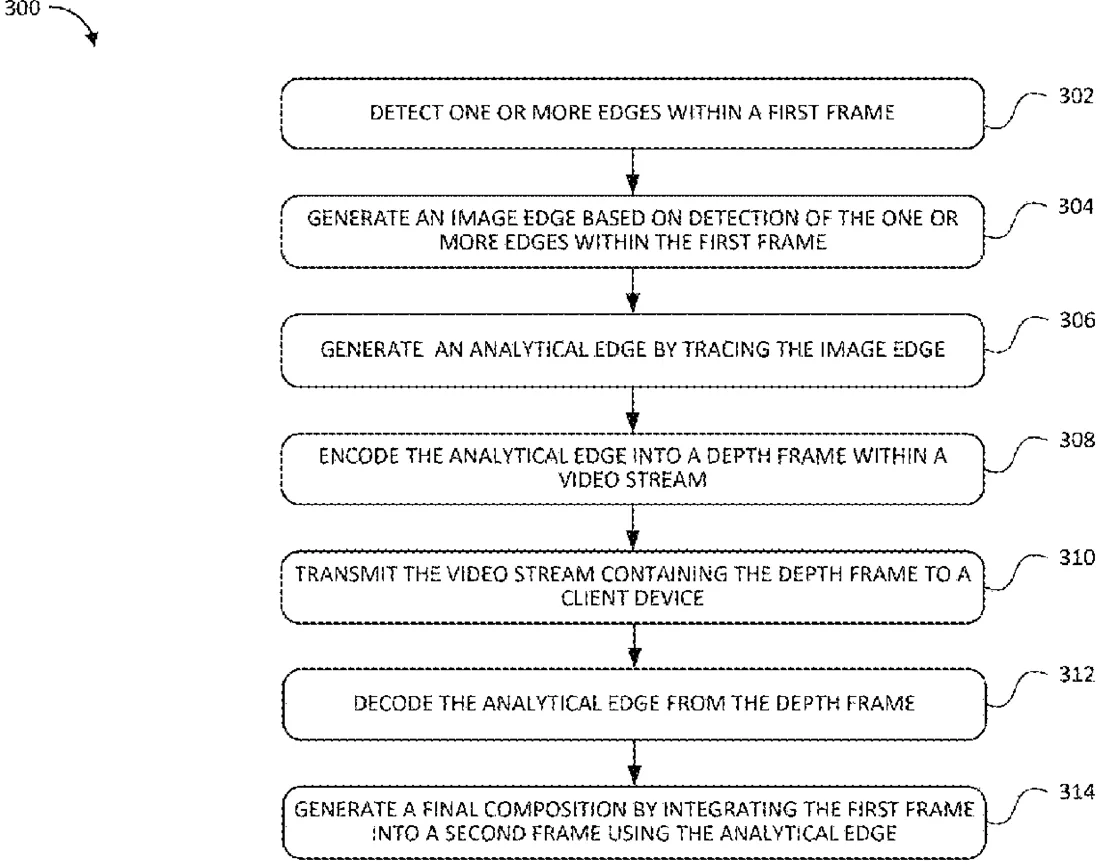
This patent describes a method for smoothing jagged edges in video streams sent from a server to a user's device. It works by detecting edges on the server, sending that data separately, and letting the user's device use it to blend the image more smoothly.
In the filing’s own words
Systems and methods provide an antialiasing engine and its related functions that distribute the computational effort and image reconstruction functions to achieve higher visual quality using morphological methods and operations. For example, an antialiasing engine detects one or more edges within a first frame and generates an edge image indicating a respective pixel's proximity to the foreground or the background based on detection of the one or more edges within the first frame. The antialiasing engine then generates an analytical edge by tracing the edge image and encodes the analytical edge into a depth frame within a video stream. The video stream is then transmitted to a client device where the analytical edge is responsively decoded by a client-side antialiasing engine and sampled to generate a final composition integrating the first frame into a second frame using the analytical edge, where the second frame is generated by the client device.
What exactly they claim (claim 1)
1. A computing apparatus comprising: a computer-readable storage medium; an antialiasing engine comprising processor-executable instructions stored on the computer-readable storage medium; and one or more processors coupled to the computer-readable storage medium and configured to execute the processor-executable instructions, wherein the processor-executable instructions, when executed by the one or more processors, direct the computing apparatus, to at least: detect one or more edges within a first frame, wherein the first frame comprises a foreground and a background; generate an edge image based on detection of the one or more edges within the first frame, wherein the edge image indicates a respective pixel's proximity to the foreground or the background within the first frame; generate an analytical edge by tracing the edge image; encode the analytical edge into a depth frame within a video stream; and transmit the video stream to a client device, wherein responsive to receiving the video stream, a client-side antialiasing engine: samples the depth frame from the video stream to reconstruct the analytical edge; and generates a final composition by integrating the first frame into a second frame using the analytical edge, wherein the second frame is generated by the client device.
Facts
- Company
- Microsoft (Microsoft Technology Licensing, LLC)
- Official title
- Antialiasing engine(s) for distributed morphological antialiasing reconstruction
- Patent number
- US12755354B2
- Application number
- 18947445
- Filed
- Nov 14, 2024
- Granted
- Oct 6, 2026
- Inventors
- 2
- Claims
- 20
Classified under
G06T 5/73 Physics & computingG06T 5/50 Physics & computingG06T 7/13 Physics & computingG06T 2207/10016 Physics & computingG06T 2207/20221 Physics & computingMore from Microsoft in AI & software
- Microsoft patents method to check AI answers against verified facts Oct 20, 2026
- Microsoft patents AI that presents PowerPoint slides for you Sep 3, 2026
- Microsoft patents method to check if LLM answers are based on real data Sep 10, 2026
- Microsoft patents system to blend multiple AI agents into one chat Oct 1, 2026
- Microsoft patents system that answers questions using your screen history Oct 15, 2026
Summaries are simplified from the filing’s own abstract and first claim. A patent filing is not a product announcement.
Patent data and drawings: U.S. Patent and Trademark Office (USPTO). Nebula is not affiliated with or endorsed by the USPTO.