Sony patents power supply design that switches modes to save energy
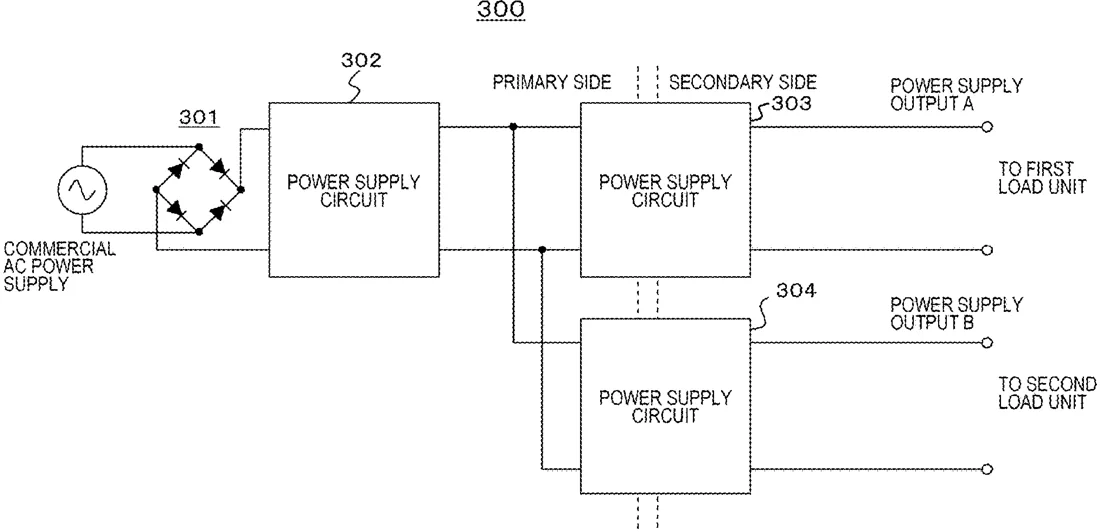
Sony describes a power supply system for electrical equipment that uses two different conversion paths to deliver electricity. When the device is using little power, it switches to a secondary path designed to reduce energy loss, improving overall efficiency.
In the filing’s own words
To improve efficiency of a power supply device by suppressing a power loss when load power decreases. There are provided: a first power conversion unit being of an insulation type and configured to be input with a DC input voltage to obtain a first power supply output of a DC voltage having a first value; a second power conversion unit being of an insulation type and configured to be input with the DC input voltage to obtain a second power supply output of a DC voltage having a second value different from the first value; and a third power conversion unit being of a non-insulation type and configured to be input with the DC voltage obtained by the second power conversion unit and having the second value to obtain a third power supply output of a DC voltage having the first value. In a second mode (light load mode) in which load power of a first load unit is equal to or less than a threshold, the third power supply output is output from a switching unit and supplied to the first load unit, and it becomes possible to improve efficiency of a power supply device by suppressing a power loss when load power decreases.
What exactly they claim (claim 1)
1. An electrical equipment device comprising: a first load unit; a second load unit; and a power supply device, wherein the power supply device includes: an input voltage generation unit configured be input with a commercial alternating current (AC) power supply to generate a direct current (DC) input voltage; a first power conversion unit being of an insulation type and configured to be input with the DC input voltage to obtain a first power supply output of a DC voltage having a first value; a second power conversion unit being of an insulation type and configured to be input with the DC input voltage to obtain a second power supply output of a DC voltage having a second value different from the first value; a third power conversion unit being of a non-insulation type and configured to be input with the DC voltage having the second value to obtain a third power supply output of a DC voltage having the first value; a switching unit configured to selectively output the first power supply output or the third power supply output; a power supply output supply unit configured to supply a power supply output that is output from the switching unit to the first load unit, and supply the second power supply output to the second load unit; and a control unit configured to cause the switching unit to output the first power supply output in a first mode in which load power of the first load unit is larger than a threshold, and cause the switching unit to output the third power supply output in a second mode in which load power of the first load unit is equal to or less than the threshold.
Facts
- Company
- Sony (SONY GROUP CORPORATION)
- Official title
- ELECTRICAL EQUIPMENT DEVICE, DISPLAY DEVICE, AND POWER SUPPLY DEVICE
- Publication number
- US20260332053A1
- Application number
- 19114078
- Filed
- Sep 20, 2023
- Published
- Oct 22, 2026
- Inventors
- 3
- Claims
- 20
Classified under
H02M 3/28 Electricity & electronicsH02M 1/4208 Electricity & electronicsMore from Sony in Chips & hardware
- Sony patents light sensor that adjusts how it counts incoming photons Sep 1, 2026
- Sony patents camera sensor with two pixel types for better motion detection Sep 1, 2026
- Sony patents game graphics that adjust quality based on hardware heat Sep 8, 2026
- Sony patents camera sensor design that stacks chips to shrink pixels Sep 8, 2026
- Sony patents chip design that measures internal temperature from outside Sep 8, 2026
Summaries are simplified from the filing’s own abstract and first claim. A patent filing is not a product announcement.
Patent data and drawings: U.S. Patent and Trademark Office (USPTO). Nebula is not affiliated with or endorsed by the USPTO.