Google patents radar system that learns from your ambiguous gestures
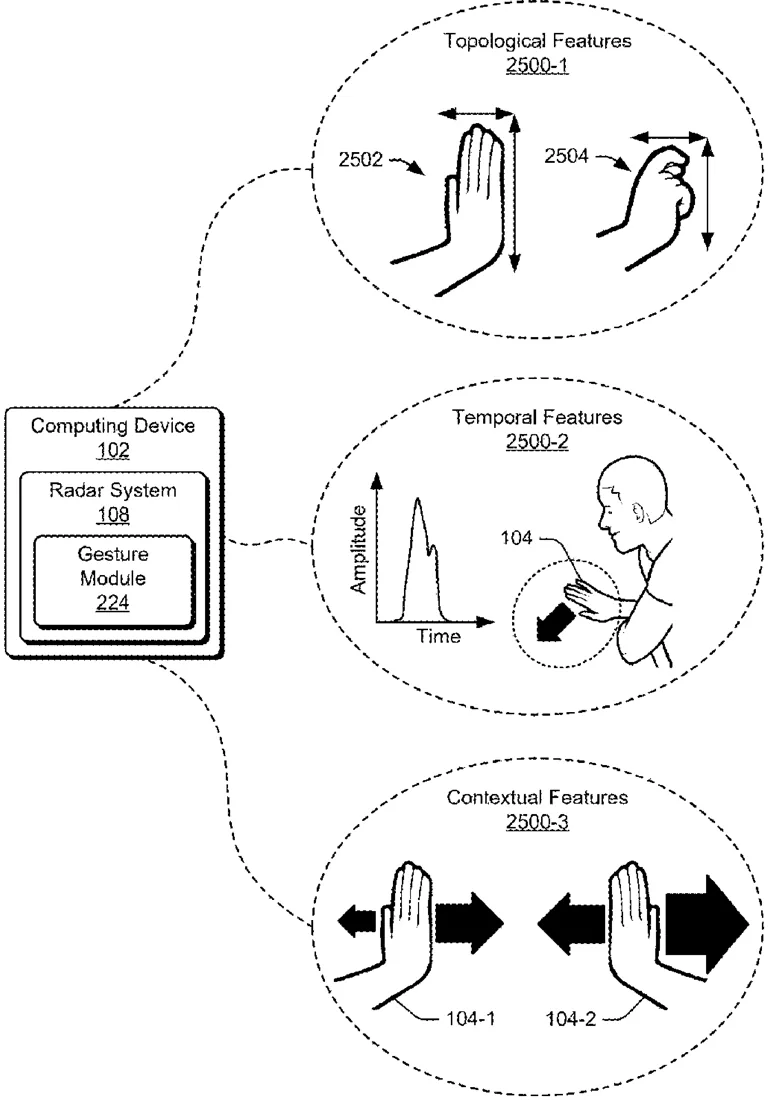
This filing describes a method where a device uses radar to detect hand movements that are too unclear to match existing commands. If the user then performs the intended action manually, the system saves the specific radar pattern of that unclear movement to recognize it correctly next time.
In the filing’s own words
This document describes techniques and devices for in-line learning based on user inputs. Through in-line learning, a computing device may store characteristics of ambiguous gestures based on subsequent commands from a user. For example, the ambiguous gesture may be associated to one or more known gestures, but the ambiguous gesture cannot be recognized as one of the known gestures with sufficient confidence for gesture recognition. When the computing device fails to recognize the ambiguous gesture, the user may perform or request the performance of a command. This command may be determined to be a first command associated with a first gesture of the known gestures with which the ambiguous gesture was associated. As such, the computing device may store a characteristic of the ambiguous gesture with the first gesture to improve recognition of the first gesture in the future.
What exactly they claim (claim 1)
1. A method comprising: detecting, at a computing device and using a radar system, an ambiguous gesture performed by a user, the ambiguous gesture associated with a radar-signal characteristic; comparing the radar-signal characteristic to one or more stored radar-signal characteristics, the comparing effective to associate the ambiguous gesture to one or more known gestures, the one or more known gestures each having a corresponding command, the association to the one or more known gestures below recognition threshold criteria sufficient to recognize the ambiguous gesture as one of the one or more known gestures; receiving, after detecting the ambiguous gesture, an indication of performance or requested performance of a command; determining that the indicated command is a first command of the corresponding commands associated with a first known gesture of the one or more known gestures with which the comparing was effective to associate the ambiguous gesture; and storing the radar-signal characteristic with the first known gesture to enable recognition of the first gesture at a future time.
Facts
- Company
- Google (Google LLC)
- Official title
- In-line Learning Based on User Inputs
- Publication number
- US20260329385A1
- Application number
- 19113102
- Filed
- Sep 30, 2022
- Published
- Oct 22, 2026
- Inventors
- 6
- Claims
- 21
Classified under
G06F 3/017 Physics & computingG01S 13/58 Physics & computingG01S 13/88 Physics & computingG09B 5/065 Physics & computingG06F 3/167 Physics & computingMore from Google in AI & software
- Google patents video search that answers questions using AI descriptions Sep 15, 2026
- Google patents photo tool that removes people and their gear Sep 15, 2026
- Google patents AI that writes live meeting notes and summaries Sep 15, 2026
- Google patents AI tool that turns messy emergency notes into clear messages Sep 3, 2026
- Google patents AI that clicks through apps to finish tasks for you Sep 24, 2026
Summaries are simplified from the filing’s own abstract and first claim. A patent filing is not a product announcement.
Patent data and drawings: U.S. Patent and Trademark Office (USPTO). Nebula is not affiliated with or endorsed by the USPTO.