Google patents watch feature that wakes up only when you tap it
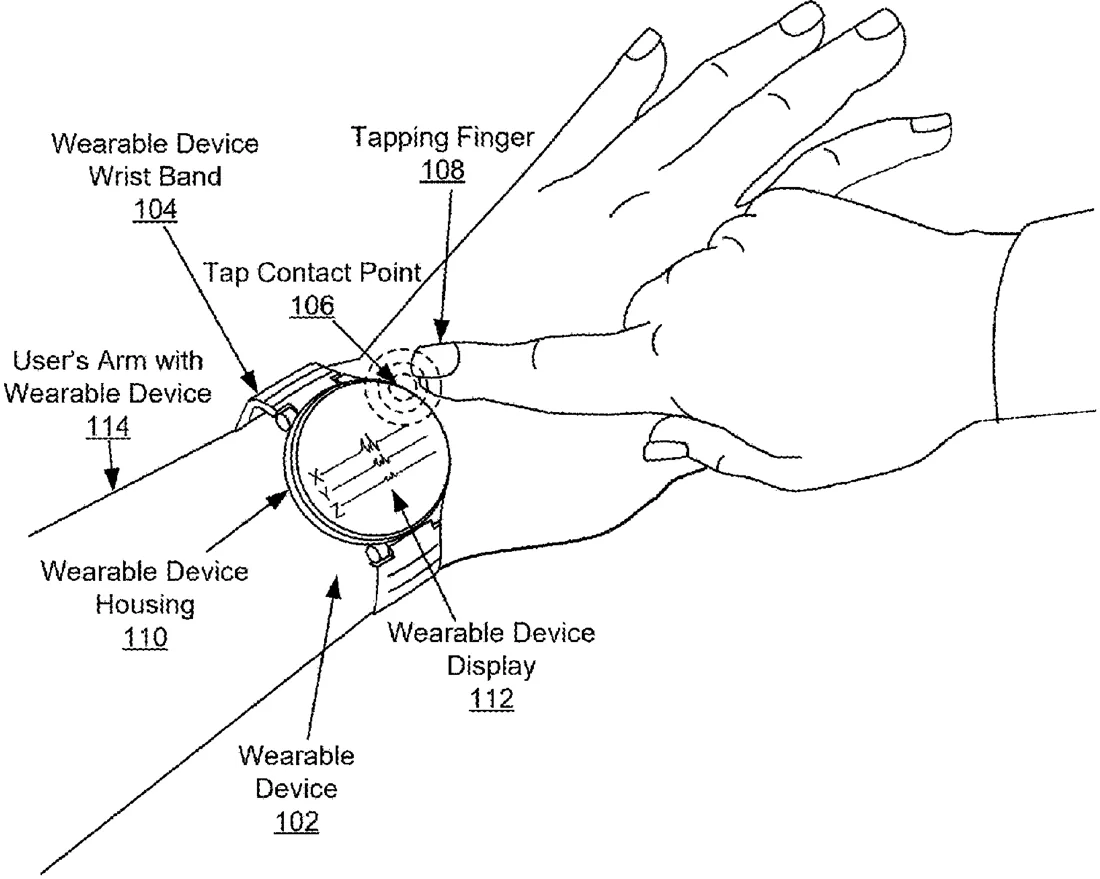
This filing describes a method for wearable devices to save battery by keeping the main processor in a low-power mode most of the time. The device uses a motion sensor to check for stability and only wakes up the full processor if it detects a physical impact, such as a tap. Once awake, the processor confirms the tap was intentional and performs the selected action.
In the filing’s own words
Processing physical input while managing power consumption is a consideration for wearable devices. At least one processor operating in a first power state receives a sensor data stream from a motion sensor and determines whether a first portion of the data stream satisfies a stability condition. Responsive to determining that the first portion satisfies the stability condition, the at least one processor detects a physical impact on the wearable device based on a second portion of the data stream. Detecting the physical impact triggers a transition of the at least one processor to a second power state that consumes more power than the first power state. While operating in the second power state, the at least one processor classifies the physical impact as an intentional tap input and executes an action mapped to the intentional tap input, facilitating input detection while managing system power.
What exactly they claim (claim 1)
1. A method comprising: receiving, by at least one processor of a wearable device operating in a first power state, a sensor data stream from a motion sensor; determining, by the at least one processor operating in the first power state, that a first portion of the sensor data stream satisfies a stability condition; responsive to determining that the first portion satisfies the stability condition, detecting, by the at least one processor operating in the first power state, a physical impact on the wearable device based on a second portion of the sensor data stream; responsive to detecting the physical impact, transitioning the at least one processor to a second power state that consumes more power than the first power state; classifying, by the at least one processor operating in the second power state, the physical impact as an intentional tap input; and executing an action mapped to the intentional tap input.
Facts
- Company
- Google (Google LLC)
- Official title
- Power-Managed Physical Impact Detection for Wearable Devices
- Publication number
- US20260329235A1
- Application number
- 19694133
- Filed
- Jun 1, 2026
- Published
- Oct 22, 2026
- Inventors
- 1
- Claims
- 10
Classified under
G04G 19/00 Physics & computingG04G 21/08 Physics & computingG06F 3/0346 Physics & computingMore from Google in Wearables
- Google patents earbuds that verify identity using ultrasound in the ear canal Oct 6, 2026
- Google patents wristband that reads hand gestures from blood flow Oct 13, 2026
- Google patents earbuds that detect jaw movement to switch modes Sep 8, 2026
- Google patents smartwatch guide for pointing your arm at satellites Sep 10, 2026
- Google patents smartwatch feature that warns you if you're too groggy to walk safely Oct 1, 2026
Summaries are simplified from the filing’s own abstract and first claim. A patent filing is not a product announcement.
Patent data and drawings: U.S. Patent and Trademark Office (USPTO). Nebula is not affiliated with or endorsed by the USPTO.