Google patents earbuds that verify identity using ultrasound in the ear canal
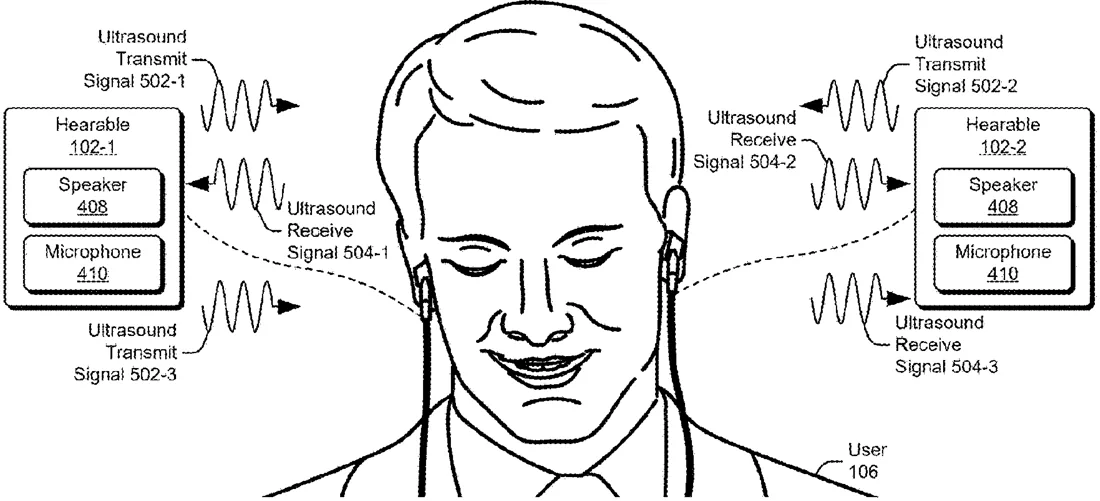
This patent describes how hearing devices can send ultrasound waves into the ear canal to detect how sound travels through the body when a person speaks. The device creates a unique signature from these waves to verify the user's identity, potentially combining this with standard voice recognition for better security.
In the filing’s own words
Techniques and apparatuses are described that perform authentication using active acoustic sensing. During active acoustic sensing, a hearable transmits and receives at least one ultrasound signal, which propagates within a person's ear canal. The ultrasound signal contains information that is related to the vocalization as well as additional contextual information in how the person created the vocalization using their body and how the vocalization travels, via bone conduction, from the person's vocal chords to their ear canal. With active acoustic sensing, the hearable can generate an ultrasound-based voice signature based on the ultrasound signal and directly perform authentication based on the ultrasound-based voice signature. In some cases, authentication can be performed using a combination of the ultrasound-based voice signature and a voice signature. With active acoustic sensing, the hearable can realize a target spoof acceptance rate and a target false acceptance rate to provide a desired level of security.
What exactly they claim (claim 1)
1. A method comprising: transmitting, during a first time period, an ultrasound transmit signal that propagates within at least a portion of an ear canal of a person; receiving, during the first time period, an ultrasound receive signal, the ultrasound receive signal representing a version of the ultrasound transmit signal with one or more characteristics modified based on the propagation within the ear canal and based on the person speaking during at least a portion of the first time period; generating an ultrasound-based voice signature based on the ultrasound receive signal, the ultrasound-based voice signature comprising a voice component and a physiological component; and authenticating the person based on the ultrasound-based voice signature.
Facts
- Company
- Google (Google LLC)
- Official title
- Authentication using active acoustic sensing
- Patent number
- US12754987B2
- Application number
- 19094114
- Filed
- Mar 28, 2025
- Granted
- Oct 6, 2026
- Inventors
- 3
- Claims
- 20
Classified under
G06F 21/32 Physics & computingG06F 3/167 Physics & computingG10L 17/04 Physics & computingG10L 17/18 Physics & computingG10L 25/30 Physics & computingH04R 1/1016 Electricity & electronicsMore from Google in Wearables
- Google patents wristband that reads hand gestures from blood flow Oct 13, 2026
- Google patents earbuds that detect jaw movement to switch modes Sep 8, 2026
- Google patents smartwatch guide for pointing your arm at satellites Sep 10, 2026
- Google patents smartwatch feature that warns you if you're too groggy to walk safely Oct 1, 2026
- Google patents glasses that flash lights in your eye for alerts Oct 8, 2026
Summaries are simplified from the filing’s own abstract and first claim. A patent filing is not a product announcement.
Patent data and drawings: U.S. Patent and Trademark Office (USPTO). Nebula is not affiliated with or endorsed by the USPTO.