Google patents method to size AI models for specific hardware limits
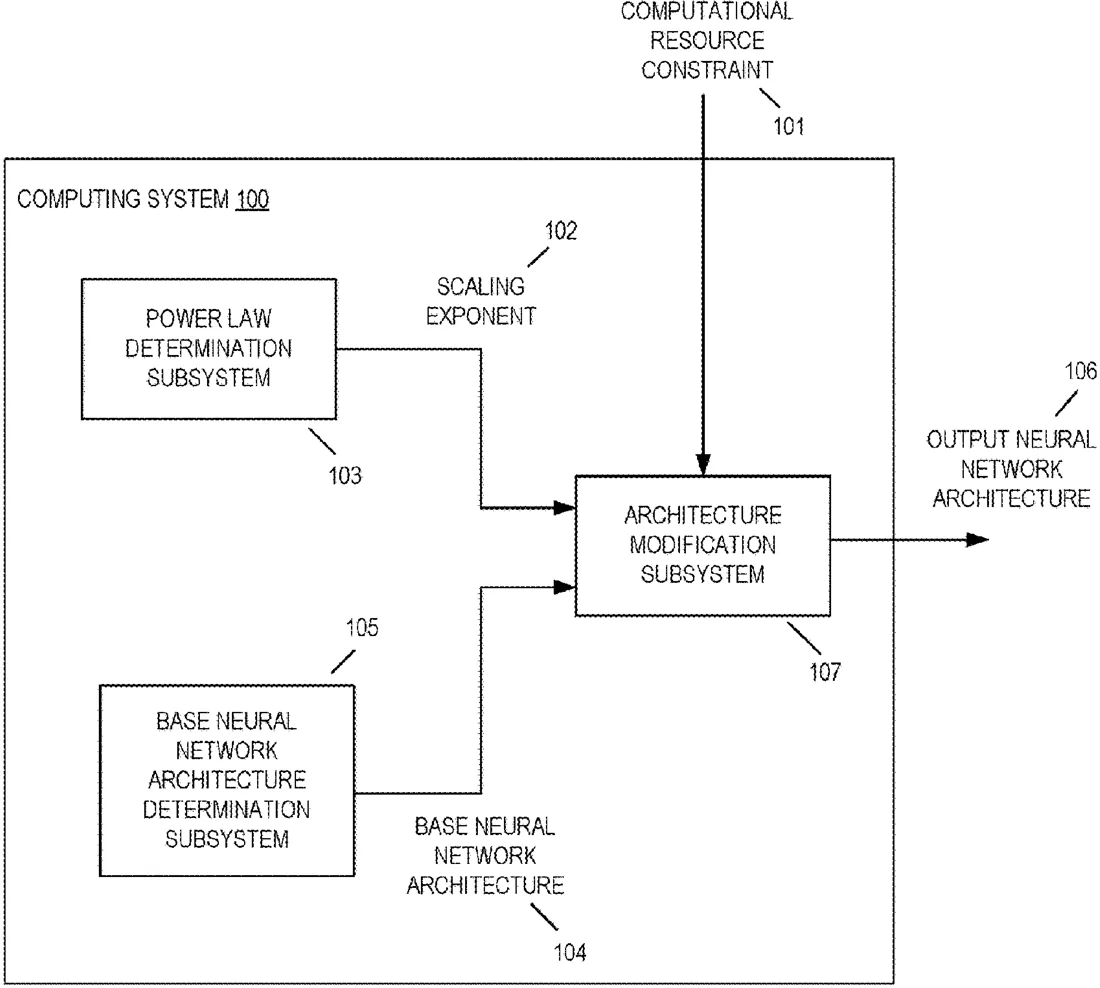
This filing describes a computer method for designing neural networks that fit within specific computational limits. It works by testing how different model sizes affect performance to find the best balance between accuracy and resource usage.
In the filing’s own words
There is disclosed a computer-implemented method for determining a neural network architecture according to a given computational resource constraint. The method comprises, for each of one or more neural network architecture dimensions that are to be adjusted: determining a power law function for the architecture dimension based upon a first plurality of neural network performance evaluations on a machine learning task using a plurality of differently scaled neural networks, the plurality of differently scaled neural networks having the same neural network architecture except for a different value in the architecture dimension; wherein the power law function is a function of a performance metric on the machine learning task with respect to the architecture dimension and computational resource utilization; and determining a scaling exponent for the architecture dimension based upon the determined power law function.
What exactly they claim (claim 1)
1. A computer-implemented method for determining a neural network architecture according to a given computational resource constraint, the method comprising: for each of one or more neural network architecture dimensions that are to be adjusted: determining a power law function for the architecture dimension based upon a first plurality of neural network performance evaluations on a machine learning task using a plurality of differently scaled neural networks, the plurality of differently scaled neural networks having the same neural network architecture except for a different value in the architecture dimension; wherein the power law function is a function of a performance metric on the machine learning task with respect to the architecture dimension and computational resource utilization; and determining a scaling exponent for the architecture dimension based upon the determined power law function; determining a base neural network architecture based upon a second plurality of neural network performance evaluations on the machine learning task using a plurality of candidate neural networks, the plurality of candidate neural networks having been trained according to a smaller computational resource constraint than the plurality of differently scaled neural networks; wherein the plurality of candidate neural networks have different architectures; and modifying the one or more architecture dimensions of the base neural network architecture based upon the corresponding scaling exponents, a computational resource utilization of the base neural network architecture and the given computational resource constraint to provide an output neural network architecture.
Facts
- Company
- Google (Google LLC)
- Official title
- Scaling Neural Network Architectures to Computational Resource Constraints
- Publication number
- US20260320392A1
- Application number
- 19485257
- Filed
- Aug 8, 2023
- Published
- Oct 15, 2026
- Inventors
- 4
- Claims
- 26
Classified under
G06N 3/082 Physics & computingG06N 3/045 Physics & computingMore from Google in AI & software
- Google patents video search that answers questions using AI descriptions Sep 15, 2026
- Google patents photo tool that removes people and their gear Sep 15, 2026
- Google patents AI that writes live meeting notes and summaries Sep 15, 2026
- Google patents AI tool that turns messy emergency notes into clear messages Sep 3, 2026
- Google patents AI that clicks through apps to finish tasks for you Sep 24, 2026
Summaries are simplified from the filing’s own abstract and first claim. A patent filing is not a product announcement.
Patent data and drawings: U.S. Patent and Trademark Office (USPTO). Nebula is not affiliated with or endorsed by the USPTO.