Google patents method to improve AI text translation accuracy
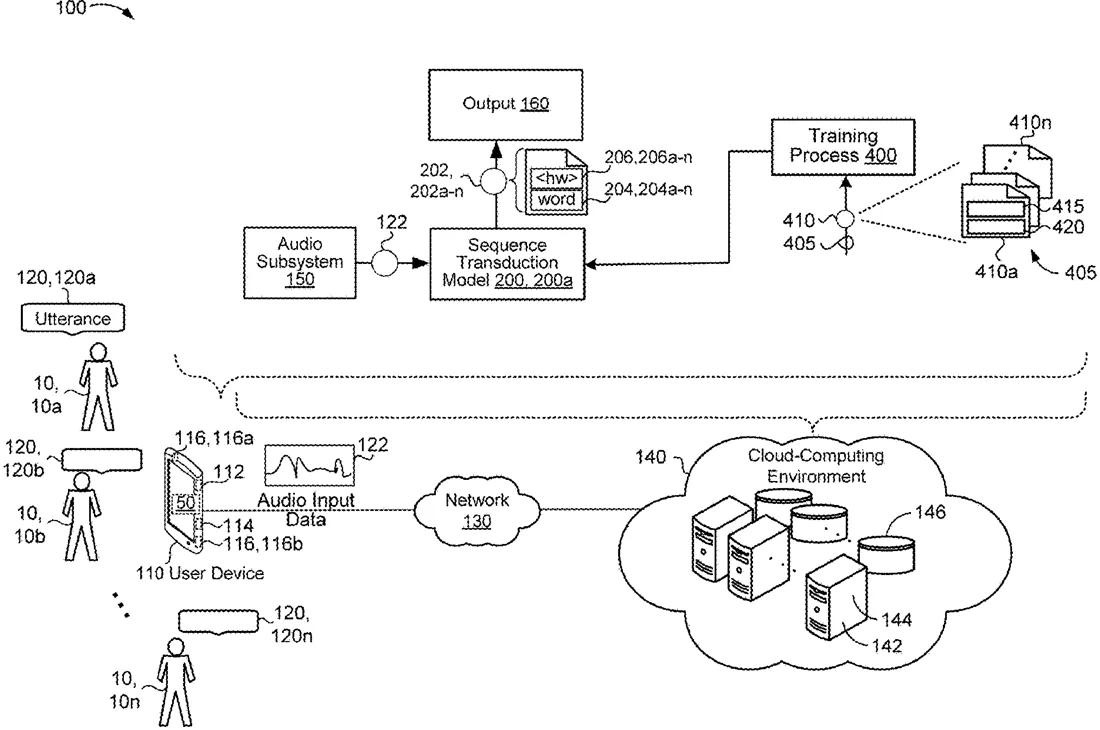
Google has filed a patent for a technique to train sequence transduction models, which are systems that convert one sequence of data into another, such as translating text or speech. The method calculates a specific error rate by counting how many 'special' tokens the model incorrectly adds or misses during training, allowing the system to adjust its learning to reduce these specific mistakes.
In the filing’s own words
A method ( 500) includes, for each training sample ( 410) of a plurality of training samples: processing, using a sequence transduction model ( 200), corresponding training input features ( 415) to obtain one or more output token sequence hypotheses ( 432) each including one or more predicted common tokens ( 204); and determining a token-level loss ( 462) based on, for each hypothesis: a number of special token insertions each associated with a corresponding predicted special token that appears in the hypothesis but does not appear in a corresponding sequence of ground-truth output tokens; and a number of special token deletions each associated with a corresponding ground-truth special token in the set of ground-truth special tokens that does not appear in hypothesis. The method also includes training the sequence transduction model to minimize additive error rate based on the token-level losses determined for the plurality of training samples.
What exactly they claim (claim 1)
1. A computer-implemented method when executed on data processing hardware causes the data processing hardware to perform operations comprising: receiving a plurality of training samples each comprising a corresponding sequence of training input features paired with a corresponding sequence of ground-truth output tokens, the sequence of ground-truth output tokens comprising a set of ground-truth common tokens and a set of ground-truth special tokens; for each training sample in the plurality of training samples: processing, using a sequence transduction model, the corresponding sequence of training input features to obtain one or more output token sequence hypotheses, each output token sequence hypothesis comprising one or more predicted common tokens; and determining a per sample token-level loss based on, for each corresponding output token sequence hypothesis obtained for the training sample: a number of special token insertions each associated with a corresponding predicted special token that appears in the corresponding output token sequence hypothesis but does not appear in the corresponding sequence of ground-truth output tokens; and a number of special token deletions each associated with a corresponding ground-truth special token in the set of ground-truth special tokens that does not appear in corresponding output token sequence hypothesis; and training the sequence transduction model to minimize additive error rate based on the per sample token-level losses determined for the plurality of training samples.
Facts
- Company
- Google (Google LLC)
- Official title
- AUGMENTING TRAINING OF SEQUENCE TRANSDUCTION MODELS USING TOKEN-LEVEL LOSSES
- Publication number
- US20260320312A1
- Application number
- 19117206
- Filed
- Nov 11, 2022
- Published
- Oct 15, 2026
- Inventors
- 6
- Claims
- 22
Classified under
G06F 40/58 Physics & computingG06N 3/044 Physics & computingG10L 15/063 Physics & computingMore from Google in AI & software
- Google patents video search that answers questions using AI descriptions Sep 15, 2026
- Google patents photo tool that removes people and their gear Sep 15, 2026
- Google patents AI that writes live meeting notes and summaries Sep 15, 2026
- Google patents AI tool that turns messy emergency notes into clear messages Sep 3, 2026
- Google patents AI that clicks through apps to finish tasks for you Sep 24, 2026
Summaries are simplified from the filing’s own abstract and first claim. A patent filing is not a product announcement.
Patent data and drawings: U.S. Patent and Trademark Office (USPTO). Nebula is not affiliated with or endorsed by the USPTO.