Google patents method to speed up complex data forecasting
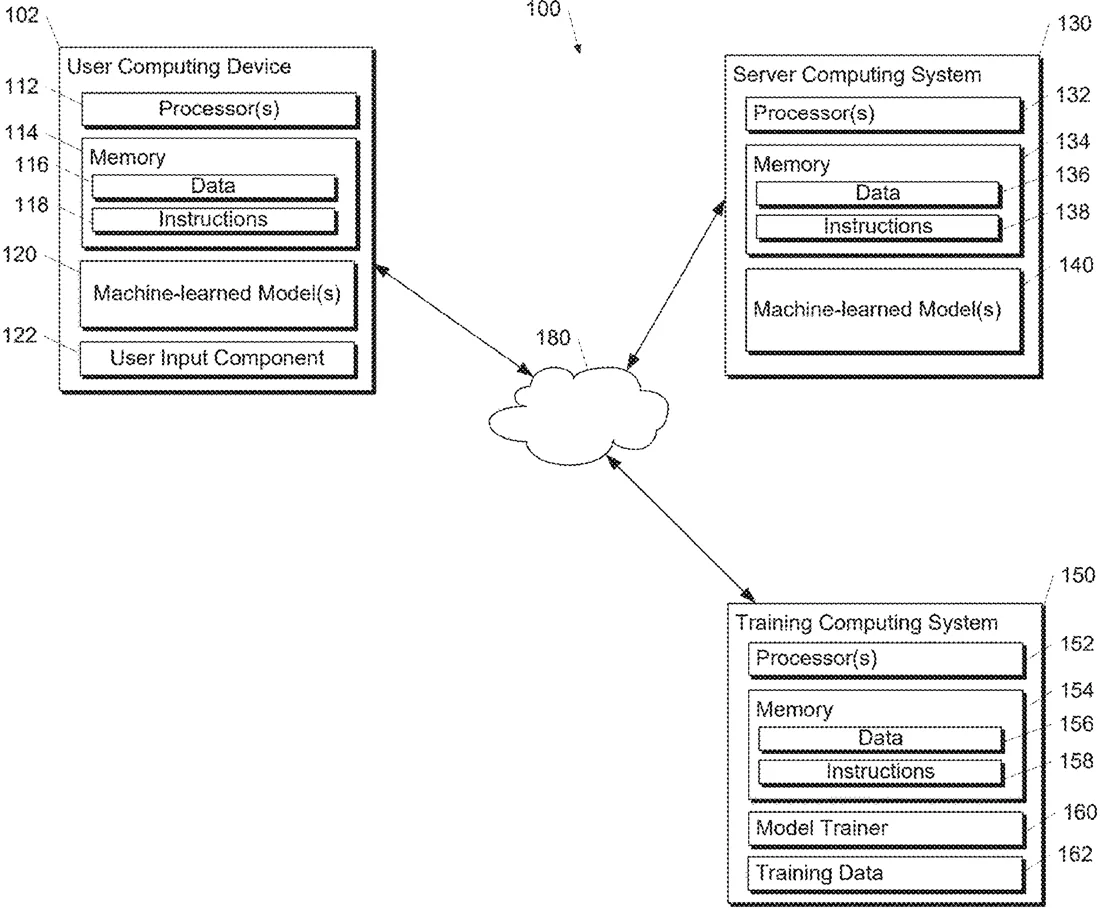
This filing describes a way to predict future trends in data that involves multiple connected factors, such as weather and sales. It breaks the problem into smaller, independent parts that can be calculated at the same time to make the process faster.
In the filing’s own words
Systems and methods described herein can provide for parallelized multivariate time series forecasting. The systems and methods described herein can provide for obtaining an input dataset including a plurality of univariate time series for a plurality of endogenous variables. Fitted regression models may be identified for each univariate time series by parallelized independent regression. A plurality of residual series may be determined, and one or more exogenous feature values may be extracted based on the fitted regression models. The systems and methods described herein can provide for forecasting a plurality of residual series using fitted forecasting models. Model parameters, forecasted residual series, and exogenous feature values may be stored in a multivariate model table for each endogenous variable. Forecasted time series data can then be generated using this table. The parallelized independent regression on each univariate time series may comprise determining regression matrices respective to a time series identifier. The systems and methods described herein can provide for generating forecasted time series data for each of the endogenous variables.
What exactly they claim (claim 1)
1. A computing system for parallelized multivariate time series forecasting, comprising: one or more processors; one or more non-transitory storage media coupled to the one or more processors, the one or more non-transitory storage media storing instructions that, when executed by the one or more processors, cause the one or more processors to perform operations, the operations including: obtaining an input dataset comprising a plurality of univariate time series respective to a plurality of endogenous variables; identifying a plurality of fitted regression models respective to the plurality of univariate time series by parallelized independent regression on each univariate time series of the plurality of univariate time series; determining a plurality of residual series respective to the plurality of univariate time series and extracting one or more exogenous feature values from the plurality of univariate time series based on the plurality of fitted regression models; forecasting a plurality of forecasted residual series respective to each of the plurality of residual series by a respective fitted residual forecasting model of a plurality of fitted forecasting model; storing in a multivariate model table, respective to each endogenous variable: parameters of the respective fitted residual forecasting model; a respective forecasted residual series of the plurality of forecasted residual series; and the one or more exogenous feature values; and generating, using the multivariate model table, forecasted time series data for each of the endogenous variables.
Facts
- Company
- Google (Google LLC)
- Official title
- Systems and Methods for Parallelized Multivariate Time Series Forecasting
- Publication number
- US20260320153A1
- Application number
- 19176986
- Filed
- Apr 11, 2025
- Published
- Oct 15, 2026
- Inventors
- 3
- Claims
- 20
Classified under
G06F 17/18 Physics & computingMore from Google in AI & software
- Google patents video search that answers questions using AI descriptions Sep 15, 2026
- Google patents photo tool that removes people and their gear Sep 15, 2026
- Google patents AI that writes live meeting notes and summaries Sep 15, 2026
- Google patents AI tool that turns messy emergency notes into clear messages Sep 3, 2026
- Google patents AI that clicks through apps to finish tasks for you Sep 24, 2026
Summaries are simplified from the filing’s own abstract and first claim. A patent filing is not a product announcement.
Patent data and drawings: U.S. Patent and Trademark Office (USPTO). Nebula is not affiliated with or endorsed by the USPTO.