Google patents image search that learns from your clicks
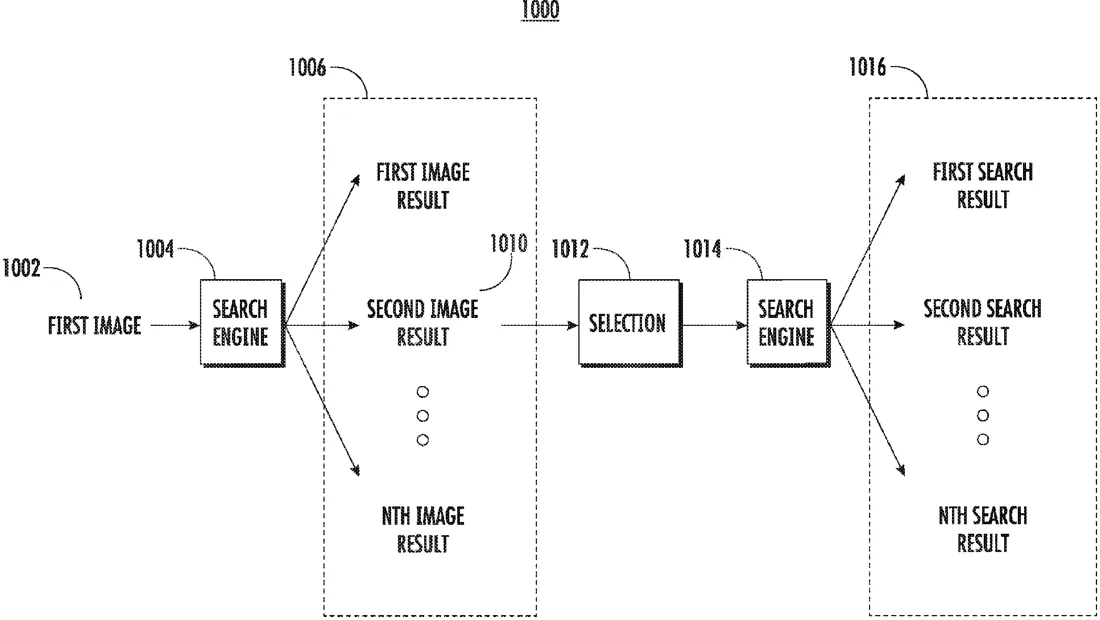
Google describes a system that improves image search by analyzing how users interact with results. It uses a mathematical model to predict what a user might want next based on the difference between their original search and the specific image they clicked on.
In the filing’s own words
Systems and methods for multi-image search can include obtaining two or more images and determining one or more search results that are based on the two or more images. The one or more search results can be determined based on determined shared attributes of the two or more images. The one or more search results may be based on feature embeddings associated with the two or more images. The two or more images may be obtained based on one or more user interactions with one or more databases.
What exactly they claim (claim 1)
1. A computing system, the system comprising: one or more processors; and one or more non-transitory computer-readable media that collectively store instructions that, when executed by the one or more processors, cause the computing system to perform operations, the operations comprising: obtaining a first image query, wherein the first image query comprises first image data; determining a first set of search results based on the first image data, wherein the first set of search results comprises a plurality of first image search results; providing the first set of search results for display in a search results interface; obtaining a selection of a particular first image search result of the plurality of first image search results, wherein the particular first image search result is associated with second image data, wherein the first image data and the second image data differ; processing the first image data with an embedding model to generate a first embedding, wherein the first embedding is associated with an embedding space; processing the second image data with the embedding model to generate a second embedding, wherein the second embedding is associated with the embedding space; determining a third embedding based on a projection prediction associated with an embedding change from the first embedding to the second embedding; determining a second set of search results based on the third embedding; and providing the second set of search results for display in the search results interface.
Facts
- Company
- Google (Google LLC)
- Official title
- Multi-Image Search
- Publication number
- US20260320109A1
- Application number
- 19718264
- Filed
- Jun 24, 2026
- Published
- Oct 15, 2026
- Inventors
- 5
- Claims
- 20
Classified under
G06F 16/532 Physics & computingG06F 16/538 Physics & computingG06F 16/55 Physics & computingG06F 16/5846 Physics & computingG06V 10/235 Physics & computingG06V 10/267 Physics & computingMore from Google in AI & software
- Google patents video search that answers questions using AI descriptions Sep 15, 2026
- Google patents photo tool that removes people and their gear Sep 15, 2026
- Google patents AI that writes live meeting notes and summaries Sep 15, 2026
- Google patents AI tool that turns messy emergency notes into clear messages Sep 3, 2026
- Google patents AI that clicks through apps to finish tasks for you Sep 24, 2026
Summaries are simplified from the filing’s own abstract and first claim. A patent filing is not a product announcement.
Patent data and drawings: U.S. Patent and Trademark Office (USPTO). Nebula is not affiliated with or endorsed by the USPTO.