OpenAI patents setting that lets users choose how much effort AI spends on answers
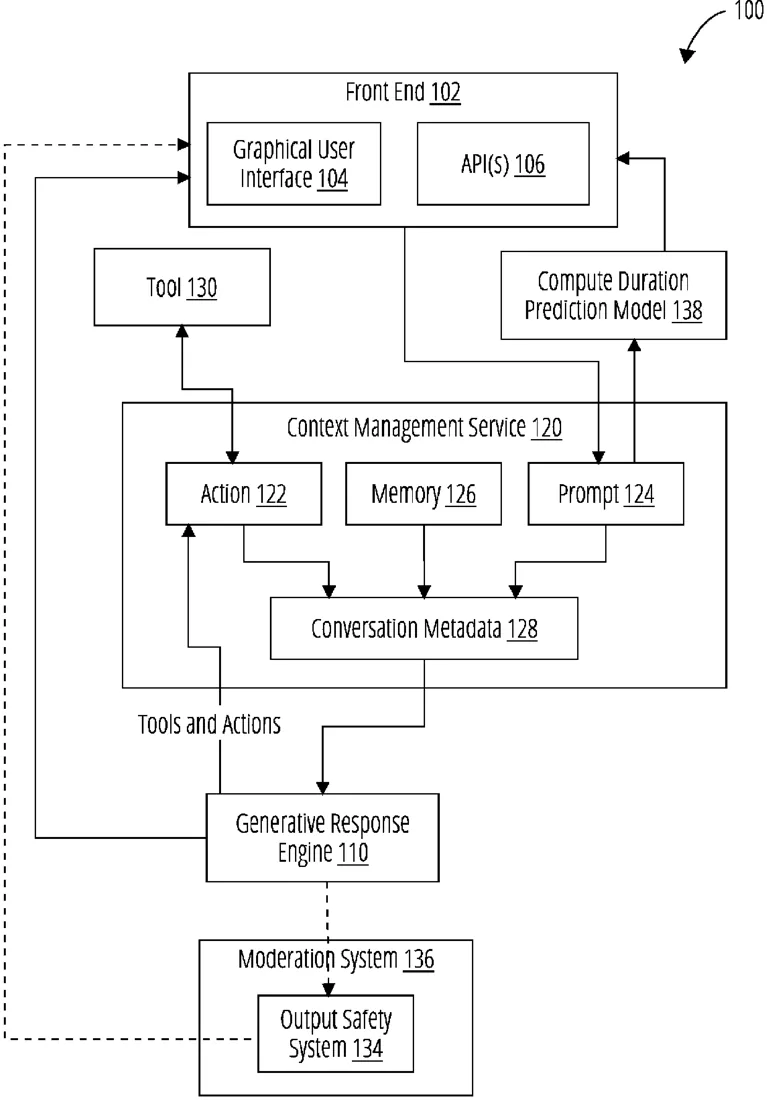
OpenAI has filed a patent for a feature that lets users choose how much computing power an AI uses to answer a question. The system offers options like 'default,' 'more effort,' or 'less effort,' which changes how many words or steps the AI takes to generate a response. It also estimates how long the answer will take to produce based on the user's choice.
In the filing’s own words
Systems and methods for adaptive compute allocation in generative response engines, providing a flexible and user-centric experience. A compute allocation interface allowing users to select from various settings, including default, greater, or lesser allocations, is presented. Responses based on the selected setting and estimates processing durations using a predictive model are generated. Users can adjust allocations and receive updated duration estimates. Conversation thread context and adjusts allocations for subsequent prompts may be maintained, enabling refined and efficient generation of responses.
What exactly they claim (claim 1)
1. A computer-implemented method comprising: presenting, by a front end to a generative response engine, a prompt composer interface with an indicator for a compute allocation user interface that previews two or more selectable compute allocation settings that affect a generation of a response by the generative response engine; upon selecting of the indicator, presenting the compute allocation user interface in the prompt composer interface wherein the compute allocation user interface includes a selector object that is configured to be manipulated by a pointer device to indicate a compute allocation setting selected from the two or more selectable compute allocation settings that include a default compute allocation setting, at least one greater compute allocation setting, or at least one lesser compute allocation setting; receiving, from a user account and by the front end to the generative response engine, a prompt and a selection of the compute allocation setting in the compute allocation user interface, wherein the compute allocation setting controls a relative amount of tokens that the generative response engine can generate when generating the response to the prompt; receiving, by the generative response engine, the prompt and the compute allocation setting associated with the selection of the compute allocation setting; and generating, by the generative response engine, the response to the prompt based on the compute allocation setting indicated by the selection of the compute allocation setting in the compute allocation user interface, wherein the at least one greater compute allocation setting causes the generative response engine to use more tokens than the default compute allocation setting when generating the response to the prompt and the at least one lesser compute allocation setting causes the generative response engine to use less tokens than the default compute allocation setting when generating the response to the prompt.
Facts
- Company
- OpenAI (OpenAI OpCo, LLC.)
- Official title
- ADAPTIVE COMPUTE ALLOCATION DISPLAY FOR GENERATIVE RESPONSE
- Publication number
- US20260319862A1
- Application number
- 19194991
- Filed
- Apr 30, 2025
- Published
- Oct 15, 2026
- Inventors
- 5
- Claims
- 24
Classified under
G06F 9/5083 Physics & computingG06F 9/451 Physics & computingG06F 2209/503 Physics & computingMore from OpenAI in AI & software
- OpenAI patents voice system that detects when you stop talking Sep 22, 2026
- OpenAI patents system to catch AI models cheating on tasks Sep 10, 2026
- OpenAI patents method to check AI thinking for cheating Sep 10, 2026
- OpenAI patents system that turns photos into new AI-generated images Sep 10, 2026
- OpenAI patents AI that answers questions using only your company's secure files Sep 17, 2026
Summaries are simplified from the filing’s own abstract and first claim. A patent filing is not a product announcement.
Patent data and drawings: U.S. Patent and Trademark Office (USPTO). Nebula is not affiliated with or endorsed by the USPTO.