Google patents method for scaling and adding noise to ad attribution reports
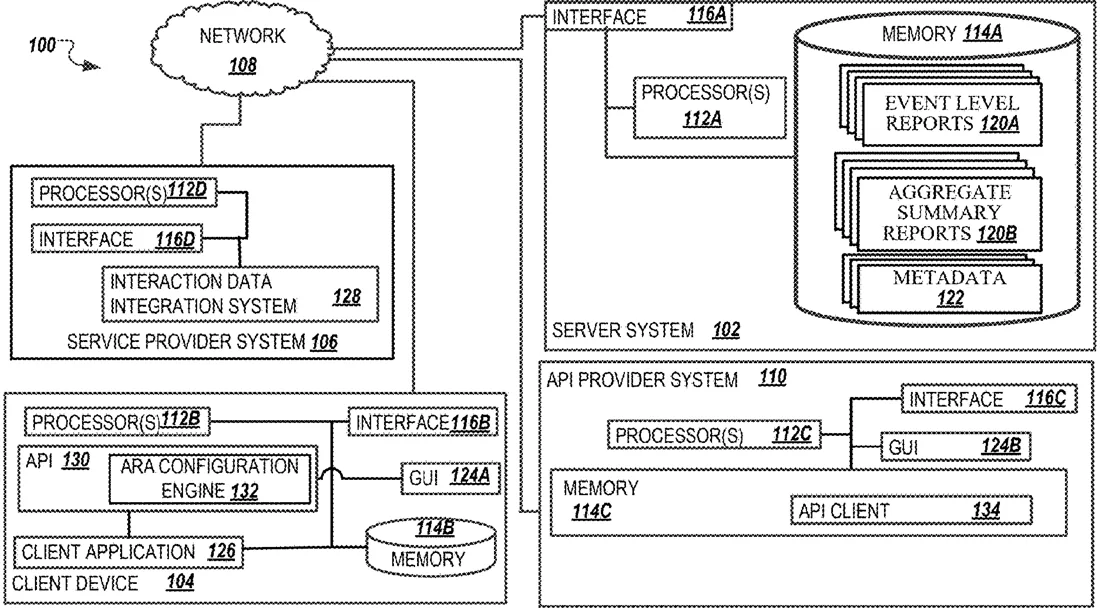
Google describes a system for processing data on how users interact with ads. It converts these interactions into a limited count, adds random noise to protect privacy, and rescales the results into summary reports.
In the filing’s own words
The disclosure generally describes methods, software, and systems for interaction data collection. A sensitivity level of an application programming interface for collecting interaction data is received. A maximum number of affirmative actions to be applied to the interaction data is received. The interaction data is converted to an affirmative action count. A scaling contribution is assigned to the affirmative action count to generate scaled data within particular units. The scaled data is aggregated by splitting the scaled data across multiple levels of an aggregate hierarchy of a targeted aggregate structure, to generate aggregated data. Noise is added to the aggregated data to generate noisy aggregated data. The noisy aggregated data is rescaled, using a scaling factor to generate rescaled data as aggregate summary reports, the aggregate summary reports being within a unit range set by the scaling factor. The rescaled data is transmitted to determine use cases.
What exactly they claim (claim 1)
1. A computer-implemented method comprising: receiving, by one or more processors from a configuration of an attribution reporting application programming interface (ARA), a sensitivity level of an application programming interface for collecting interaction data, the sensitivity level defining parameters of an interaction level monitored for collection of the interaction data; receiving, by the one or more processors from the configuration of the ARA, a maximum number of affirmative actions to be applied to the interaction data collected within the sensitivity level, the maximum number of affirmative actions defining a truncation applied to the affirmative actions; converting, by the one or more processors, the interaction data using the maximum number of affirmative actions to generate an affirmative action count; assigning, by the one or more processors, a scaling contribution to the affirmative action count to generate scaled data within particular units; aggregating, by the one or more processors, the scaled data by splitting the scaled data across a plurality of levels of an aggregate hierarchy of a targeted aggregate structure, to generate aggregated data; adding, by the one or more processors, noise to the aggregated data to generate noisy aggregated data; rescaling, by the one or more processors, the noisy aggregated data, using a scaling factor to generate rescaled data as aggregate summary reports, the aggregate summary reports being within a unit range set by the scaling factor; and transmitting, by the one or more processors, the rescaled data to determine use cases.
Facts
- Company
- Google (Google LLC)
- Official title
- OPTIMIZING CONFIGURATION OF THE ATTRIBUTION REPORTING APPLICATION PROGRAMMING INTERFACE
- Publication number
- US20260319810A1
- Application number
- 18861512
- Filed
- Jul 23, 2024
- Published
- Oct 15, 2026
- Inventors
- 11
- Claims
- 20
Classified under
G06F 9/44505 Physics & computingG06F 11/3072 Physics & computingMore from Google in AI & software
- Google patents video search that answers questions using AI descriptions Sep 15, 2026
- Google patents photo tool that removes people and their gear Sep 15, 2026
- Google patents AI that writes live meeting notes and summaries Sep 15, 2026
- Google patents AI tool that turns messy emergency notes into clear messages Sep 3, 2026
- Google patents AI that clicks through apps to finish tasks for you Sep 24, 2026
Summaries are simplified from the filing’s own abstract and first claim. A patent filing is not a product announcement.
Patent data and drawings: U.S. Patent and Trademark Office (USPTO). Nebula is not affiliated with or endorsed by the USPTO.