Google patents smarter way to load AI models onto chips
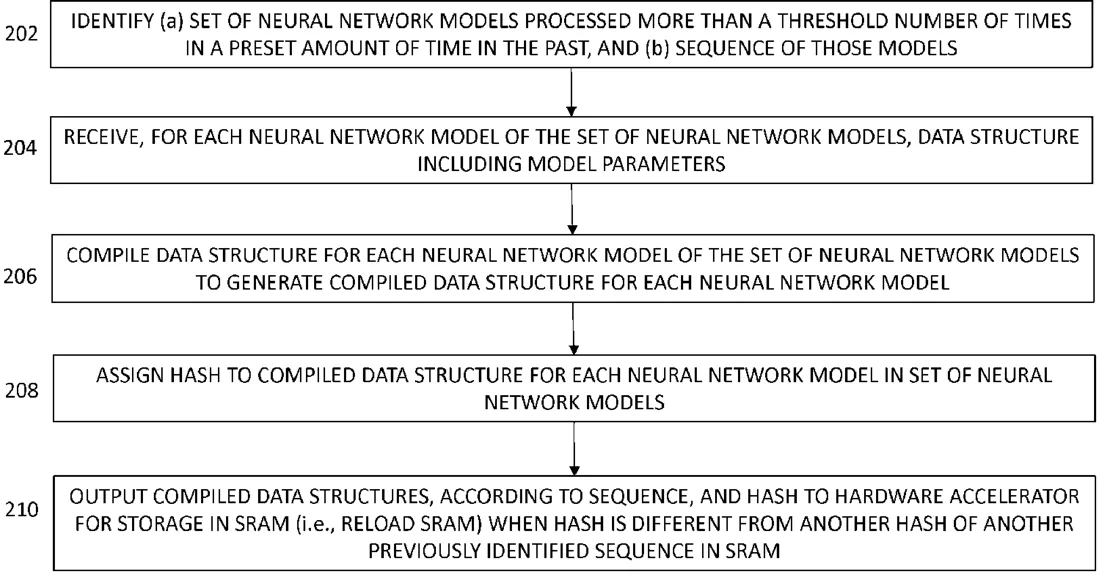
Google describes a method where a software compiler checks which AI models an app uses most often. It then loads these models directly into the chip's fast memory only if they aren't already there, skipping repeated loading steps.
In the filing’s own words
A compiler of a computing device is described that identifies a sequence of neural network models frequently invoked by an application of the computing device, compiles the models in that sequence, and loads a static random access memory (SRAM) of a hardware accelerator with the compiled models only when the same compiled models-from another, but same, sequence that was previously invoked-are not already present in the SRAM. This prevents unnecessary reloading of compiled models into the SRAM, thereby increasing runtime speed and conserving computational energy.
What exactly they claim (claim 1)
1. A method performed by a compiler and a hardware accelerator, the method comprising: identifying, by the compiler, a first set of neural network models that have been executed on a hardware accelerator of a computing device more than a threshold number of times in a preset amount of time in the past; identifying, by the compiler, a sequence in which the first set of neural network models are executed on the hardware accelerator; compiling, by the compiler, each neural network model of the first set of neural network models for execution by the hardware accelerator to generate a respective compiled data structure for the neural network model; and outputting, by the compiler, for each neural network model of the first set of neural network models, the respective compiled data structure to the hardware accelerator for storage according to the sequence in one or more memories of the hardware accelerator, wherein the outputting comprises: determining that a portion of a compiled data structure in the respective compiled data structures cannot be allocated in the one or more memories of the hardware accelerator; in response, outputting the compiled data structure for storage in another memory external to the one or more memories of the hardware accelerator; generating instructions that, once executed by the hardware accelerator, cause fetching the compiled data structure stored in the other memory; and storing the rest of the respective compiled data structures other than the compiled data structure stored in the other memory according to the sequence in the one or more memories; executing, by the hardware accelerator, the sequence of the first set of neural network models, wherein the executing comprises executing the generated instructions; determining, by the compiler, a next sequence of neural network models to be executed and if the next sequence of neural network models differs from the sequence of the first set of neural network models, erasing the rest of the compiled data structures stored in the first memory; and if the next sequence of neural network models is the sequence of the first set of neural network models, executing the compiled data structures in the one or more memories again on the hardware accelerator.
Facts
- Company
- Google (Google LLC)
- Official title
- COMPILER FOR NEURAL ACCELERATOR
- Publication number
- US20260319769A1
- Application number
- 19462940
- Filed
- Jan 28, 2026
- Published
- Oct 15, 2026
- Inventors
- 3
- Claims
- 20
Classified under
G06F 8/41 Physics & computingG06N 3/06 Physics & computingG06N 3/063 Physics & computingG05B 2219/13119 Physics & computingG05B 2219/23266 Physics & computingG06N 3/045 Physics & computingMore from Google in AI & software
- Google patents video search that answers questions using AI descriptions Sep 15, 2026
- Google patents photo tool that removes people and their gear Sep 15, 2026
- Google patents AI that writes live meeting notes and summaries Sep 15, 2026
- Google patents AI tool that turns messy emergency notes into clear messages Sep 3, 2026
- Google patents AI that clicks through apps to finish tasks for you Sep 24, 2026
Summaries are simplified from the filing’s own abstract and first claim. A patent filing is not a product announcement.
Patent data and drawings: U.S. Patent and Trademark Office (USPTO). Nebula is not affiliated with or endorsed by the USPTO.