Samsung patents server method for searching videos by scene and sound
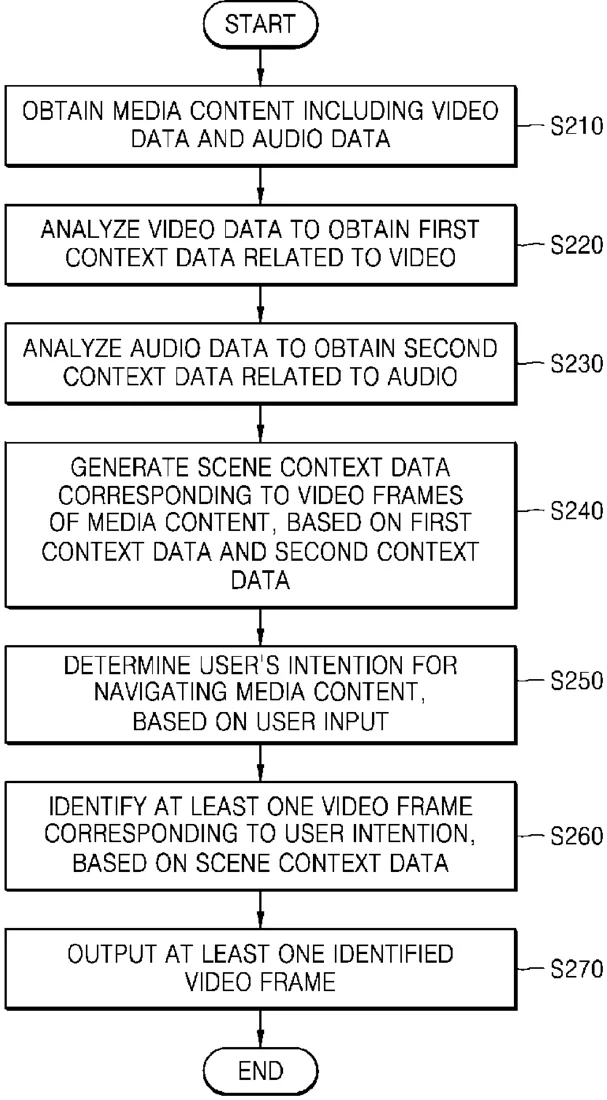
Samsung describes a server method that analyzes video and audio in media files to create detailed context data for each scene. It uses this data to match user search inputs with specific video frames, allowing for more precise navigation through content.
In the filing’s own words
A method, performed by a server, of providing media content includes: obtaining media content including video data and audio data; obtaining first context data by analyzing the video data; obtaining second context data by analyzing the audio data; based on the first context data and the second context data, generating scene context data corresponding to a plurality of video frames of the media content; determining a user intention for navigating the media content based on a user input; identifying a first at least one video frame of the plurality of video frames corresponding to the user intention based on the scene context data; and outputting the identified first at least one video frame.
What exactly they claim (claim 1)
1. A method, performed by a server for providing media content, the method comprising: obtaining media content including video data and audio data, the video data comprising a plurality of video frames; obtaining scene information by applying object recognition to a first at least one video frame of the plurality of video frames; generating at least one scene graph corresponding to the first at least one video frame, based on the scene information; obtaining first context data representing context of the video data, based on the at least one scene graph; obtaining scene-sound information by applying at least one of voice recognition, sound event detection, or sound event classification to the audio data; obtaining second context data representing context of the audio data, based on the scene-sound information; based on the first context data and the second context data, generating scene context data corresponding to the plurality of video frames; determining user intention information for navigating the media content based on a first user input, wherein the user intention information corresponds to an intention of the user with respect to the first user input; identifying a second at least one video frame of the plurality of video frames corresponding to the user intention information based on the scene context data; and outputting the identified second at least one video frame.
Facts
- Company
- Samsung (SAMSUNG ELECTRONICS CO., LTD.)
- Official title
- METHOD AND SERVER FOR PROVIDING MEDIA CONTENT
- Publication number
- US20260313196A1
- Application number
- 19707862
- Filed
- Jun 15, 2026
- Published
- Oct 8, 2026
- Inventors
- 6
- Claims
- 16
Classified under
H04N 21/44222 Electricity & electronicsG06V 20/40 Physics & computingH04N 21/233 Electricity & electronicsH04N 21/23418 Electricity & electronicsH04N 21/42203 Electricity & electronicsH04N 21/472 Electricity & electronicsMore from Samsung in AI & software
- Samsung patents tool to erase objects from photos using AI Sep 24, 2026
- Samsung patents drawing objects into photos with AI Oct 15, 2026
- Samsung patents AI that creates personalized exercise videos Sep 10, 2026
- Samsung patents AI summaries for paused TV shows based on your viewing habits Sep 24, 2026
- Samsung patents turning chat conversations into image prompts Oct 1, 2026
Summaries are simplified from the filing’s own abstract and first claim. A patent filing is not a product announcement.
Patent data and drawings: U.S. Patent and Trademark Office (USPTO). Nebula is not affiliated with or endorsed by the USPTO.