Google patents math method to help AI rank lists of items
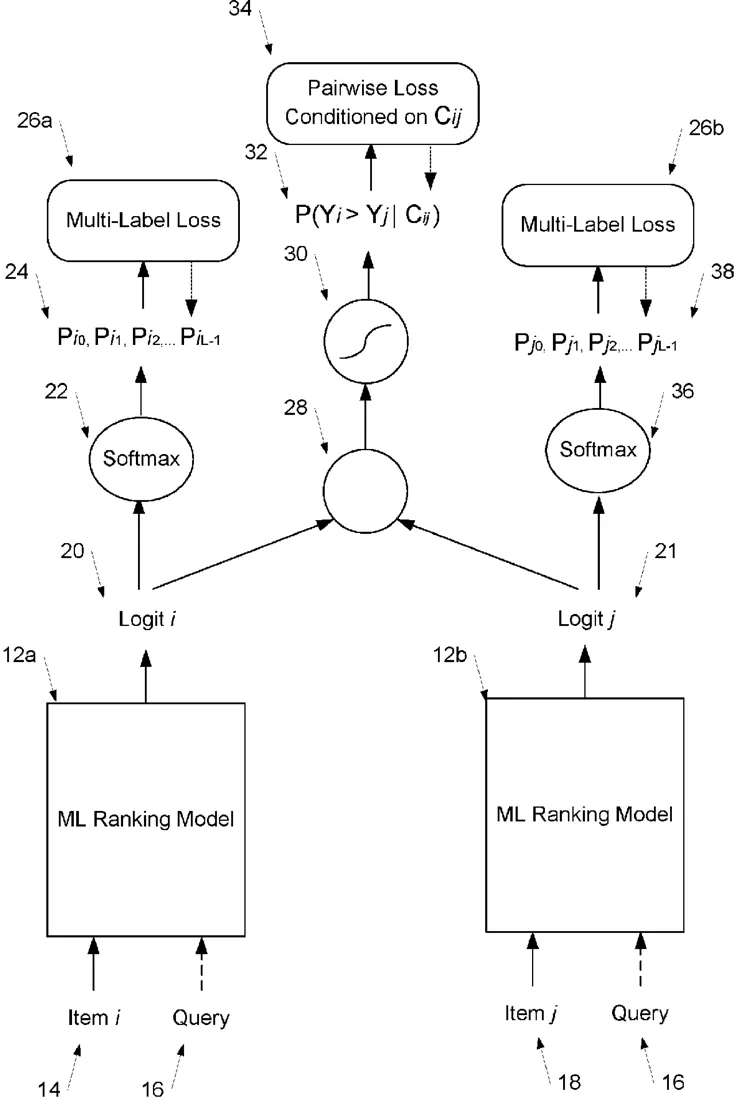
Google has filed a patent for a specific mathematical method used to train artificial intelligence models that rank lists of items. The technique helps the AI learn by comparing pairs of items and adjusting its internal settings based on how well it predicts their relative order. This approach focuses on improving how the model calculates the difference in relevance between different options.
In the filing’s own words
Provided are pairwise ranking losses for multi-label ranking problems. One example setting for the proposed approaches is when a machine learning ranking model generates a label output for a given input, where the label output is generated relative to a plurality of potential labels that correspond to relevance scores, and where the relevance scores can also define an ordering among items. The loss function(s) applied to the machine learning model capture the labels, the ranking order, and ranking score differences, integrating these into ranking optimization. Example techniques provided herein take a view of pairwise ranking in which the loss is applied only to a subset of events which is defined by the relation between labels in a pair. Each such event can dictate two symmetric events conditioned on it with opposite rankings.
What exactly they claim (claim 1)
1. A computer-implemented method to perform training for multi-label pairwise ranking, the method comprising: processing, by a computing system comprising one or more computing devices, a first input with a machine-learned ranking model to generate a first intermediate representation for the first input; processing, by a computing system comprising one or more computing devices, a second input with the machine-learned ranking model to generate a second intermediate representation for the second input; generating, by the computing system, a first label output for the first input based on the first intermediate representation, wherein the first label output is generated relative to a plurality of potential labels; generating, by the computing system, a second label output for the second input based on the second intermediate representation, wherein the second label output is generated relative to the plurality of potential labels; generating, by the computing system, a ranking output for the first input and the second input based on the first intermediate representation and the second intermediate representation, wherein the ranking output indicates a relative ranking between the first input and the second input; and evaluating, by the computing system, one or more ranking loss functions based on the ranking output, wherein the one or more ranking loss functions comprise a conditional loss that is conditioned on a conditioning event partitioned into two complement sets of events; and modifying, by the computing system, the machine-learned ranking model based on the one or more ranking loss functions.
Facts
- Company
- Google (Google LLC)
- Official title
- Multi-Label Pairwise Ranking
- Publication number
- US20260311034A1
- Application number
- 19100852
- Filed
- Aug 1, 2022
- Published
- Oct 8, 2026
- Inventors
- 1
- Claims
- 22
Classified under
G06N 20/00 Physics & computingG06F 16/9535 Physics & computingMore from Google in AI & software
- Google patents video search that answers questions using AI descriptions Sep 15, 2026
- Google patents photo tool that removes people and their gear Sep 15, 2026
- Google patents AI that writes live meeting notes and summaries Sep 15, 2026
- Google patents AI tool that turns messy emergency notes into clear messages Sep 3, 2026
- Google patents AI that clicks through apps to finish tasks for you Sep 24, 2026
Summaries are simplified from the filing’s own abstract and first claim. A patent filing is not a product announcement.
Patent data and drawings: U.S. Patent and Trademark Office (USPTO). Nebula is not affiliated with or endorsed by the USPTO.