Google patents database search that changes strategy mid-query
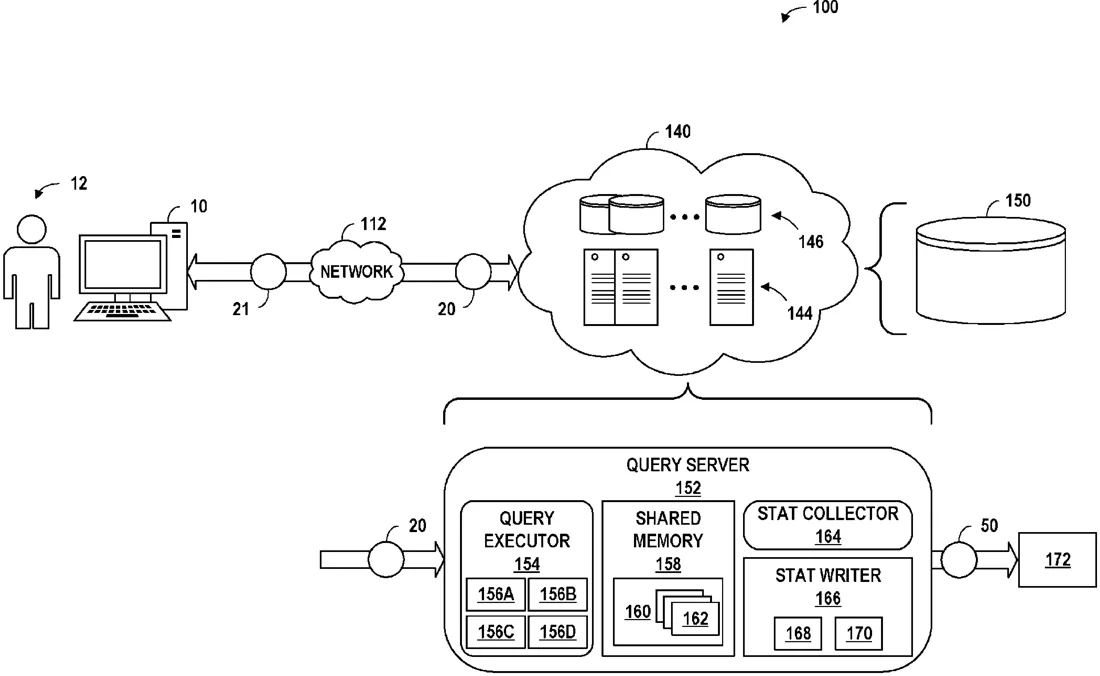
Google describes a method for searching databases that store both standard data and complex numerical vectors. The system starts a search using one method, then checks performance stats to decide if it should switch to a different search method for the rest of the query.
In the filing’s own words
A method includes storing a set of data records including vectors and structured attribute fields. The method further includes receiving a query including a query vector and one or more filter conditions. The method also includes executing a first portion of the query on a relational database by at least applying a first evaluation strategy. The first evaluation strategy is from a set of evaluation strategies. The method additionally includes generating, during execution of the first portion of the query, runtime statistics of the first portion of the query. The method further includes determining, based on the runtime statistics, whether to execute a second portion of the query via a second evaluation strategy of the set of evaluation strategies. The method also includes, responsive to the determination, executing the second portion of the query by at least applying the second evaluation strategy.
What exactly they claim (claim 1)
1. A method comprising: storing, by a computing system and in a relational database, a set of data records including vectors and structured attribute fields, each data record including a respective vector and one or more respective structured attribute fields; receiving, by the computing system, a query including a query vector and one or more filter conditions; executing, by the computing system, a first portion of the query on the relational database by at least applying a first evaluation strategy, wherein: the first evaluation strategy is for searching the vectors based on the query vector and for searching the structured attribute fields based on the one or more filter conditions; and the first evaluation strategy is from a set of evaluation strategies; generating, by the computing system and during execution of the first portion of the query, runtime statistics of the first portion of the query; determining, by the computing system and based on the runtime statistics, whether to execute a second portion of the query by at least applying a second evaluation strategy of the set of evaluation strategies, wherein: the second evaluation strategy is for searching the vectors based on the query vector and for searching the structured attribute fields based on the one or more filter conditions; and the second evaluation strategy is different than the first evaluation strategy; and responsive to determining to execute the second portion of the query by at least applying the second evaluation strategy, executing, by the computing system, the second portion of the query by at least applying the second evaluation strategy.
Facts
- Company
- Google (Google LLC)
- Official title
- ADAPTIVE VECTOR QUERY PROCESSING
- Publication number
- US20260310670A1
- Application number
- 19571592
- Filed
- Mar 19, 2026
- Published
- Oct 8, 2026
- Inventors
- 5
- Claims
- 20
Classified under
G06F 16/24549 Physics & computingG06F 16/2237 Physics & computingG06F 16/24542 Physics & computingMore from Google in AI & software
- Google patents video search that answers questions using AI descriptions Sep 15, 2026
- Google patents photo tool that removes people and their gear Sep 15, 2026
- Google patents AI that writes live meeting notes and summaries Sep 15, 2026
- Google patents AI tool that turns messy emergency notes into clear messages Sep 3, 2026
- Google patents AI that clicks through apps to finish tasks for you Sep 24, 2026
Summaries are simplified from the filing’s own abstract and first claim. A patent filing is not a product announcement.
Patent data and drawings: U.S. Patent and Trademark Office (USPTO). Nebula is not affiliated with or endorsed by the USPTO.