Google patents robot control via natural language instructions
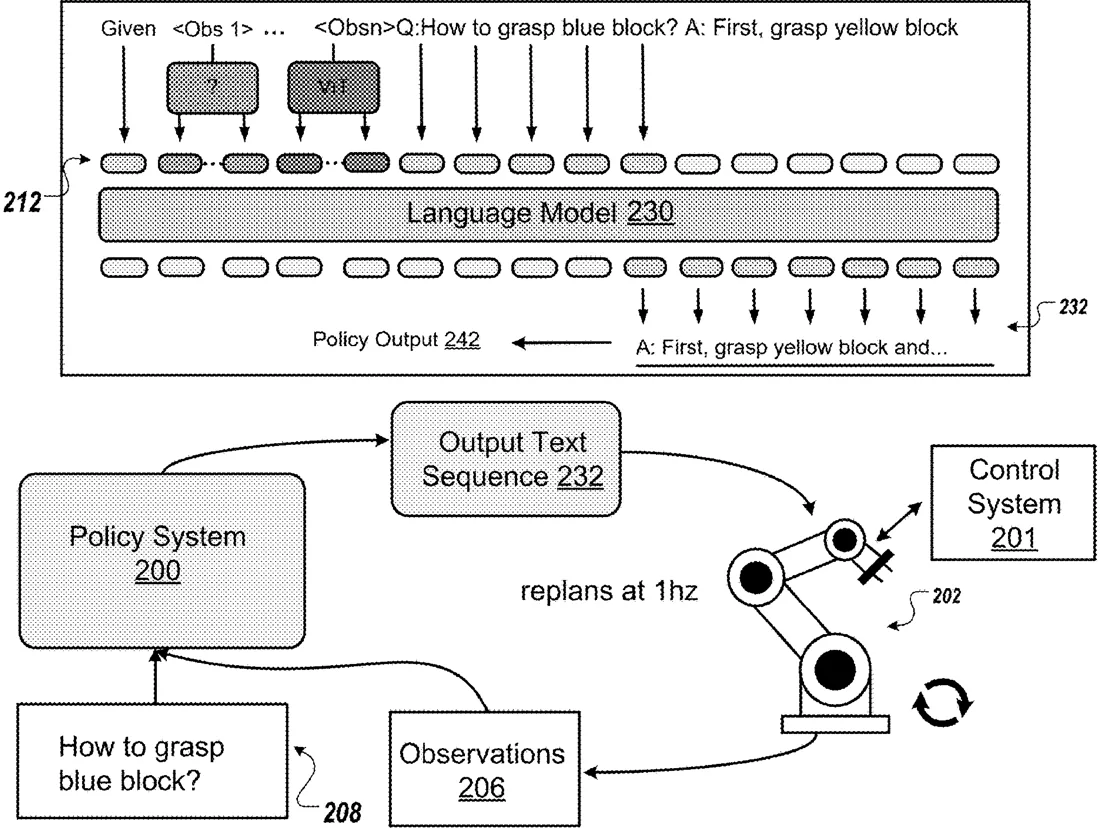
Google has filed a patent for a system that lets robots understand and execute tasks described in plain text. The method converts both the text instructions and visual observations of the environment into a shared digital format, allowing a language model to generate step-by-step commands for the robot.
In the filing’s own words
Methods, systems, and apparatus, including computer programs encoded on a computer storage medium, for controlling an agent interacting with an environment. In one aspect, a method comprises: receiving one or more observations of an environment; receiving an input text sequence that describes a task to be performed by a robot in the environment; generating an encoded representation of the input text sequence in an embedding space; generating a corresponding encoded representation of each of the one or more observations in the embedding space; generating a sequence of input tokens that comprises the encoded representation of the input text sequence and the corresponding encoded representation of each observation; processing the sequence of input tokens using a language model neural network to generate an output text sequence that comprises high-level natural language instructions; and determining, from the high-level natural language instructions, one or more actions to be performed by the robot.
What exactly they claim (claim 1)
1. A computer-implemented method comprising: receiving one or more observations of an environment that comprises one or more objects; receiving an input text sequence that describes a task to be performed by a robot in the environment and that references the one or more objects in the environment; generating an encoded representation of the input text sequence in an embedding space; generating a corresponding encoded representation of each of the one or more observations in the embedding space; generating a sequence of input tokens that comprises the encoded representation of the input text sequence and the corresponding encoded representation of each observation; processing the sequence of input tokens using a language model neural network to autoregressively generate an output text sequence that comprises high-level natural language instructions for the robot; and determining, from the high-level natural language instructions, one or more actions to be performed by the robot.
Facts
- Company
- Google (Google LLC)
- Official title
- CONTROLLING ROBOTS USING MULTI-MODAL LANGUAGE MODELS
- Publication number
- US20260307248A1
- Application number
- 19540472
- Filed
- Feb 13, 2026
- Published
- Oct 8, 2026
- Inventors
- 6
- Claims
- 1
Classified under
B25J 9/1658 Operations & transportMore from Google in Robots & automation
- Google patents robot control via AI-generated code Oct 15, 2026
- Google patents robot control via natural language instructions Oct 15, 2026
- Google patents robot that finds objects you point at using a stored map Sep 29, 2026
- Google patents robot navigation check to prevent driving into known safe zones Sep 22, 2026
- Google patents robot brain that plans moves from camera views Oct 20, 2026
Summaries are simplified from the filing’s own abstract and first claim. A patent filing is not a product announcement.
Patent data and drawings: U.S. Patent and Trademark Office (USPTO). Nebula is not affiliated with or endorsed by the USPTO.