Microsoft patents AI model that cleans up video calls by removing echoes and background voices
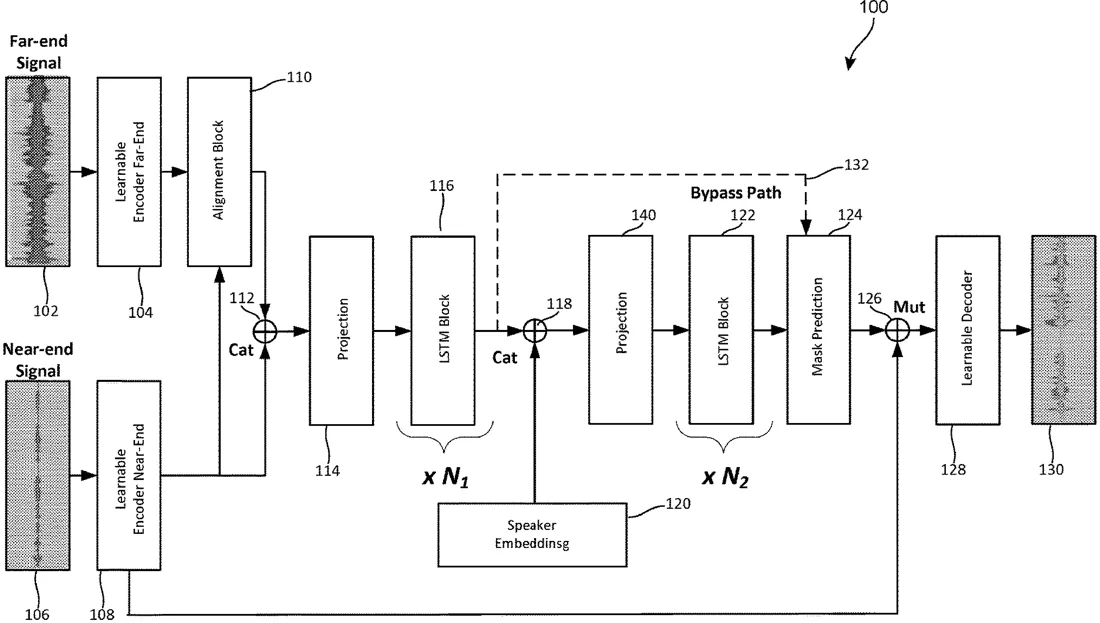
Microsoft describes a system that uses a machine learning model to process audio from online meetings. The model takes in the sound from other participants and the local microphone, then specifically removes echoes and the voices of people talking in the background while keeping the main speaker's voice clear.
In the filing’s own words
A data processing system implements receiving a far-end signal associated with a first computing device participating in an online communication session and receiving a near-end signal associated with a second computing device participating in the online communication session. The near-end signal includes speech of a target speaker, a first interfering speaker, and an echo signal. The system further implements providing the far-end signal, the near-end signal, and an indication of the target speaker as an input to a machine learning model. The machine learning model trained to analyze the far-end signal and the near-end signal to perform personalized noise suppression (PNS) to remove speech from one or more interfering speakers and acoustic echo cancellation (AEC) to remove echoes. The model is trained to output an audio signal comprising speech of the target speaker. The system obtains the audio signal comprising the speech of the target speaker from the model.
What exactly they claim (claim 1)
1. A data processing system comprising: a processor; and a machine-readable medium storing executable instructions that, when executed, cause the processor to perform operations comprising: obtaining first embeddings representing an encoded version of a far-end signal associated with a first computing device participating in an online communication session; obtaining second embeddings representing an encoded version of a near-end signal associated with a second computing device participating in the online communication session, the near-end signal including speech of a target speaker, one or more interfering speakers, and an echo signal; obtaining target speaker embeddings representing speech characteristics of the target speaker; providing the first embeddings, the second embeddings, and the target speaker embeddings as an input to a machine learning model comprising: a self-attention alignment block configured to use attention to determine a soft-alignment of first features of the first embeddings and second features of the second embeddings, the self-attention alignment block outputting attention weights associated with the soft-alignment; a first fusing block configured to fuse the first embeddings, the second embeddings, and the attention weights into a first fused output; a first group of Long Short-Term Memory (LSTM) blocks trained to perform acoustic echo cancellation (AEC) on the first fused output to remove the echo signal and to output third features, a second fusing block configured to fuse the third features output by the first group of LSTM blocks and the target speaker embeddings to generate a second fused output, and a second group of LSTM blocks trained to perform personalized noise suppression (PNS) on the second fused output to remove the speech from the one or more interfering speakers; and obtaining an audio signal comprising the speech of the target speaker from the machine learning model.
Facts
- Company
- Microsoft (Microsoft Technology Licensing, LLC)
- Official title
- Joint Acoustic Echo Cancellation (AEC) and Personalized Noise Suppression (PNS)
- Publication number
- US20260301758A1
- Application number
- 19700903
- Filed
- Jun 8, 2026
- Published
- Oct 1, 2026
- Inventors
- 6
- Claims
- 20
Classified under
G10L 21/0232 Physics & computingG06N 3/0442 Physics & computingG10L 17/02 Physics & computingG10L 17/04 Physics & computingG10L 17/06 Physics & computingG10L 17/18 Physics & computingMore from Microsoft in Audio & voice
- Microsoft patents system to grade how well audio fills in missing data Sep 29, 2026
- Microsoft patents audio effect that turns group speech into background chatter Sep 29, 2026
- Microsoft patents audio tool that adjusts sound based on hearing tests Sep 29, 2026
- Microsoft patents audio system that removes private details from recordings Oct 1, 2026
- Microsoft patents voice ID that works across different recording speeds Oct 15, 2026
Summaries are simplified from the filing’s own abstract and first claim. A patent filing is not a product announcement.
Patent data and drawings: U.S. Patent and Trademark Office (USPTO). Nebula is not affiliated with or endorsed by the USPTO.