Microsoft patents audio system that removes private details from recordings
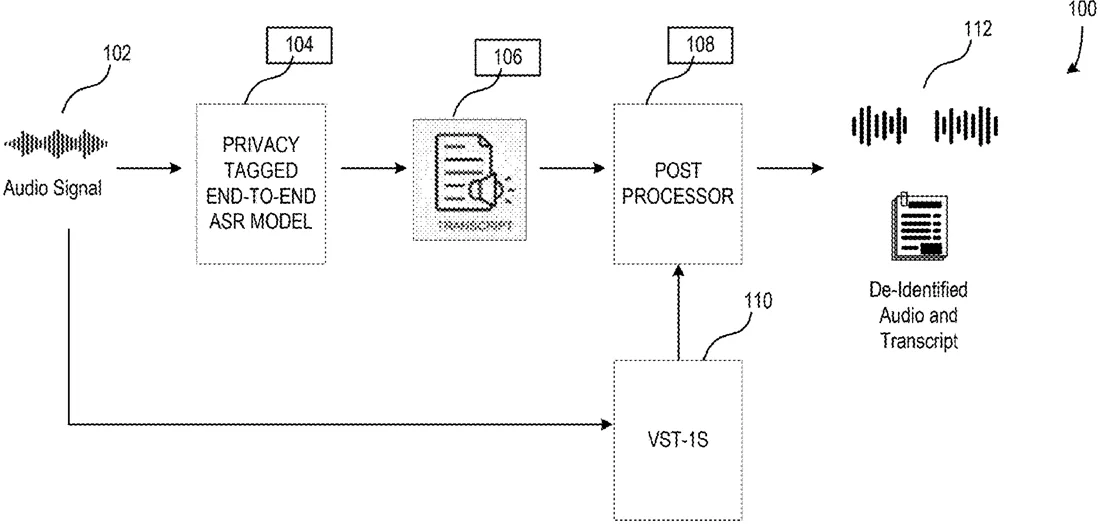
Microsoft describes a system that listens to audio and automatically identifies private information, such as names or IDs, while transcribing speech. It then removes or replaces those specific sounds and words in both the audio file and the written transcript to protect privacy.
In the filing’s own words
A computerized system and method for audio de-identification is provided. An audio signal is received and its transcript is generated using a trained privacy tagged end-to-end automatic speech recognition (ASR) model. The transcript includes privacy tags indicating privacy information in the audio signal. The ASR model is trained using privacy tags and non-privacy tags surrounding words in a training transcript of a training audio signal. Audio segments corresponding to the privacy tags in the audio signal and the transcript are de-identified to generate de-identified audio signal and transcript. De-identification includes removing or replacing (with some filler or otherwise de-identified information) the privacy information in the audio segments of the audio signal and transcript. Examples of the disclosure have practical applications in various fields for de-identifying private information (e.g., patient name, unique health identification number, etc.) in an audio signal and transcript, for example associated with a doctor-patient encounter.
What exactly they claim (claim 1)
1. A system for audio de-identification comprising: a processor; and a memory storing instructions that upon execution by the processor cause the processor to: receive an audio signal comprising a first phrase representing privacy information and a second phrase representing non-privacy information; generate, using a privacy tagged end-to-end automatic speech recognition (ASR) model, a transcript associated with the audio signal, the transcript including a privacy tag encoding the first phrase representing the privacy information and a non-privacy tag encoding the second phrase representing the non-privacy information; and remove a first audio segment corresponding to the privacy tag encoding the first phrase in the audio signal and the transcript to generate de-identified audio signal and transcript, the de-identified audio signal and transcript including a second audio segment corresponding to the non-privacy tag encoding the second phrase in the audio signal and the transcript.
Facts
- Company
- Microsoft (Microsoft Technology Licensing, LLC)
- Official title
- AUDIO DE-IDENTIFICATION
- Publication number
- US20260301754A1
- Application number
- 19224763
- Filed
- May 31, 2025
- Published
- Oct 1, 2026
- Inventors
- 5
- Claims
- 20
Classified under
G10L 21/00 Physics & computingG10L 15/063 Physics & computingG10L 15/26 Physics & computingG10L 25/78 Physics & computingMore from Microsoft in Audio & voice
- Microsoft patents AI model that cleans up video calls by removing echoes and background voices Oct 1, 2026
- Microsoft patents system to grade how well audio fills in missing data Sep 29, 2026
- Microsoft patents audio effect that turns group speech into background chatter Sep 29, 2026
- Microsoft patents audio tool that adjusts sound based on hearing tests Sep 29, 2026
- Microsoft patents voice ID that works across different recording speeds Oct 15, 2026
Summaries are simplified from the filing’s own abstract and first claim. A patent filing is not a product announcement.
Patent data and drawings: U.S. Patent and Trademark Office (USPTO). Nebula is not affiliated with or endorsed by the USPTO.