Google patents voice control that checks who is speaking before acting
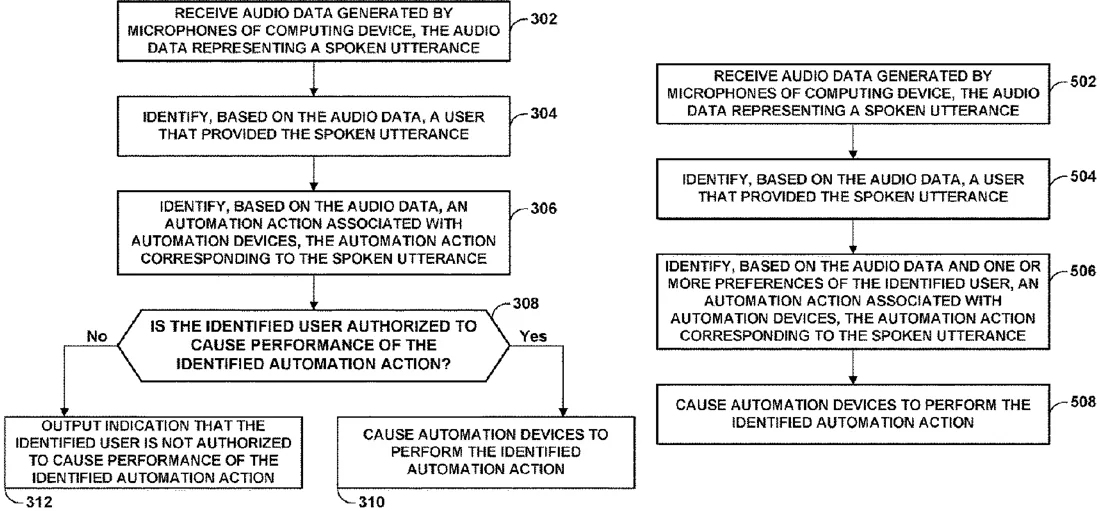
This patent describes a system that listens to spoken commands and identifies the specific person speaking using audio data. It then checks if that person has permission to control smart devices, only executing the command if the speaker is authorized.
In the filing’s own words
In one example, a method includes receiving audio data generated by one or more microphones of a computing device, the audio data representing a spoken utterance; identifying, based on the audio data, a user that provided the spoken utterance; identifying, based on the audio data, an automation action associated with one or more automation devices, the automation action corresponding to the spoken utterance; determining whether the identified user is authorized to cause performance of the identified automation action; and responsive to determining that the identified user is authorized to cause performance of the identified automation action, causing the one or more automation devices to perform the identified automation action.
What exactly they claim (claim 1)
1. A method implemented by one or more processors, the method comprising: receiving audio data generated by one or more microphones of a computing device, the audio data representing a spoken utterance; identifying, based on the audio data, that a guest user provided the spoken utterance; identifying, based on the audio data, a particular automation action for a particular automation device, the particular automation action corresponding to the spoken utterance; determining that the guest user is not authorized to cause performance of the particular automation action for the particular automation device; in response to determining that the guest user is not authorized to cause performance of the particular automation action for the particular automation device: refraining from initiating performance of the particular automation action; receiving additional audio data generated by the one or more microphones of the computing device, the additional audio data representing an additional spoken utterance; identifying, based on the additional audio data, that a registered user provided the additional spoken utterance; identifying, based on the additional audio data, the particular automation action for the particular automation device, the particular automation action corresponding to the additional spoken utterance; determining that the registered user is authorized to cause performance of the particular automation action for the particular automation device; and in response to determining that the registered user is authorized to cause performance of the particular automation action for the particular automation device: causing the particular automation device to perform the particular automation action.
Facts
- Company
- Google (GOOGLE LLC)
- Official title
- Multi-user virtual assistant for verbal device control
- Patent number
- US12770616B2
- Application number
- 18375861
- Filed
- Oct 2, 2023
- Granted
- Oct 20, 2026
- Inventors
- 2
- Claims
- 19
Classified under
G10L 15/22 Physics & computingG06F 21/32 Physics & computingG10L 15/08 Physics & computingG10L 17/22 Physics & computingH04L 63/0861 Electricity & electronicsH04L 63/102 Electricity & electronicsMore from Google in AI & software
- Google patents video search that answers questions using AI descriptions Sep 15, 2026
- Google patents photo tool that removes people and their gear Sep 15, 2026
- Google patents AI that writes live meeting notes and summaries Sep 15, 2026
- Google patents AI tool that turns messy emergency notes into clear messages Sep 3, 2026
- Google patents AI that clicks through apps to finish tasks for you Sep 24, 2026
Summaries are simplified from the filing’s own abstract and first claim. A patent filing is not a product announcement.
Patent data and drawings: U.S. Patent and Trademark Office (USPTO). Nebula is not affiliated with or endorsed by the USPTO.