Google patents method to pick best image features for AI models
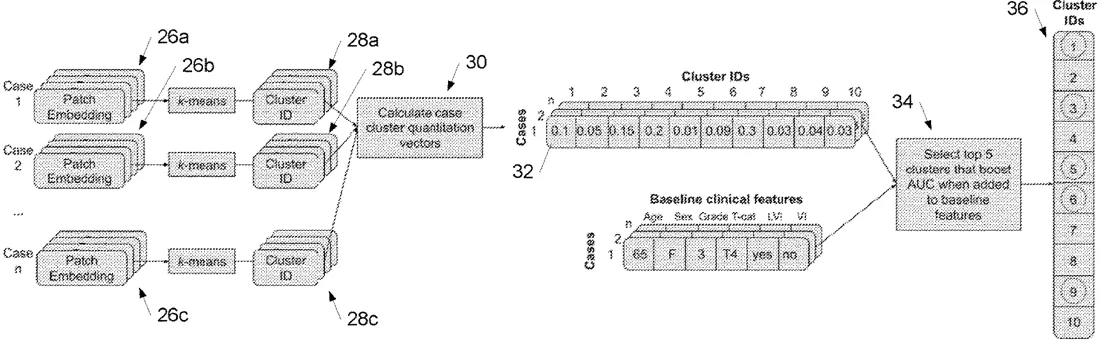
This patent describes a way to improve how computer vision systems learn from images. It uses a pre-trained model to turn images into data points, groups similar points together, and then selects only the groups that actually help a prediction model work better alongside existing data.
In the filing’s own words
Provided are systems and methods for the generation of machine-learning features by clustering deep learning embeddings and selecting embedding cluster data while controlling for known associations. In particular, a computing system can use a pre-trained machine learning model (e.g., an image embedding model) to obtain embeddings of input images. The computing system can train a clustering algorithm (e.g., a k-means algorithm) to cluster these embeddings into one of a number (e.g., k) clusters. The computing system can then perform a selection process to select one or more (e.g., the top n) clusters that boost performance in a prediction model (e.g., a logistic regression model) trained with a combination of the selected clusters and one or more baseline features. In such fashion, the computer system can enable an improved combination of extracted deep learned features and baseline features. This can maximize generalizable performance while controlling for known variables.
What exactly they claim (claim 1)
1. A computer-implemented method to generate machine-learning features, the method comprising: obtaining, by a computing system comprising one or more computing devices, a plurality of training cases, wherein each training case has a plurality of training images associated therewith; processing, by the computing system, the plurality of training images associated with each of the plurality of training cases with a machine-learned image embedding model to generate a plurality of image embeddings respectively for the plurality of training images; assigning, by the computing system, each image embedding to one of a number of embedding clusters; generating, by the computing system, a respective cluster quantitation vector for each training case that indicates an amount of the image embeddings associated with such training case that were assigned to each of the number of embedding clusters; evaluating, by the computing system, a respective change in performance of a machine-learned prediction model when respectively supplied with the cluster quantitation vector values for each embedding cluster in addition to a set of one or more baseline features; and selecting, by the computing system, one or more embedding clusters of the number of embedding clusters for use as machine-learning features based at least in part on the respective changes in performance of the machine-learned prediction model associated with the embedding clusters.
Facts
- Company
- Google (Google LLC)
- Official title
- Maximizing generalizable performance by extraction of deep learned features while controlling for known variables
- Patent number
- US12770376B2
- Application number
- 18845384
- Filed
- Mar 9, 2023
- Granted
- Oct 20, 2026
- Inventors
- 5
- Claims
- 20
Classified under
G06V 10/774 Physics & computingG06V 10/762 Physics & computingG06V 10/766 Physics & computingG06V 10/776 Physics & computingG06V 20/698 Physics & computingG16H 30/40 Physics & computingMore from Google in AI & software
- Google patents video search that answers questions using AI descriptions Sep 15, 2026
- Google patents photo tool that removes people and their gear Sep 15, 2026
- Google patents AI that writes live meeting notes and summaries Sep 15, 2026
- Google patents AI tool that turns messy emergency notes into clear messages Sep 3, 2026
- Google patents AI that clicks through apps to finish tasks for you Sep 24, 2026
Summaries are simplified from the filing’s own abstract and first claim. A patent filing is not a product announcement.
Patent data and drawings: U.S. Patent and Trademark Office (USPTO). Nebula is not affiliated with or endorsed by the USPTO.