Samsung patents chip that trains neural networks with less math
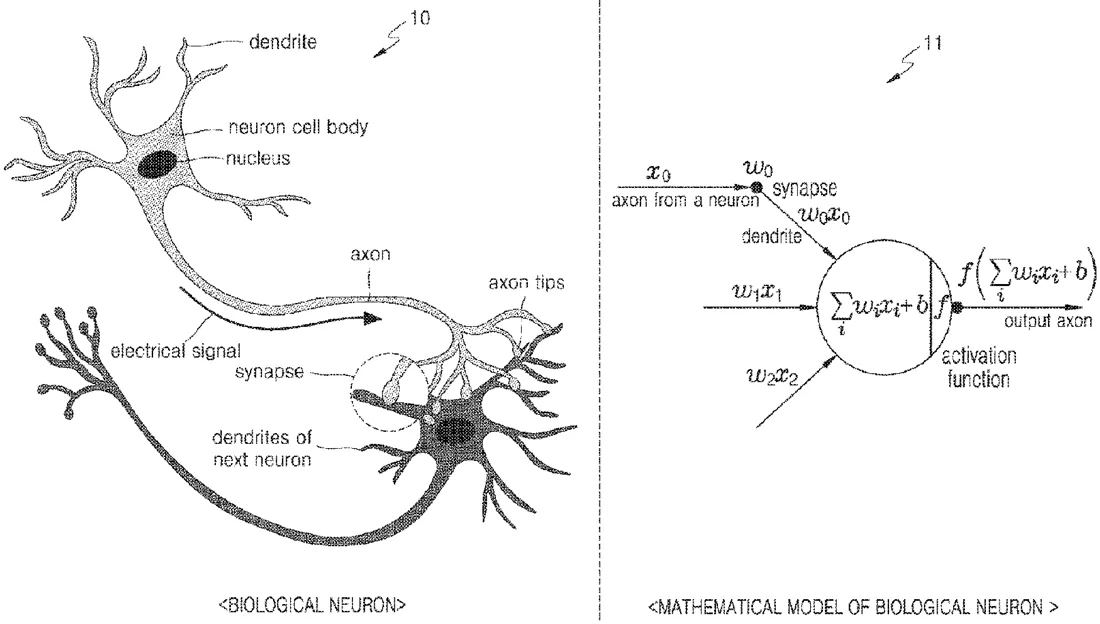
Samsung describes a processor design that splits the training of a neural network into two distinct steps. It uses a self-organizing map to learn initial features without complex calculations, then applies standard supervised learning to the final layers for classification.
In the filing’s own words
A processor-implemented neural network implementation method includes: learning each of first layers included in a neural network according to a first method; learning at least one second layer included in the neural network according to a second method; and generating output data from input data by using the learned first layers and the learned at least one second layer.
What exactly they claim (claim 1)
1. A processor-implemented neural network implementation method executed by a processor and an on-chip memory included in a neuromorphic apparatus for performing a neuromorphic operation, the method comprising: performing, by the processor and the on-chip memory included in the neuromorphic apparatus, a first training of each of first layers included in a convolution neural network based on unsupervised learning according to a self-organizing map without using back-propagation, including determining a similarity between partial input vectors and an updated weight of at least one output neuron using input feature map data stored in the on-chip memory, wherein the self-organizing map comprises an input layer having a number of neurons equal to dimensions of an input and an output layer having a number of neurons equal to clustering target classes, and wherein each neuron of the output layer of the self-organizing map has a weight vector having the same dimension as the input and the input of the self-organizing map is clustered by classifying the input into one of most similar neuron of the output layer based on a calculated similarity between the input and the weight vector of each neuron of the output layer; performing, by the processor and the on-chip memory, a second training of at least one second layer included in the convolution neural network based on supervised learning according to back-propagation; and performing, by the processor and the on-chip memory, an inference operation, including generating, by the processor and the on-chip memory, output data based on input data stored in the on-chip memory, by using the learned first layers and the learned at least one second layer, wherein the first layers comprise convolutional layers of the convolution neural network to extract features from the input data and the at least one second layer comprises at least one fully-connected layer of the convolution neural network to perform classification and identification based on output feature map data extracted from the input data by the first layers, wherein the convolution neural network is implemented as a single convolution neural network including the first layers and the at least one second layer, wherein the performing the first training comprises generating output feature map data for the convolutional layers via addition operation and subtraction operation instead of a MAC (multiply and accumulate) operation based on the self-organizing map, wherein the generated output feature map data of the first layers is used as an input feature map for the at least one second layer to perform the supervised learning according to the back-propagation, wherein the generating the output feature map data comprises: generating partial input vectors based on input feature map data of an initial layer of the first layers; determining the similarity between the partial input vectors and the updated weights, to generate similarity vectors; and generating the output feature map data of the initial layer based on the similarity vectors, and wherein the similarity vectors are determined as partial output feature map data, and the partial output feature map data is matched with a coordinate of the input feature map data of which the partial input vectors are generated, to generate the output feature map data of the initial layer, and wherein the first training, the second training and the inference operation are performed by the processor and the on-chip memory.
Facts
- Company
- Samsung (Samsung Electronics Co., Ltd.)
- Official title
- Neuromorphic apparatus and method with neural network
- Patent number
- US12762408B2
- Application number
- 17078714
- Filed
- Oct 23, 2020
- Granted
- Oct 13, 2026
- Inventors
- 1
- Claims
- 12
Classified under
G06N 3/084 Physics & computingG06N 3/04 Physics & computingG06N 3/088 Physics & computingMore from Samsung in AI & software
- Samsung patents tool to erase objects from photos using AI Sep 24, 2026
- Samsung patents drawing objects into photos with AI Oct 15, 2026
- Samsung patents AI that creates personalized exercise videos Sep 10, 2026
- Samsung patents AI summaries for paused TV shows based on your viewing habits Sep 24, 2026
- Samsung patents turning chat conversations into image prompts Oct 1, 2026
Summaries are simplified from the filing’s own abstract and first claim. A patent filing is not a product announcement.
Patent data and drawings: U.S. Patent and Trademark Office (USPTO). Nebula is not affiliated with or endorsed by the USPTO.