Samsung patents radar-based sleep tracking using neural networks
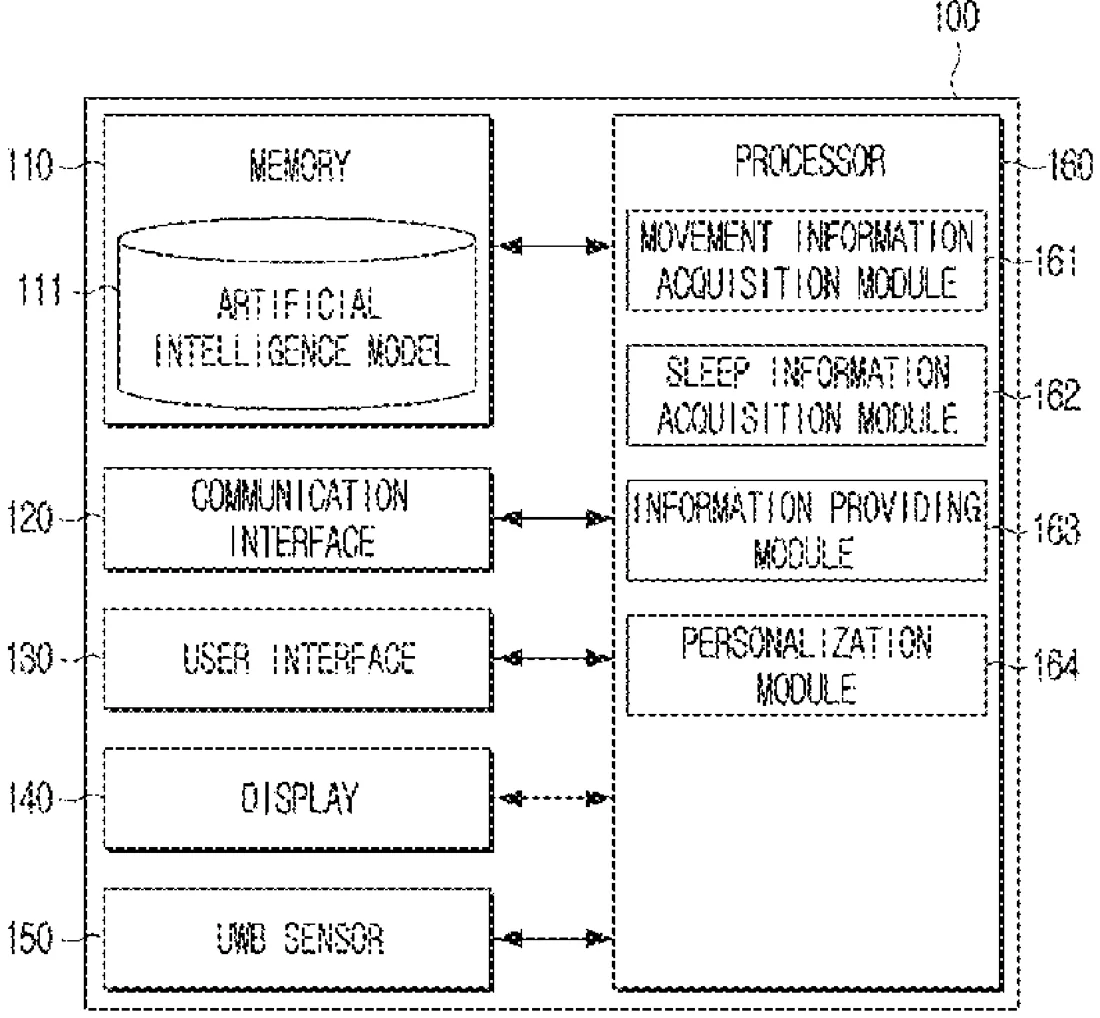
Samsung describes an electronic device that uses an ultra-wideband (UWB) sensor to send radar signals toward a user and detect reflected movements. The system processes this data using three neural networks to analyze chest movement and calculate sleep information without requiring wearable sensors.
In the filing’s own words
An electronic apparatus is provided. The electronic apparatus includes an ultra-wideband (UWB) sensor, a memory storing at least one instruction, and a processor. The processor, by executing the at least one instruction, is configured to transmit a radar signal through the UWB sensor and receive a signal reflected by a user, acquire first information on the user's movement based on the reflected signal, acquire second information on the user's movement by performing a Fourier transform on the first information, acquire first feature information corresponding to the first information and second feature information corresponding to the second information by inputting the first information and the second information to a first neural network and a second neural network, respectively, acquire information on the user's sleep by inputting the first feature information and the second feature information into a third neural network, and provide information on the acquired sleep.
What exactly they claim (claim 1)
1. An electronic apparatus comprising: an ultra-wideband (UWB) sensor; memory storing at least one instruction; and a processor connected to the memory, wherein, the instructions, when executed by the processor, cause the electronic apparatus to: transmit a radar signal through the UWB sensor and receive a signal reflected by a user, based on the signal reflected by the user, acquire first information on a user's movement, acquire second information on the user's movement by performing a Fourier transform on the first information, acquire first feature information corresponding to the first information by inputting the first information into a first neural network, acquire second feature information corresponding to the second information by inputting the second information into a second neural network, acquire input data acquired by performing position embedding on feature information combining element-wise the first feature information and the second feature information, acquire sleep information on a user's sleep by inputting the input data into a third neural network, and provide the sleep information on the user's sleep, wherein the first information includes a distance map with respect to a movement of a user's chest, and the second information includes a Doppler map with respect to the movement of the user's chest, and wherein the instructions, when executed by the processor, further cause the electronic apparatus to: acquire the sleep information on the user's sleep by inputting a value acquired by multiplying the first feature information and the second feature information for each element into the third neural network.
Facts
- Company
- Samsung (Samsung Electronics Co., Ltd.)
- Official title
- Electronic apparatus and controlling method thereof
- Patent number
- US12762377B2
- Application number
- 18299355
- Filed
- Apr 12, 2023
- Granted
- Oct 13, 2026
- Inventors
- 3
- Claims
- 16
Classified under
G06N 3/045 Physics & computingA61B 5/4818 Human necessitiesG01S 13/62 Physics & computingG01S 13/88 Physics & computingG06N 3/09 Physics & computingMore from Samsung in Health & body
- Samsung patents UWB radar to track sleep without wearables Sep 8, 2026
- Samsung patents camera method to estimate blood oxygen from skin video Sep 15, 2026
- Samsung patents earbuds that detect stress and suggest coping strategies Sep 29, 2026
- Samsung patents eye test device using a lens that changes shape electronically Oct 6, 2026
- Samsung patents exercise device that adjusts workouts using medical data Oct 13, 2026
Summaries are simplified from the filing’s own abstract and first claim. A patent filing is not a product announcement.
Patent data and drawings: U.S. Patent and Trademark Office (USPTO). Nebula is not affiliated with or endorsed by the USPTO.