Samsung patents exercise device that adjusts workouts using medical data
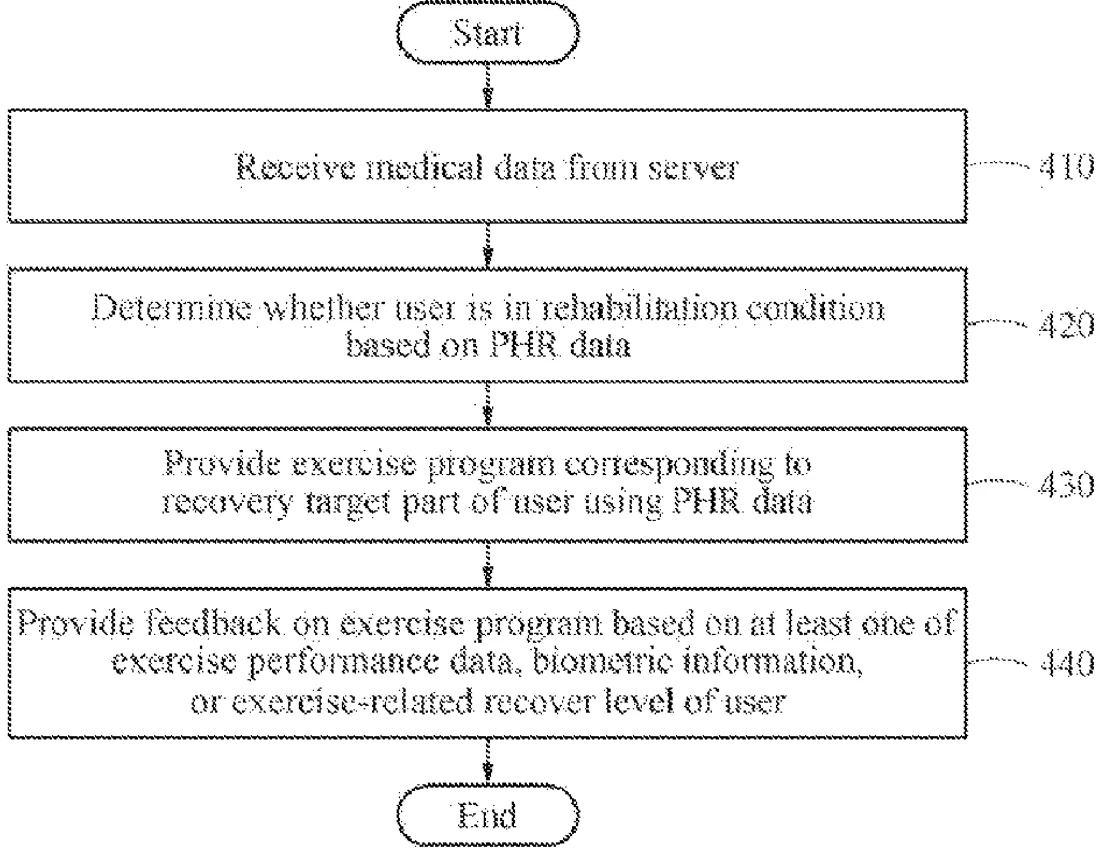
Samsung describes an electronic device that receives a user's medical records from a server to determine if they are in a rehabilitation phase. If so, it creates a specific exercise plan for the recovering body part and uses built-in sensors like heart rate monitors and balance sensors to track performance. The device automatically adjusts the speed or duration of the workout machine if it detects that the user's vital signs are dropping or their balance is off.
In the filing’s own words
An electronic device includes: a communication interface configured to receive medical data of a user from a server; at least one processor electrically connected to the communication module; and a memory electrically connected to the at least one processor. The at least one processor is configured to: determine whether the user is in a rehabilitation condition based on the received medical data; when the user is determined to be in the rehabilitation condition, provide an exercise program corresponding to a recovery target part of the user using the received medical data; and provide feedback on the exercise program based on at least one of exercise performance data, biometric information, or an exercise-related recovery level of the user.
What exactly they claim (claim 1)
1. An electronic device comprising: a communication interface; at least one processor electrically connected to the communication interface; and a memory electrically connected to the at least one processor, wherein the at least one processor is configured to: receive medical data of a user from a server; determine whether the user is in a rehabilitation condition based on the received medical data; when the user is determined to be in the rehabilitation condition, generate a first exercise program corresponding to a recovery target part of the user using the received medical data; display the generated first exercise program on the electronic device; during the rehabilitation condition, increase monitoring of biometric information of the user by increasing at least two types of sensors, included in the electronic device, activated for measurement of the biometric information during the first exercise program performed by the user when compared to a condition in which recovery is not needed, the sensors comprising: a green light emitting diode (LED) configured to measure a heart rate of the user, the green LED configured to contact the user's skin; a red LED configured to measure the heart rate of the user based on light emitted by the red LED penetrating the user's skin; an infrared (IR) LED configured to measure the heart rate and a saturation pulse oxygen of the user; and a pressure sensor configured to measure a center of gravity balance of the user; based on the activated measurement of the biometric information of the user of the sensors, detect an abnormality of the biometric information that comprises: when at least one LED of the green LED, the red LED, or the IR LED is activated, detecting the abnormality of the biometric information, based on the heart rate of the user has decreased; when the IR LED is activated, detecting the abnormality of the biometric information, based on the saturation pulse oxygen of the user has decreased; and when the pressure sensor is activated, detecting the abnormality of the biometric information, based on the center of gravity balance of the user is not maintained; when the abnormality of the biometric information is detected during the first exercise program, transmit, by the electronic device, an instruction without human intervention, to decrease at least one of a speed or an operation time of the exercise machine; when the abnormality of the biometric information is not detected during the first exercise program, transmit, by the electronic device, an instruction without human intervention to increase at least one of the speed or the operation time of the exercise machine; after end of the first exercise program, determine recovery level of the user based on comparison of biometric information of the user obtained during the first exercise program based on increasing the at least two types of sensors used and biometric information of the user during the condition in which recovery is not needed; generate a second exercise program following the first exercise program based on the recovery level of the user without human intervention; and display the second exercise program.
Facts
- Company
- Samsung (SAMSUNG ELECTRONICS CO., LTD.)
- Official title
- Electronic device for providing exercise program using medical data and method therefor
- Patent number
- US12758825B2
- Application number
- 18370562
- Filed
- Sep 20, 2023
- Granted
- Oct 13, 2026
- Inventors
- 5
- Claims
- 19
Classified under
A63B 24/0075 Human necessitiesA63B 71/0622 Human necessitiesG16H 20/30 Physics & computingA63B 2024/0068 Human necessitiesA63B 2220/62 Human necessitiesA63B 2230/04 Human necessitiesMore from Samsung in Health & body
- Samsung patents UWB radar to track sleep without wearables Sep 8, 2026
- Samsung patents camera method to estimate blood oxygen from skin video Sep 15, 2026
- Samsung patents earbuds that detect stress and suggest coping strategies Sep 29, 2026
- Samsung patents eye test device using a lens that changes shape electronically Oct 6, 2026
- Samsung patents filling in gaps in health data using AI Oct 1, 2026
Summaries are simplified from the filing’s own abstract and first claim. A patent filing is not a product announcement.
Patent data and drawings: U.S. Patent and Trademark Office (USPTO). Nebula is not affiliated with or endorsed by the USPTO.