Amazon patents data clean room that exports privacy-safe user labels
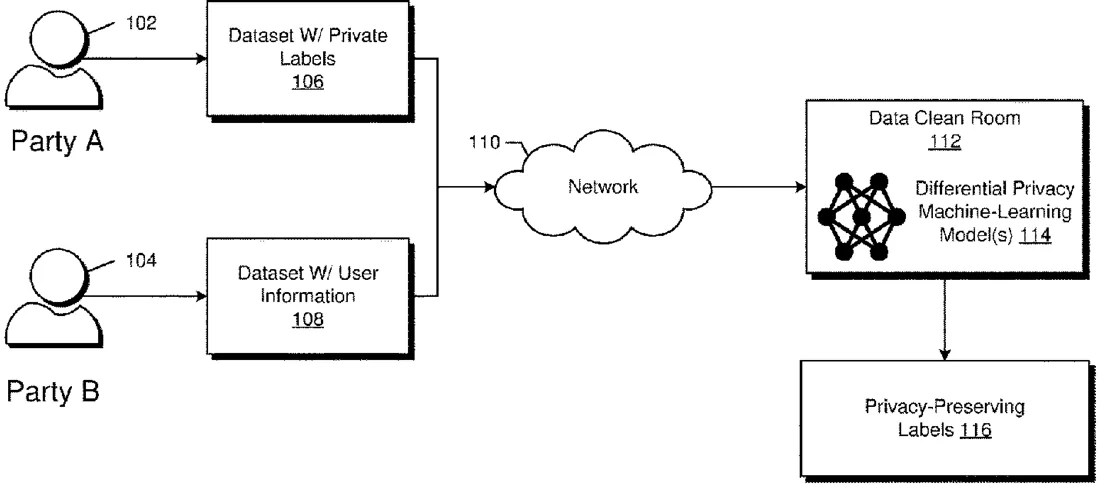
Amazon describes a system where companies share data in a secure environment called a data clean room. It uses a special math technique to create approximate, or noisy, labels for users so that sensitive personal details are never revealed.
In the filing’s own words
Systems, devices, and methods are provided for providing data clean room capabilities that allow for the export of privacy-preserving labels. A data clean room may be provisioned to obtain datasets from various parties. Code executing in the data clean room may select a differential privacy machine-learning model from a plurality of differential privacy machine-learning models train the selected differential privacy machine-learning model to infer noisy labels, determine a set of users of interest for a multi-party collaboration effort, infer, using the differential privacy machine-learning model, a set of noisy labels for the set of users, and determine an exportable dataset that comprises the noisy labels rather than private labels containing sensitive/private information.
What exactly they claim (claim 1)
1. A computer-implemented method, comprising: provisioning, by a computing resource service provider, a data clean room; obtaining, in the data clean room: from a first computing entity: a first dataset, wherein the first dataset comprises first subject identification information corresponding to a first set of subjects associated with the first computing entity; and from a second computing entity: a second dataset from a second computing entity, wherein the second dataset comprises: second subject identification information corresponding to a second set of subjects that are associated with the second computing entity; a set of true labels associated with the second set of subjects; and wherein the set of true labels are unexportable from the data clean room; and one or more privacy parameters; within the data clean room: selecting a differential privacy machine-learning algorithm from one or more differential privacy machine-learning algorithms, based at least in part on the one or more privacy parameters; training, based at least in part on the second dataset, a differential privacy machine-learning model according to the selected differential privacy machine-learning algorithm; determining, based at least in part on the first dataset and the second dataset, a set of subjects; inferring, using the differential privacy machine-learning model, a set of privacy-preserving labels for the set of subjects; determining a training dataset based at least in part on the set of privacy-preserving labels and the set of subjects; and making the training dataset available to the first computing entity.
Facts
- Company
- Amazon (Amazon Technologies, Inc.)
- Official title
- Data clean room with exportable, privacy-preserving labels
- Patent number
- US12762273B1
- Application number
- 18541544
- Filed
- Dec 15, 2023
- Granted
- Oct 13, 2026
- Inventors
- 6
- Claims
- 20
Classified under
G06F 21/6245 Physics & computingG06F 21/604 Physics & computingMore from Amazon in Security & privacy
- Amazon patents camera encryption that cuts cloud access Sep 8, 2026
- Amazon patents voice assistant login using a second device Sep 1, 2026
- Amazon patents system to spot suspicious IP activity in its network Sep 8, 2026
- Amazon patents radar system that triggers cameras only on real motion Sep 15, 2026
- Amazon patents ad system that groups anonymous users without cookies Sep 22, 2026
Summaries are simplified from the filing’s own abstract and first claim. A patent filing is not a product announcement.
Patent data and drawings: U.S. Patent and Trademark Office (USPTO). Nebula is not affiliated with or endorsed by the USPTO.