Google patents method to help AI models find the right tools for tasks
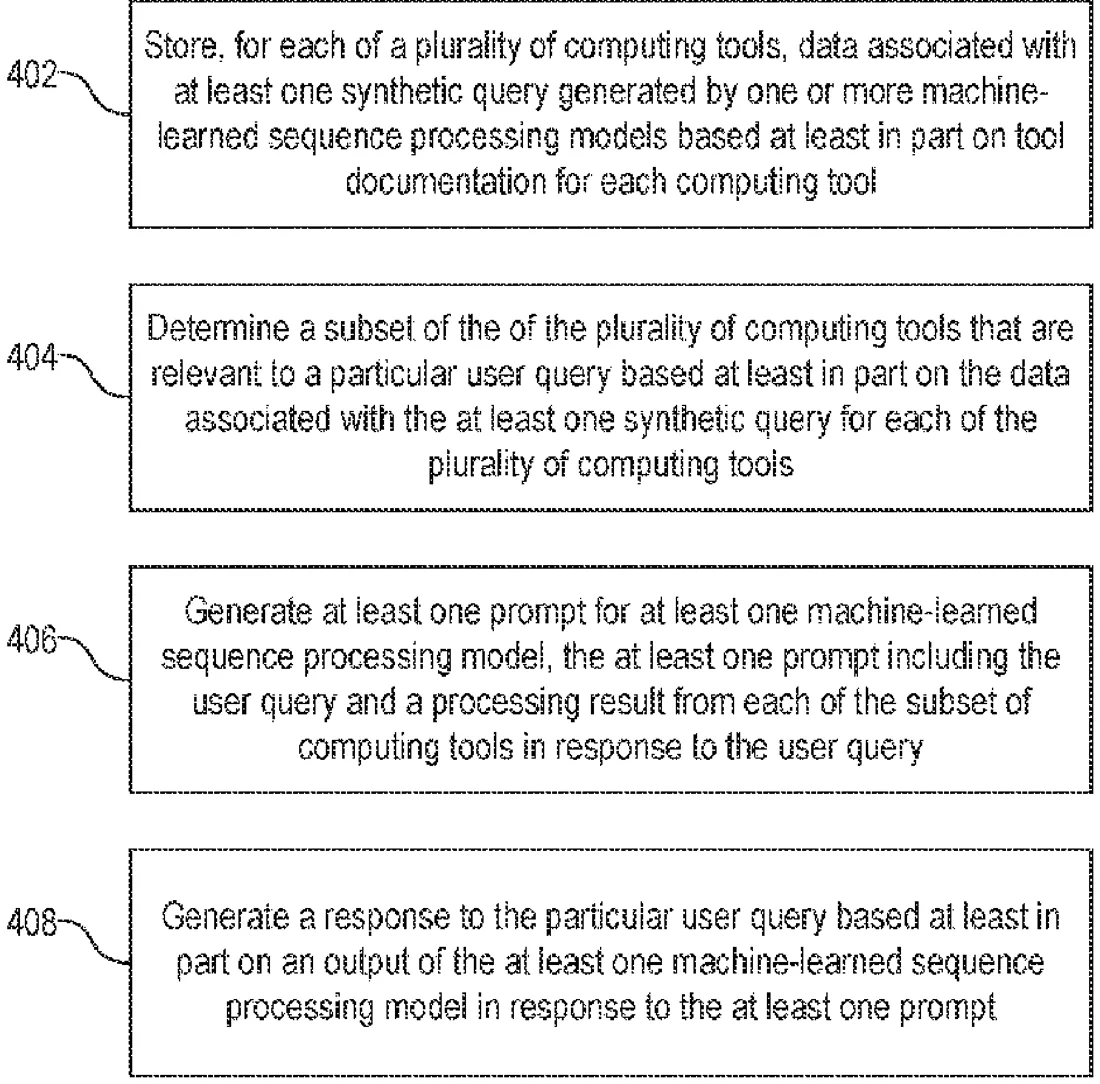
Google has been granted a patent for a system that helps large language models identify which external tools or functions are needed to answer a user's question. The system works by creating synthetic examples of how each tool might be used, storing these as data points, and then matching a user's query to the most relevant tools before generating a final response.
In the filing’s own words
A machine-learning system effectively and efficiently identifies computing tools that are relevant to processing a query for a sequence processing model. A system can stores, for each computing tool, data associated with at least one synthetic query generated by a machine-learned sequence processing model based on tool documentation for the computing tools. The system determines a subset of computing tools relevant to a particular user query based on the synthetic query for each of the plurality of computing tools. The system generates at least one prompt including the user query and a processing result from each of the subset of computing tools in response to the user query. The system generates a response to the particular user query based at least in part on an output of at least one machine-learned sequence processing model in response to the at least one prompt.
What exactly they claim (claim 1)
1. A computer-implemented method for improving efficiency of computing tool retrieval for a sequence processing model, comprising: for each of a plurality of computing tools, creating, by a computing system, an expanded tool documentation data encoding by encoding, via one or more machine-learned sequence processing models, at least one synthetic query into a multidimensional embedding space based on tool documentation for said each computing tool, wherein the at least one synthetic query represents a potential use case for said each computing tool; storing, by the computing system in an embedding database, a plurality of embeddings corresponding to the expanded tool documentation data encodings for the plurality of computing tools; receiving a particular user query; determining, by the computing system, a subset of the plurality of computing tools that are relevant to the particular user query by comparing an embedding of the particular user query to the plurality of stored embeddings, wherein the subset includes less than all of the plurality of computing tools; generating, by the computing system, at least one prompt for at least one machine-learned sequence processing model, the at least one prompt including the particular user query and a processing result from each of the subset of the plurality of computing tools in response to the particular user query; and generating, by the computing system, a response to the particular user query based at least in part on an output of the at least one machine-learned sequence processing model in response to the at least one prompt.
Facts
- Company
- Google (Google LLC)
- Official title
- Computing tool retrieval using sequence processing models
- Patent number
- US12762164B2
- Application number
- 18444094
- Filed
- Feb 16, 2024
- Granted
- Oct 13, 2026
- Inventors
- 7
- Claims
- 19
Classified under
G06F 16/3334 Physics & computingG06F 16/2438 Physics & computingMore from Google in AI & software
- Google patents video search that answers questions using AI descriptions Sep 15, 2026
- Google patents photo tool that removes people and their gear Sep 15, 2026
- Google patents AI that writes live meeting notes and summaries Sep 15, 2026
- Google patents AI tool that turns messy emergency notes into clear messages Sep 3, 2026
- Google patents AI that clicks through apps to finish tasks for you Sep 24, 2026
Summaries are simplified from the filing’s own abstract and first claim. A patent filing is not a product announcement.
Patent data and drawings: U.S. Patent and Trademark Office (USPTO). Nebula is not affiliated with or endorsed by the USPTO.