Microsoft patents AR glasses that slide to fit different eye spacing
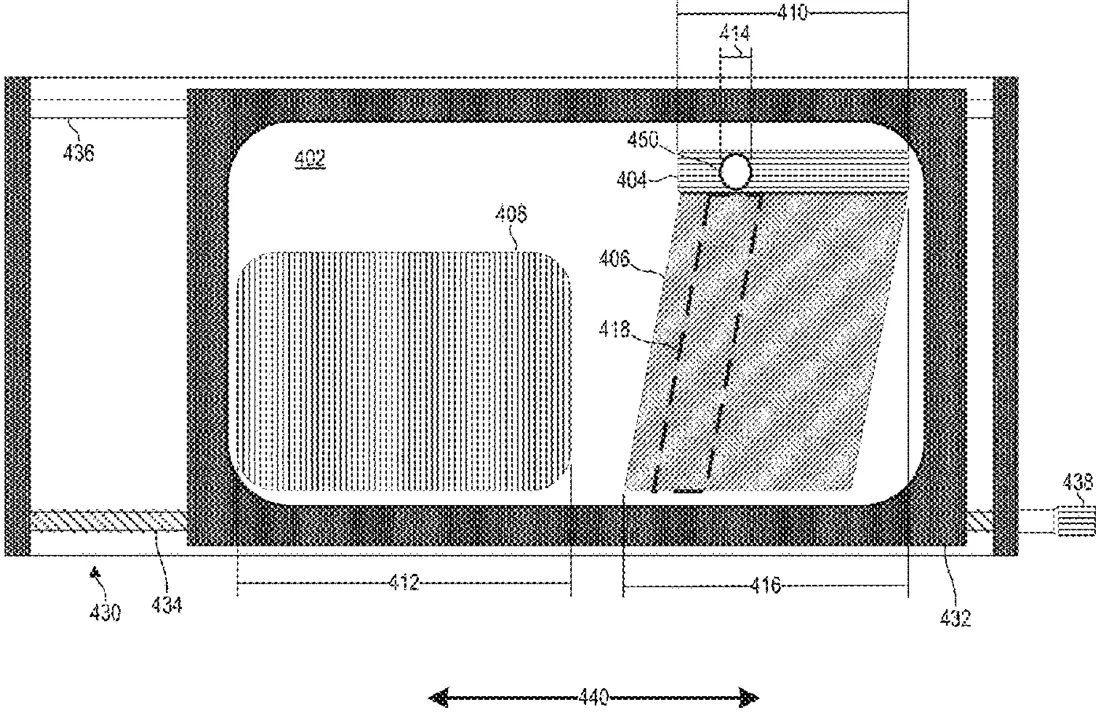
This filing describes a display system for augmented reality glasses that uses a sliding mechanism to adjust the distance between the lenses. By moving the internal waveguide plate relative to the light source, the system can change the interpupillary distance (IPD) to match the user's specific eye spacing.
In the filing’s own words
A display system may include a waveguide plate comprising opposing parallel surfaces, an in-coupling grating, an expansion grating, and an out-coupling grating. The display system may include a projection system configured to direct input light toward the in-coupling grating and a translation assembly configured to translate the waveguide plate relative to the projection system along an axis. The in-coupling grating may be configured to diffract the input light to cause total internal reflection of the input light within the waveguide plate. The expansion grating may be configured to (i) cause replica expansion of the input light and (ii) cause the input light to propagate within the waveguide plate toward the out-coupling grating. The out-coupling grating may be configured to (i) cause replica expansion of the input light replica expanded by the expansion grating and (ii) diffract the input light replica expanded by the expansion grating outward from the waveguide plate.
What exactly they claim (claim 1)
1. A display system for accommodating different interpupillary distances (IPDs), the display system comprising: a waveguide plate comprising opposing parallel surfaces, the waveguide plate further comprising an in-coupling grating, an expansion grating, and an out-coupling grating; a projection system configured to direct input light toward the in-coupling grating; and a translation assembly configured to translate the waveguide plate relative to the projection system along an axis, wherein: the in-coupling grating is configured to diffract the input light to cause total internal reflection of the input light within the waveguide plate via the opposing parallel surfaces of the waveguide plate, the expansion grating is configured to (i) cause replica expansion of the input light and (ii) cause the input light to propagate within the waveguide plate toward the out-coupling grating, and the out-coupling grating is configured to (i) cause replica expansion of the input light replica expanded by the expansion grating and (ii) diffract the input light replica expanded by the expansion grating outward from the waveguide plate.
Facts
- Company
- Microsoft (Microsoft Technology Licensing, LLC)
- Official title
- Diffractive display system with adjustable IPD
- Patent number
- US12761492B2
- Application number
- 18674336
- Filed
- May 24, 2024
- Granted
- Oct 13, 2026
- Inventors
- 1
- Claims
- 20
Classified under
G02B 27/0944 Physics & computingG02B 6/29304 Physics & computingG02B 27/0172 Physics & computingMore from Microsoft in AR, VR & displays
- Microsoft patents 3D video calls that highlight body parts doctors mention Oct 1, 2026
- Microsoft patents AR glasses that hide your eyes from others Sep 3, 2026
- Microsoft patents thinner lens coating for mixed reality glasses Sep 1, 2026
- Microsoft patents matching 3D spaces to share holograms between remote users Sep 1, 2026
- Microsoft patents AR display that adjusts laser brightness to stay consistent Sep 8, 2026
Summaries are simplified from the filing’s own abstract and first claim. A patent filing is not a product announcement.
Patent data and drawings: U.S. Patent and Trademark Office (USPTO). Nebula is not affiliated with or endorsed by the USPTO.