Google patents method to find oddities in complex data streams
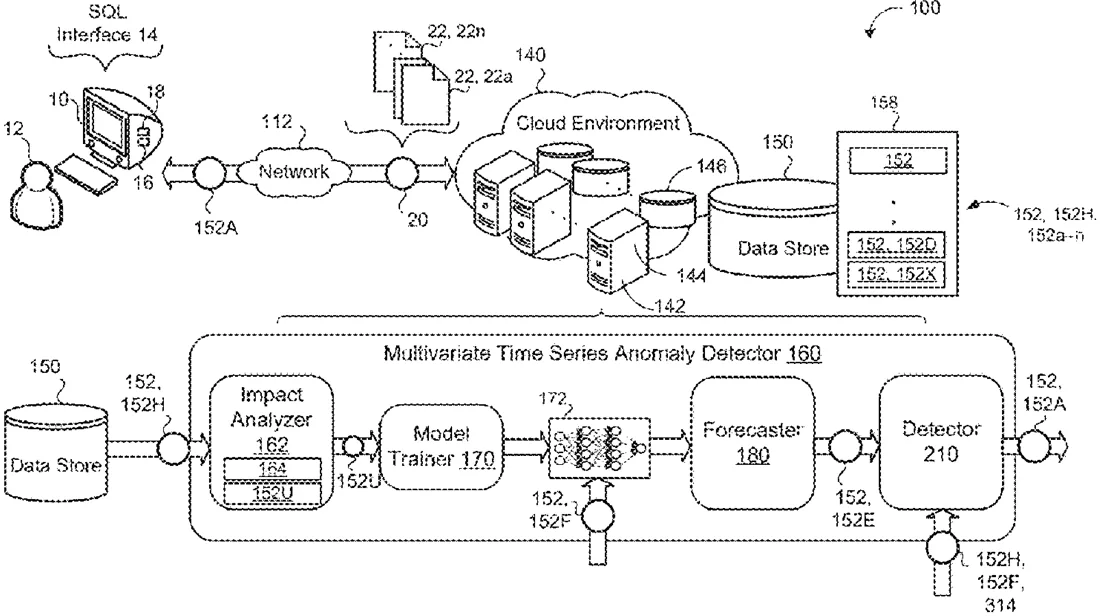
This patent describes a computer method for detecting unusual patterns in data that changes over time. It works by separating different factors influencing the data, training models on simplified versions, and flagging values that differ significantly from what the model predicts.
In the filing’s own words
A method includes receiving a query to determine anomalies in a set of multivariate time series data values including an endogenous variable and an exogenous variable. The method includes determining an impact of the exogenous variable on the endogenous variable. The method includes determining a set of univariate time series data values and training one or more models using the univariate time series data values. The method includes determining an expected data value for a respective time series data value and determining a difference between the expected data value and the respective time series data value. The method includes determining that the difference between the expected data value for a particular time series data value and the particular time series data value satisfies a threshold. In response, the method includes determining that the particular time series data value is anomalous and reporting the anomalous value to a user.
What exactly they claim (claim 1)
1. A computer-implemented method executed by data processing hardware that causes the data processing hardware to perform operations comprising: receiving a time series anomaly detection query from a user, the time series anomaly detection query requesting the data processing hardware to determine one or more anomalies in a set of multivariate time series data values, the set of multivariate time series data values comprising an endogenous variable and at least one exogenous variable; determining an impact of the at least one exogenous variable on the endogenous variable; determining, using the impact of the at least one exogenous variable on the endogenous variable, a set of univariate time series data values; training one or more models using each time series data value in the set of univariate time series data values; for each respective time series data value in the set of univariate time series data values: determining, using the trained one or more models and the impact of the at least one exogenous variable on the endogenous variable, an expected data value for the respective time series data value; and determining a difference between the expected data value for the respective time series data value and the respective time series data value; and for a particular time series data value in the set of univariate time series data values: determining that the difference between the expected data value for the particular time series data value and the particular time series data value satisfies a threshold; in response to determining that the difference between the expected data value for the particular time series data value and the particular time series data value satisfies the threshold, determining that the particular time series data value is anomalous; and reporting the anomalous particular time series data value to the user.
Facts
- Company
- Google (Google LLC)
- Official title
- Multivariate time series anomaly detection
- Patent number
- US12756732B2
- Application number
- 18973018
- Filed
- Dec 8, 2024
- Granted
- Oct 6, 2026
- Inventors
- 4
- Claims
- 20
Classified under
H04L 63/1425 Electricity & electronicsG06F 11/0751 Physics & computingG06F 11/0766 Physics & computingG06F 16/2477 Physics & computingG06F 21/552 Physics & computingMore from Google in AI & software
- Google patents video search that answers questions using AI descriptions Sep 15, 2026
- Google patents photo tool that removes people and their gear Sep 15, 2026
- Google patents AI that writes live meeting notes and summaries Sep 15, 2026
- Google patents AI tool that turns messy emergency notes into clear messages Sep 3, 2026
- Google patents AI that clicks through apps to finish tasks for you Sep 24, 2026
Summaries are simplified from the filing’s own abstract and first claim. A patent filing is not a product announcement.
Patent data and drawings: U.S. Patent and Trademark Office (USPTO). Nebula is not affiliated with or endorsed by the USPTO.