Google patents speech model that cuts down on extra calculations
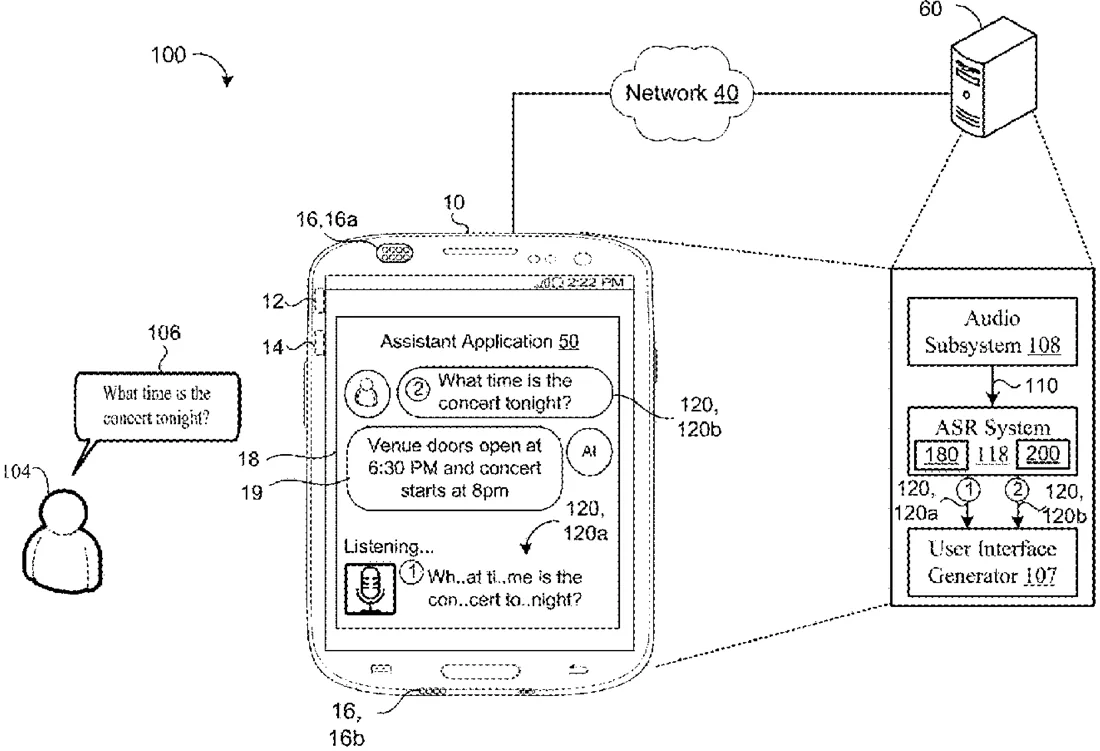
This patent describes a way to make speech recognition software run more efficiently by simplifying how it processes sounds. Instead of creating a separate data point for every single sound, the system combines them into one summary vector at each step. This helps the computer guess what you are saying without doing as much heavy lifting.
In the filing’s own words
A RNN-T model includes a prediction network configured to, at each of a plurality of times steps subsequent to an initial time step, receive a sequence of non-blank symbols. For each non-blank symbol the prediction network is also configured to generate, using a shared embedding matrix, an embedding of the corresponding non-blank symbol, assign a respective position vector to the corresponding non-blank symbol, and weight the embedding proportional to a similarity between the embedding and the respective position vector. The prediction network is also configured to generate a single embedding vector at the corresponding time step. The RNN-T model also includes a joint network configured to, at each of the plurality of time steps subsequent to the initial time step, receive the single embedding vector generated as output from the prediction network at the corresponding time step and generate a probability distribution over possible speech recognition hypotheses.
What exactly they claim (claim 1)
1. A computer-implemented method executed on data processing hardware that causes the data processing hardware to perform operations comprising: receiving a sequence of acoustic frames characterizing an utterance; at each of a plurality of time steps subsequent to an initial time step: receiving, as input to a prediction network of a recurrent neural network-transducer (RNN-T) model, a sequence of non-blank symbols output by a final Softmax layer; generating, by a single head of the prediction network, a sequence of embeddings for the sequence of non-blank symbols received as input at the corresponding time step, each corresponding embedding in the sequence of embeddings corresponds to a respective non-blank symbol in the sequence of non-blank symbols; weighting, by the single head of the prediction network, each corresponding embedding in the sequence of embeddings based on a respective position embedding assigned to the respective non-blank symbol that corresponds to the corresponding embedding; generating, as output from the single head of the prediction network, a weighted average of the sequence of weighted embeddings; generating, by a projection layer of the prediction network, a projection output for the weighted average of the sequence of weighted embeddings output from the single head of the prediction network; and normalizing the projection output for the weighted average of the sequence of weighted embeddings to provide, as output from the prediction network, a single embedding vector at the corresponding time step; and generating, by the final Softmax layer, as output, a speech recognition result for the sequence of acoustic frames based the single embedding vectors output from the prediction network at each of the plurality of time steps.
Facts
- Company
- Google (Google LLC)
- Official title
- Tied and reduced RNN-T
- Patent number
- US12755733B2
- Application number
- 18779894
- Filed
- Jul 22, 2024
- Granted
- Oct 6, 2026
- Inventors
- 2
- Claims
- 20
Classified under
G10L 15/16 Physics & computingG10L 15/083 Physics & computingMore from Google in AI & software
- Google patents video search that answers questions using AI descriptions Sep 15, 2026
- Google patents photo tool that removes people and their gear Sep 15, 2026
- Google patents AI that writes live meeting notes and summaries Sep 15, 2026
- Google patents AI tool that turns messy emergency notes into clear messages Sep 3, 2026
- Google patents AI that clicks through apps to finish tasks for you Sep 24, 2026
Summaries are simplified from the filing’s own abstract and first claim. A patent filing is not a product announcement.
Patent data and drawings: U.S. Patent and Trademark Office (USPTO). Nebula is not affiliated with or endorsed by the USPTO.