Samsung patents video tracking that cuts down on repeated object checks
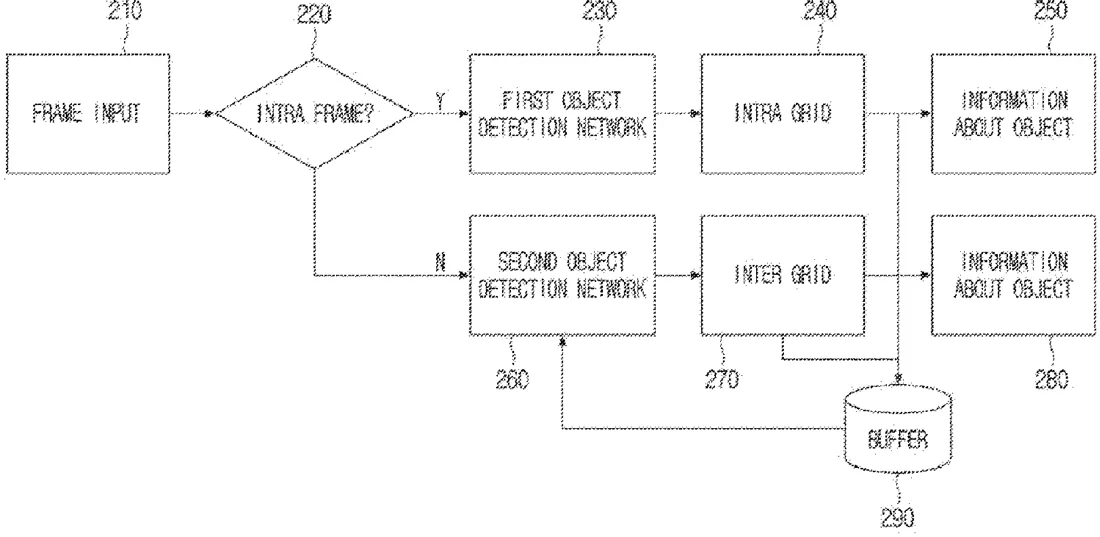
Samsung describes a method for electronic devices to track objects in video by using two separate detection systems. The first system identifies an object in a video frame, and the second system uses that previous result to help find the object in the next frame. This approach allows the device to focus its search on specific areas where the object is likely to move, rather than scanning the entire image again.
In the filing’s own words
Provided are an electronic device and a control method thereof. The electronic device includes at least one memory storing at least one instruction; and at least one processor connected to the at least one memory and configured to execute the at least one instruction to: input information about a first frame among a plurality of frames to a first object detection network and obtain first information about an object included in the first frame, store the first information in the at least one memory, and input the first information and information about a second frame among the plurality of frames to a second object detection network and obtain second information about an object included in the second frame, wherein the second frame is a next frame following the first frame.
What exactly they claim (claim 1)
1. An electronic device comprising: at least one memory storing at least one instruction; and at least one processor connected to the at least one memory and configured to execute the at least one instruction to: input information about a first frame among a plurality of frames to a first object detection network and obtain first information about an object included in the first frame, store the first information in the at least one memory, and input the first information and information about a second frame among the plurality of frames to a second object detection network and obtain second information about an object included in the second frame, wherein the second frame is a next frame following the first frame, wherein the first object detection network and the second object detection network are separate object detection networks, wherein the first object detection network is trained to obtain information about an object by using a plurality of anchor boxes, and wherein the at least one processor is further configured to execute the at least one instruction to: obtain the first information using an anchor box located in a first grid among a plurality of grids, and obtain the second information by: using a bounding box, as an anchor box, of the object included in the first frame located in the first grid, using a bounding box, as an anchor box, located in a second grid among the plurality of grids around the first grid based on information about a motion of the object included in the second frame, or using a bounding box, as an anchor box, located in the first grid and a plurality of third grids from among the plurality of grids located at an upper, lower, left, or right portions of the first grid.
Facts
- Company
- Samsung (SAMSUNG ELECTRONICS CO., LTD.)
- Official title
- Electronic device and method for controlling the electronic device thereof
- Patent number
- US12755531B2
- Application number
- 18379969
- Filed
- Oct 13, 2023
- Granted
- Oct 6, 2026
- Inventors
- 5
- Claims
- 9
Classified under
G06V 20/41 Physics & computingG06V 10/225 Physics & computingG06V 10/82 Physics & computingG06V 20/46 Physics & computingMore from Samsung in AI & software
- Samsung patents tool to erase objects from photos using AI Sep 24, 2026
- Samsung patents drawing objects into photos with AI Oct 15, 2026
- Samsung patents AI that creates personalized exercise videos Sep 10, 2026
- Samsung patents AI summaries for paused TV shows based on your viewing habits Sep 24, 2026
- Samsung patents turning chat conversations into image prompts Oct 1, 2026
Summaries are simplified from the filing’s own abstract and first claim. A patent filing is not a product announcement.
Patent data and drawings: U.S. Patent and Trademark Office (USPTO). Nebula is not affiliated with or endorsed by the USPTO.