Google patents image processing method using local attention blocks
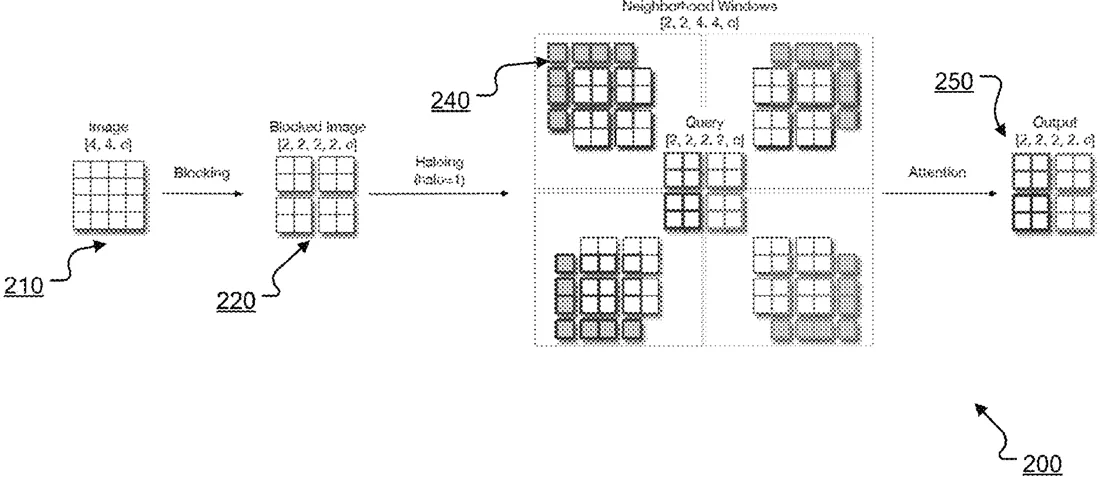
This patent describes a computer vision system that processes images by dividing them into non-overlapping blocks. Each block looks at its own pixels and a surrounding area to understand local details before combining the results into a full image representation.
In the filing’s own words
Methods, systems, and apparatus, including computer programs encoded on computer storage media, for processing images using a computer vision neural network that has one or more local self-attention layers. Each local self-attention layer is configured to apply or more local self-attention mechanisms to the layer input to the local self-attention layer.
What exactly they claim (claim 1)
1. A system for processing an image with parallel processing, comprising: one or more computers; and one or more storage devices storing instructions that when executed by the one or more computers cause the one or more computers to implement a computer vision neural network comprising a backbone neural network having one or more local self-attention layers and configured to process the image to generate a feature representation of the image and an output neural network configured to process the image to generate an output for a computer vision task from the feature representation of the image, wherein each local self-attention layer is configured to apply a local self-attention mechanism to a layer input representing the image and to generate a self-attention layer output, wherein applying the local self-attention mechanism to generate the self-attention layer output comprises: determining, by the local self-attention layer, a plurality of query blocks, wherein each query block is a respective non-overlapping subset of elements of the layer input that represents the image and comprises a respective plurality of neighboring elements of the layer input; determining, by the local self-attention layer, a plurality of context blocks, each context block corresponding to a respective query block, wherein each context block comprises elements in a corresponding query block and a plurality of elements of the layer input in a local window surrounding the corresponding query block within the layer input that represents the image, and wherein the local self-attention layer pads boundaries of the layer input such that the plurality of context blocks are of a same size, the size of each of the plurality of context blocks being determined by a halo value of the local self-attention layer; and generating, by the local self-attention layer, in parallel across the plurality of query blocks that are each a respective non-overlapping subset of the elements of the layer input, a respective block attention output for each query block, comprising: determining a respective query for each element in the query block based on applying a first learned linear transformation to the element, determining a respective key for each element of the corresponding context block based on applying a second learned linear transformation to each element of the corresponding context block, determining a respective value for each element of the corresponding context block based on applying a third learned linear transformation to each element of the corresponding context block, and using the determined query, keys, and values to generate a respective attention output for each element of the query block.
Facts
- Company
- Google (Google LLC)
- Official title
- Local self-attention computer vision neural networks
- Patent number
- US12755520B2
- Application number
- 17347416
- Filed
- Jun 14, 2021
- Granted
- Oct 6, 2026
- Inventors
- 5
- Claims
- 20
Classified under
G06V 10/82 Physics & computingG06F 18/2163 Physics & computingG06N 3/08 Physics & computingG06V 10/454 Physics & computingMore from Google in AI & software
- Google patents video search that answers questions using AI descriptions Sep 15, 2026
- Google patents photo tool that removes people and their gear Sep 15, 2026
- Google patents AI that writes live meeting notes and summaries Sep 15, 2026
- Google patents AI tool that turns messy emergency notes into clear messages Sep 3, 2026
- Google patents AI that clicks through apps to finish tasks for you Sep 24, 2026
Summaries are simplified from the filing’s own abstract and first claim. A patent filing is not a product announcement.
Patent data and drawings: U.S. Patent and Trademark Office (USPTO). Nebula is not affiliated with or endorsed by the USPTO.